
Introduction
You made it! Welcome to the beginning of differentiation and derivatives! In our last unit, we talked about limits and the many different ways to evaluate them. Now as teased in our first lesson, Unit 1.1, we will apply the concept of limits to rate of change and continue our pursuit of calculus in this new unit.
To start off, let’s review what rate of change is. The rate of change can be described as rise over run, or simply slope. You may be familiar with , and used it for linear functions. The derivative is a very similar concept to slope except it allows us to find the instantaneous rate of change at a specific point of any function.
Why Learn About Derivatives?
Again, the derivative is very similar to slope. However, there is a difference between what you’ve learned so far and what the derivative is. You’ve learnt how to find the slope of a linear function, but the derivative allows you to find the slope of any function at any point. We can use difference quotients to learn about derivatives.
Difference Quotients
A difference quotient expresses the average rate of change of a function over an interval. There are two different quotients we use in this class to express the average rate of change. Notice the similarities between both formulae and the change in slope.
Form 1
This is the average rate of change on the interval []
Form 2
This is the average rate of change on the interval []
Change in Slope
This is the formula for slope when you have two coordinates provided.
Intuition
If provided two points of a function that isn’t linear, you may get different results if you plug in different numbers. For example, if we have the function and want to find the slope at , how would we do it? Would we trace a line which intersects the graph at , or would we include and its -coordinate into the two coordinates we use to evaluate the slope?
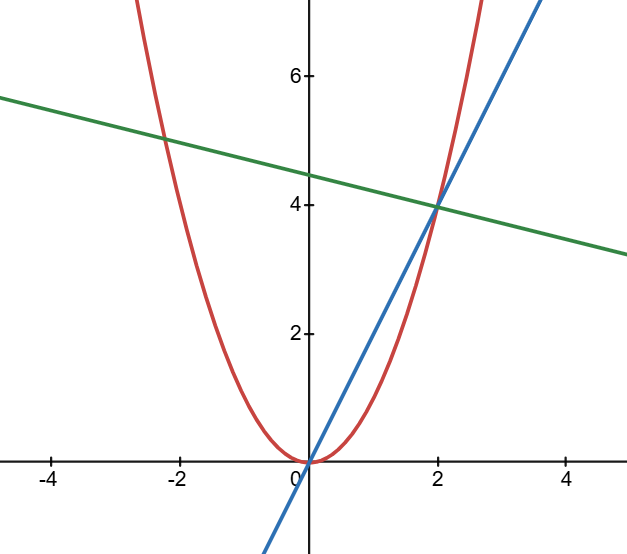
When a line touches two points of a function, it is called a secant line. However, this is not what we are looking for to find the slope of a function at one point.
The magic of the derivative is that you find the slope with the function and just one point without the need to plug in two coordinates. One way is to go back to the two coordinate method but instead, choose two points which are incredibly close to each other, a difference or a difference. As the difference becomes smaller, the two points we choose become closer and closer until they are nearly at the exact same spot.
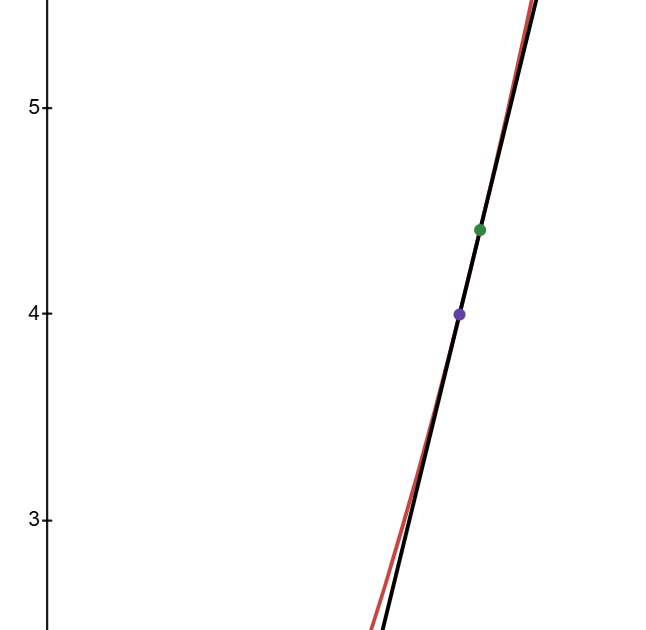
Notice that the difference between the two points () can be represented with . As gets smaller, the slope at the point gets more accurate. All we have to do now is reduce the denominator to nearly using limits.
This gives us a tangent line which will only touch the function at one point. The slope of the tangent line is the slope of the function at that singular point. This is the derivative of a function at a point
Definition of the Derivative at a Point
For Form 1, the derivative of function at point can be found by taking the limit as goes to 0 which reduces to nearly . For Form 2, it is found by taking the limit as goes to which also reduces to nearly . After applying the changes, we get two definitions for the derivative.
Form 1:
Form 2:
To denote the instantaneous rate of change, or derivative, of a function at we use , read " prime of ".
Notice that the expression itself has not been altered, and that a limit was added to reduce so that the slope would be 100% accurate when evaluating.
Let’s do an example using the derivative formulae.
Examples
Example 1:
If , calculate .
Both forms mean the same thing so you only have to use one of them. Since this is the first time solving the derivative from definition I will show both forms.
Form 1:
Form 2:
As you can see no matter which way you solve it, .
Practice
Now that we have gone over an example of doing a derivative it's time for some independent practice on finding some instantaneous rates of change at a point.