
Introduction
Now that we have learned how to find the derivative of a function at a point, we can generalize this to finding the derivatives of functions. I think College Board lays it out really well in their enduring understanding CHA-2 “Derivatives allow us to determine rates of change at an instant by applying limits to knowledge about rates of change over intervals.”
Finding derivatives of functions
The derivative of a function will have the value at the chosen -value if that limit exists. Notice how it looks very similar to one of the definitions of the derivative we introduced in the last article, the key difference being that is replaced with the variable . This difference in the formula allows us to find a function that represents the slope of the function rather than the slope of a function at just one point.
Derivatives have many notations popularized by many great mathematicians. The ones that we will focus on are these: If the derivative of the function with respect to can be written as , , or .
Derivative of a Linear Function
Find the derivative with respect to of .
Using the definition:
Notice that the slope of the line is , just like its derivative. That is because the derivative of a function at a point is the slope of the tangent line to the function at that point as mentioned in the previous article. However, the function is linear so we just have to find the slope of that line.
Now, what happens if we take the derivative of a function that isn’t linear? Well, we will get another function that will tell us the slope of the tangent line or the instantaneous rate of change at any point on the function.
Derivative of a Nonlinear Function
Find the derivative with respect to of .
So when the slope of the tangent line would also be , but when the slope of the tangent line would be , and the steepness of this line grows quadratically according to the function that is the derivative of .
Finding the Tangent Line
Now recall from your Algebra classes the point-slope form of a line:
where is the slope, and is any point on the line.
We can now calculate the slope by finding the derivative at a point. We can change the formula up a little bit using function and derivative notation:
represents the slope, and is the point on the line.
Tangent Line Example
Find the line tangent to the function at the point .
From Example 2, we already know that the derivative of with respect to is 3x^2.
In math notation: .
Now we just have to plug our numbers into the formula.
We will leave as is, because is the equation of the tangent line. Similarly, will remain unchanged. We are given and that . So we just have to find .
, so .
So the tangent line is: and with some simplification, .
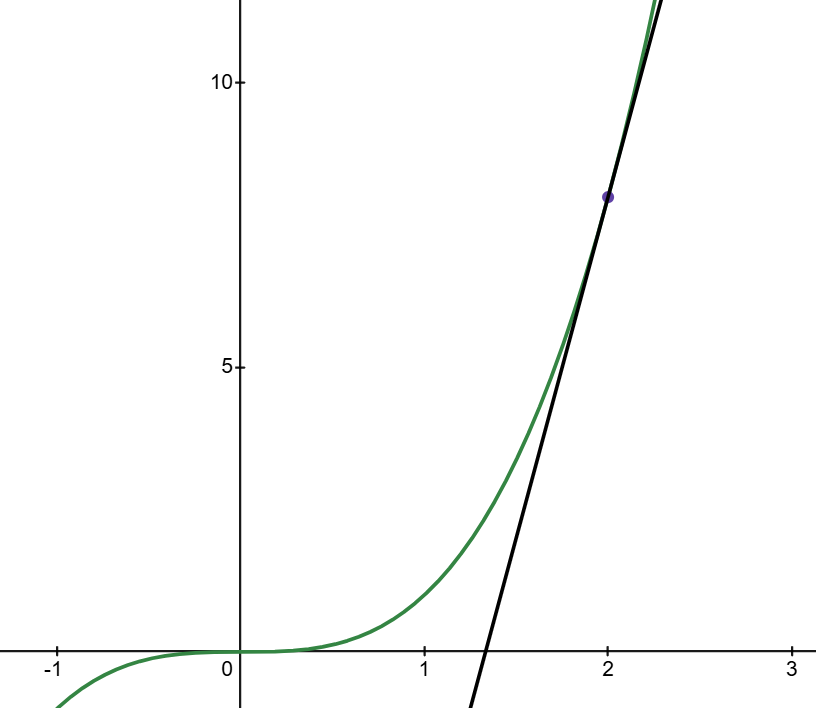
Note that the -axis and -axis do not follow the same increments in this picture.
Practice
Now, it is time for you to practice what you’ve learnt.