
Introduction
Welcome to another exciting calculus adventure! We have learnt about the definition of the derivative, and so now we will learn about how to estimate that limit. We will use both numerical and graphical methods to estimate the derivatives.
In the previous article, we described derivatives as the slope of a tangent line. Using this fact, we can start estimating derivatives using different methods and gain a conceptual understanding of what the derivative really is.
Estimating the Derivative using a Graph
Question: Estimate .
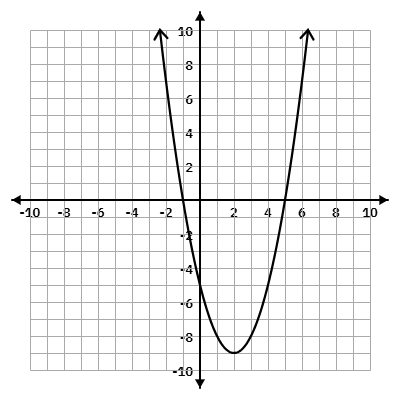
If we draw a tangent line we should get some value around .
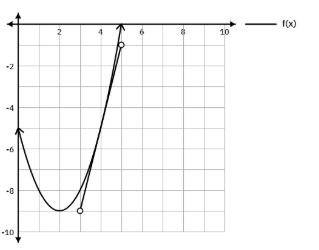
Here is a more zoomed in version of the graph with the tangent line. Both graphs were made with graphfree.com.
As you can see visually, the slope of the tangent line here is . We won’t always have access to the exact tangent line or the function, so estimating with only a graph provided will be useful.
Imagining a tangent line which touches only one point of the function can be very beneficial, or seeing how fast the function generally goes. You do not need to have exact estimations, as having a reasonable idea of the slope would be enough to solve this type of question.
The only times you would have to be certain is if the derivative at the point was (horizontal tangent), or if the derivative is undefined. We will learn about undefined derivatives in the next article.
Another way to estimate derivatives is by using numerical methods with tables. We will use the average rate of change to estimate the instantaneous rate of change, the derivative.
Estimating a Derivative using a Table
Question: Estimate using the table below:
A sensible way to find the derivative is to go back to the two coordinate idea by choosing two points and finding the slope from there. The most sensible coordinates to choose are the ones right next to the point of interest to find the derivative. Near , we have two coordinate points adjacent to it being and .
Using the slope formula, we get . Know that could be or for all we know. We are simply finding a sensible numerical estimation based on what we know.
Do make sure to keep this question in mind, as this is a common FRQ that shows up in the AP Calculus AB/BC
We can also use technology to tell us the derivative of complicated functions. On the AP Calculus AB/BC exam, you will be allowed to use Desmos which can assist in finding derivatives and other information. https://www.desmos.com/testing/cb-sat-ap/graphing
Note that you are given a different version of Desmos on the AP exam, and for other College Board exams. However, they function nearly the same.
Solving for the Derivative using a Graphing Calculator
Question: Use the desmos calculator to calculate the derivative of with respect to at .
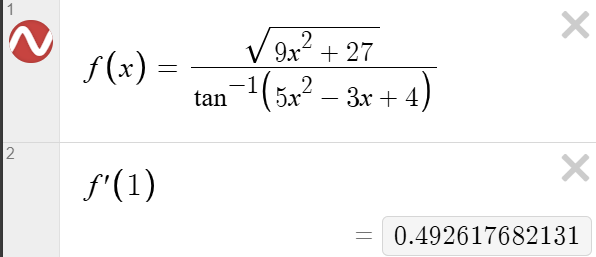
To make sure you do not make a mistake, always equate the function with . Then, you can type to solve the problem. Do not make the mistake of typing . One more thing worth pointing out is to be in radian mode for trigonometric functions, which is luckily the default on Desmos.
Also, make sure you round to three digits whenever you have decimals!
Practice
Now it is time for you to use your skills and go play!