
Introduction
In this article, we will be exploring a concept we have already been familiar with, and it is the notion that something does not exist. Just like limits, derivatives can also not exist. We will be exploring all about it here.
There are a few ways a derivative will not exist. We will discuss four ways that such a situation can occur. Please note that in all of these examples, calculating the derivative using its definition causes the limit to not exist (DNE).
Remember back in Topic 2.2 we introduced the definitions of the derivative, and that they were all limits. These limits can be nonexistent if the derivative there also does not exist.
Differentiating at a Discontinuity
If , show that DNE.
One way that a function doesn’t have a derivative if it is not continuous. Remember that the derivative is a function the same way is, so it can have points of discontinuity too.
If is not continuous at a point, then there is no value to plug in into our limit definition.
Notice that is undefined, and so a limit cannot be evaluated at this point. Please do not confuse this and think that the derivative does not exist as a whole. It simply means that at this exact point , there is no derivative.
Something you should note is that in general, if a function is not continuous at a point, it is automatically not differentiable at that point. Also, differentiating at -values that are outside of the domain of the function won’t work, as it simply does not exist (DNE). Therefore, it will not exist on the function's derivative either.
The next two examples will show that even continuous functions can be non-differentiable at a point in their domain.
Differentiating at a Corner
If show that DNE.
In this example, the function is continuous everywhere, so there must be another factor that causes the derivative to be undefined. We have to look at the derivative at this point and figure out if it is continuous at . We can also use the limit definition of the derivative again, this time using the other definition.
We need to calculate , which is just . However, notice that plugging in numbers to the left and right side of the limit reveals the problem. The left side limit equals , while the right side limit equals , so the derivative at that -value DNE.
Again, this only causes the derivative to be undefined at and at other points where there can be discontinuity. Notice that if we graph , there is a clear gap at . The red line is and the blue line is .
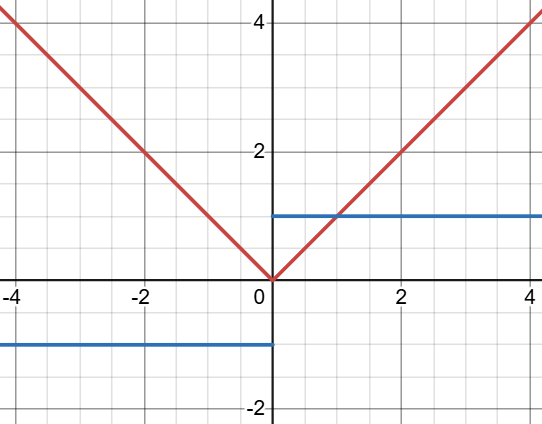
When the function is continuous, not differentiable, and the limit of the difference quotient is approaching two different numbers, then this is called a corner. Many continuous piecewise functions may have corners.
Differentiating at a Cusp
If , show that DNE.
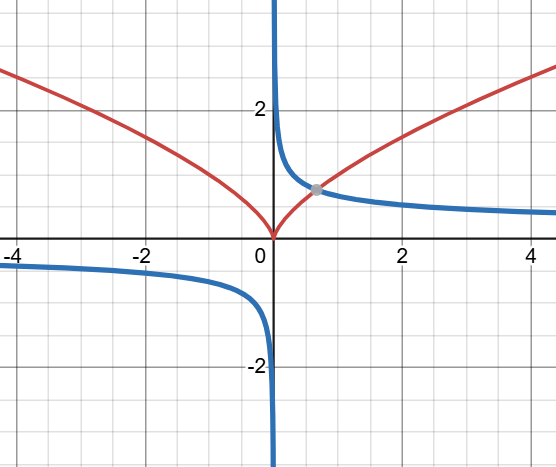
Doing the same thing we did last example, we will use the definition of the derivative. which again is a nonexistent limit. The left side limit approaches , while the right side limit approaches . Once again, the derivative at that -value DNE. When the function is continuous, not differentiable, and the limit approaches two different infinities, then this is called a cusp. Notice the shape of the red graph, , and how the blue line has an asymptote at .
Differentiating at a Vertical Tangent
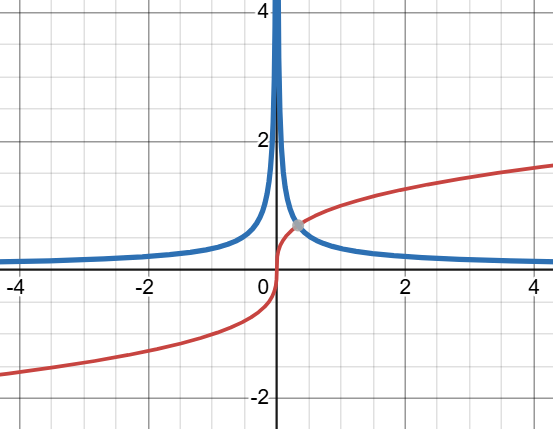
It can be shown through similar works that if then is also nonexistent, and this type of non-differentiability is called a vertical tangent. This is when the limit of the difference quotient approaches the same infinity. The red graph is and the blue graph is .
The Weierstrass Function
We have now learnt that a function that has a discontinuity at that point is not differentiable at that point. Also, a function being continuous does not mean that the function is differentiable at every point. A unique function that is continuous but differentiable nowhere is the Weierstrass function. The math behind it is beyond this class, but here is one approximate graph from it from Desmos.
https://www.desmos.com/calculator/fco232p5mj
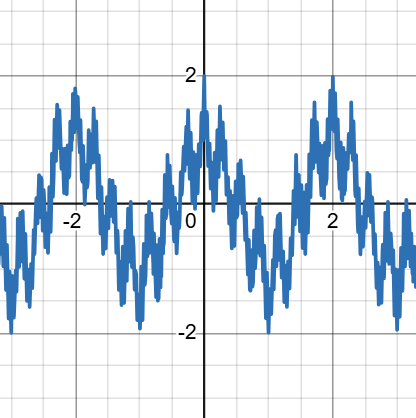
One thing to note is that a function that is differentiable is always continuous. Do not think this works the other way around, as we have seen points that are not differentiable, but the function is still continuous.