
Introduction
In a chemistry lab, it's not feasible to count every single particle in a sample and watch every single one react. Therefore, there must be another way to count the number of particles we have on a larger scale, and a way to convert between the number of particles and mass. This topic covers the mole and shows how it helps relate the number of particles to measurable quantities
The Mole and Avogrado's Number
Instead of individual particles, substances are counted using a measurement called the mole. One mole is equal to particles. This number is called Avogadro’s number, and is significant in the way it correlates atomic mass units (amu) to grams, as (or one mole) amu is equal to one gram. It’s important to understand that a mole is not measuring volume or mass, but simply measuring the amount of something there is. Similarly to how a dozen eggs is 12 eggs, a mole of atoms is atoms.
Molar Mass
The molar mass of a particle shows the mass of one mole of it. This allows you to understand the relationship between the number of particles and their mass, along with performing calculations between mass and moles. To use the example of a dozen, if you had a dozen eggs, it would have a smaller mass than a dozen cars, as you have equal amounts of each, but each individual car has a larger mass than an individual egg. Similarly, one mole of a small molecule like has a smaller mass than one mole of a larger molecule like .
The formula for molar mass is , where is the mass in grams and is the number of moles. This formula is most often seen, however, in the form , where is the molar mass. This is a lot more convenient for calculations between the mass and moles of a substance, and can be found on the AP Chemistry formula sheet.
Finding Molar Mass
Being able to find the molar mass of elements and calculate the molar mass of molecules is an extremely important skill in chemistry. The molar mass of an element can be found below its chemical symbol in the periodic table.
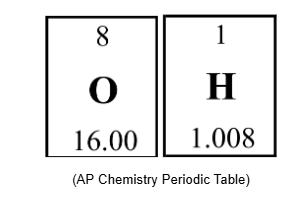
For example, oxygen has a molar mass of and hydrogen has a molar mass of . Let’s say we want to find the molar mass of a molecule like . We can add up the molar masses of each of the elements, making sure to count each occurrence of the atom in the molecule. For , this would look like .
Dimensional Analysis
The practice that ties all of this together is dimensional analysis. Simply put, it is converting between different units and checking your equations using units. Let’s say you have of a substance and you want to see how many liters you have. You can set up a conversion chart, multiplying the starting value in mL by the conversion factor from to , which is . In a practice, that would look like this
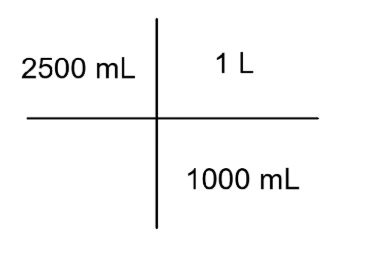
Now you can simplify by dividing the top by the bottom and crossing out any units that are on both sides.
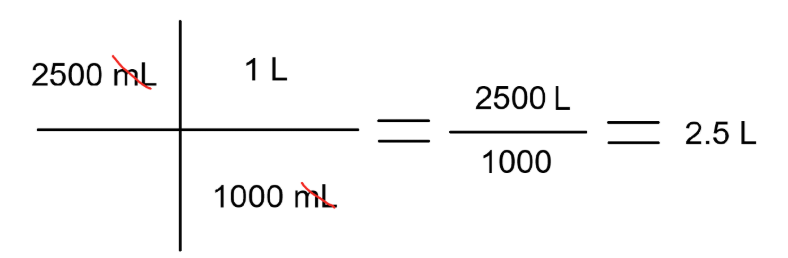
In the end, we got . This is a simple example, but it is very important to understand how to convert between units, making sure you're crossing out units correctly.
Dimensional Analysis in Chemistry
Let’s try another example with chemistry, using the ideas of the mole we learned earlier. If we have particles of potassium chloride (), how many grams do we have?
First, we add our original value to a conversion chart:
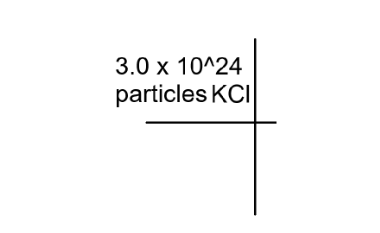
We can’t go straight from particles to grams, so first we need to convert the particles to moles using Avogadro’s number.
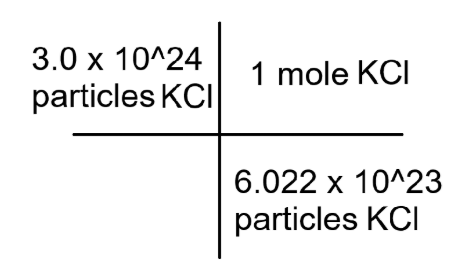
Now that we have moles, we can use the molar mass to find the grams. The molar mass of is and the molar mass of is , so we can perform the calculation to get the molar mass, then put that into our conversion chart.
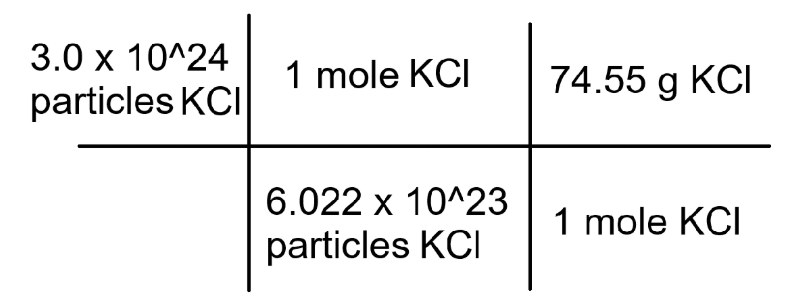
Finally, we can simplify.
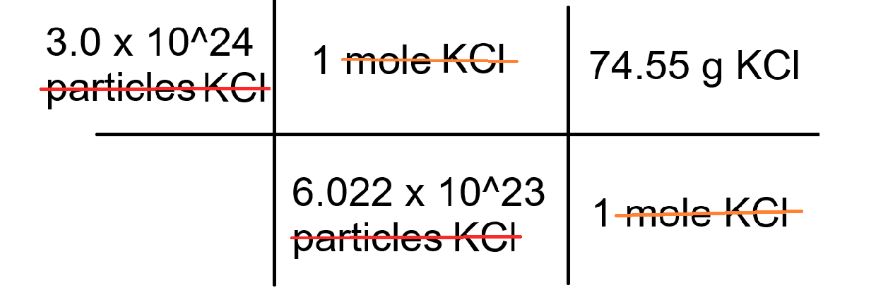
After checking the units, we perform the calculation
,
and get the end result of , and with sig figs that simplifies our final answer to .
Practice
Understanding the mole is a very important concept in understanding all of chemistry. To practice, answer the following questions.
- Think about the difference between one mole of a substance with high molar mass and one mole of a substance with a low molar mass. Which would have a greater mass? Explain how this scenario is similar to having a dozen chicken eggs compared to a dozen ostrich eggs.
- Imagine two substances, one with a high molar mass and one with a low molar mass. If you have the same mass of each of them, which do you have more moles of? Which do you have more particles of?
- Finally, some practice with dimensional analysis and conversion charts. Find the molar mass of methane () and calculate how many moles of methane are in a 5.0-gram sample.
Answers
- One mole of the substance with the higher molar mass would have a greater mass than one mole of the substance with the lower molar mass. Similarly to the example of a dozen eggs, one mole is just the number of objects you have, and having a higher mass per object makes the total mass higher.
- The substance with the lower molar mass would have more moles than the same mass of the substance with a higher molar mass. This is true with particles, as they are also just a way of counting the amount of something, and you need more of the smaller particles to meet the same mass as a certain amount of larger particles.
- The molar mass of methane is . We can then perform the calculation to get our final answer of
.