
Introduction
Understanding the atom is fundamental in chemistry, as you need to be able to connect ideas of the subatomic particles that make up an atom to how the atoms, molecules, and substances interact together.
Subatomic Particles
There are 3 different particles that make up an atom, the proton, neutron, and electron. Each of these particles has a different magnetic charge which lets them interact with each other. Protons are positive, electrons are negative, and neutrons have no charge. Opposite charges attract towards each other and similar charges repel, so protons are attracted to electrons and vice versa, but protons repel away from protons and electrons repel away from electrons.
Coulomb's law helps to explain the relations and calculate the magnetic force between particles. It states that the magnetic force is proportional to the the charge of each particle divided by the distance between them, or . In AP Chemistry you will not need to calculate with Coulomb’s law, and it can be better to think about a simplified equation of just . Using this we can understand that a larger charge correlates to a larger force, and a larger distance means a smaller force. This will be important for understanding how the subatomic particles interact, but also how atoms and molecules interact with each other.
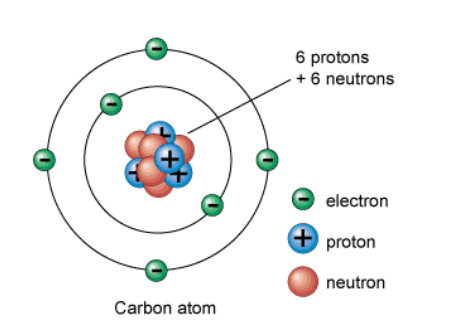
Looking at a diagram of a carbon atom, we can see that the protons and neutrons are in the center of the atom in something known as the nucleus, and the electrons are circling around the nucleus in electron orbitals. The electrons are kept in their orbits because of the attraction of the protons in the nucleus, but have to stay in certain orbitals because of the repelling of the other electrons. The protons stay together in the nucleus because of an effect called the strong nuclear force, but understanding this effect isn’t necessary for AP Chemistry.
As with any diagram, however, this is only a representation of what an atom looks like. In reality, every single part of the atom is so small that it would be impossible to show every part accurately in one photo. Over of an atom is empty space, with the nucleus being the only part of the atom with significant mass and size. Protons and neutrons are both much larger than electrons, being (or about ), while the electron is (or ).
Electrons are also misrepresented by diagrams. On top of being much smaller than shown, electrons move very quickly and somewhat randomly inside of an atom, and the electron orbital that an electron inhabits is a 3D space where the electron spends most of its time in, rather than a simple circular path.
Atomic Notation
Now let’s apply these ideas of what's inside the atom to the periodic table and see how we can apply this to actual elements. An element on the periodic table is defined by its atomic number, or more simply, the number of protons it has.
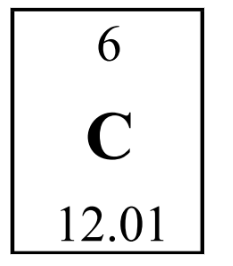
The atomic number can be found above the chemical symbol for the element. In the case of carbon, this number is 6, which means any carbon atom will always have 6 protons, and that any atom with 6 protons can only ever be a carbon atom. The number of neutrons can change while the number of protons, and therefore the element, stays the same. These are called isotopes, and are what we covered in topic 1.2. The number of electrons can also change in a given element, which are known as ions. The neutral state of all atoms is when the number of protons and electrons is even, as their charges cancel out. If an atom has one less electron than proton, then there is a net +1 charge on that ion. If the atom gains an electron, it has a net negative charge. Some examples of ions include .
The atomic notation for an element is a way of representing the number of protons, neutrons, and electrons that an element has.
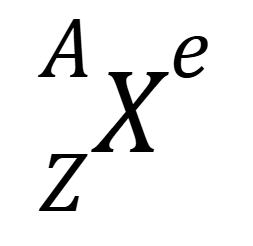
Atomic notation looks like this, where is the chemical symbol, is the atomic number (# of protons), is the atomic mass (# of protons + neutrons), and is the charge.
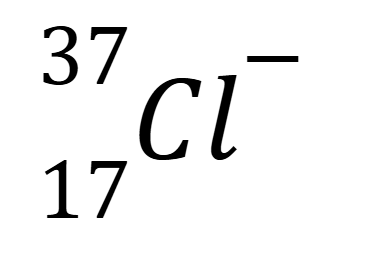
Using the atomic notation of chlorine, we can figure out how many protons, neutrons, and electrons there are. The number of protons is the same as the atomic number, so 17. We can figure out the number of neutrons by subtracting the number of protons from the mass number, which gives us 20 neutrons. Lastly, this atom has a -1 negative charge, which means there is one more electron than there are protons, meaning this atom has 18 electrons.
Shells and Subshells
Knowing that electron orbitals are the space that the electron spends time in, we can categorize orbitals based on where they are using electron shells. The lower shells have orbitals that are closer to the nucleus, and the higher shells have ones that are farther away. These can further be split into the subshells. Each subshell has a general shape that the orbitals within it resemble.
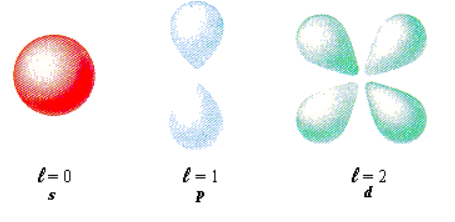
These subshells are named using the letters , , , and , in terms of increasing distance from the nucleus. It’s important to know that not every shell will have every type of subshell. The 1st shell will only have an subshell, the 2nd shell will have an orbital and a subshell, and the pattern continues where one subshell is added up until the 5th shell, where it cannot support more electrons and still only goes up to the subshell, like the 4th shell.
Each type of subshell has a different number of orbitals. The subshell only has one orbital, the subshell has 3, the subshell has 5, and the subshell has 7. It’s easier to see why when you think of variations of these 3d shapes, as shown here.
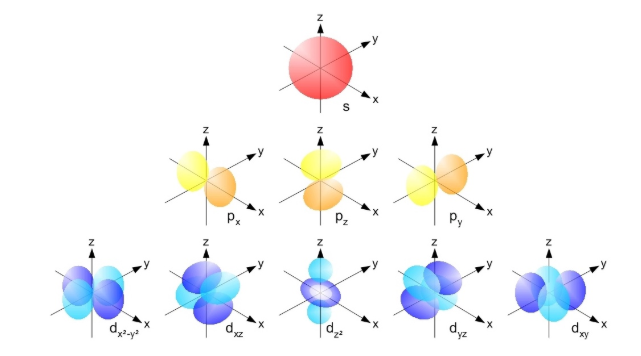
Lastly, each orbital in these subshells holds 2 electrons. Each electron spins around the orbital in an opposite direction, and we label each electron in an orbital with either up spin or down spin.
Electron Configuration
According to the Aufbau principle, electrons will fill up the lowest energy orbitals possible in an atom. For electrons, this typically means being in the closest possible orbital to the nucleus. This is because electrons are attracted to the positive charge of the nucleus, and it requires larger amounts of energy to fight that magnetic force and bring the electron away from the nucleus.
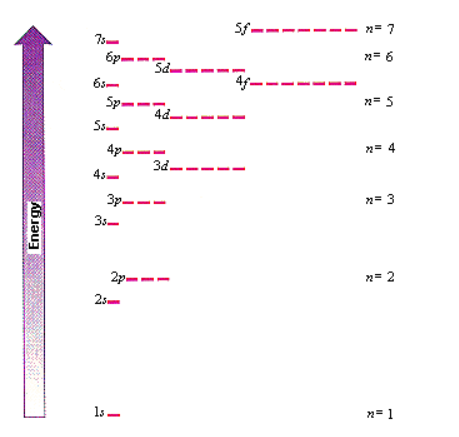
Here we can see the energy level of orbitals in each subshell. We see some obvious patterns, like the shells closest to the nucleus have the least amount of energy, and that inside of a shell, the energy of the subshells increases with , , , and then . There is some overlap between shells, however. The first example of this is that the s subshell of shell 4, or the subshell, has lower energy orbitals than the subshell, and therefore the orbitals in the 4s subshell will fill up before the ones in the do.
Knowing all of this, we can apply it to the periodic table and use the periodic table as a tool to understand electron configurations and orbitals.
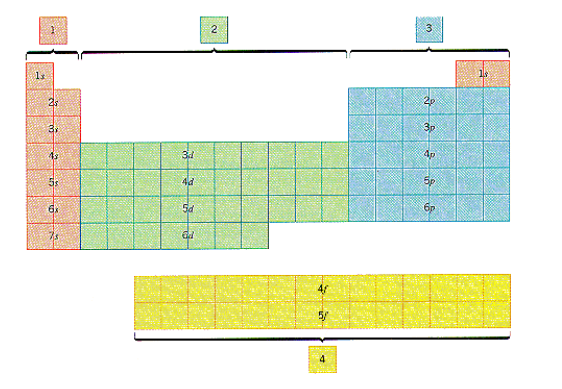
If you read the periodic table in order of the increasing atomic numbers (left to right, top to bottom), you can see that it matches the energy levels of different subshells. Each type of subshell is also well organized on the periodic table, with subshells being on the far left (groups 1 and 2), subshells being on the right (groups 13-18), and the subshells being in between them (groups 3-12). This helps to explain similarities in functions of elements in the same groups, as the types of electron subshells that they fill up are similar.
Using this information, we can write the electron configuration for any given element. We do this by stating the subshell and then how many electrons are in that subshell above it. For Bromine (), this would look like . Another important thing to remember when writing electron configurations is that the electron configuration changes if the atom is an ion, because the number of electrons is different from normal. If the atom was instead a ion, the electron configuration would be .
Noble gas configuration is a shorthand way of writing long electron configurations. Instead of writing out the entire electron configuration for an atom, you can replace all the filled shells with the noble gas element in that place. For example, for the element barium (), instead of writing the entire electron configuration, we can simply write .
Another way of showing electron configurations is by drawing the electrons in their orbitals based on their spin. Boxes are used for each orbital, and the electrons are drawn with up and down arrows.
This, for example, would be the electron configuration for sodium (). For an element like Phosphorus (), you would expect it to be similar, with the first orbital to have 2 electrons and the second to have one. Instead, the electron configuration looks like this.
This is because of Hund’s rule, which states that within a subshell, you must add one electron to each orbital before doubling up in the same orbital. The reason for this is that while each orbital in the same subshell has the same energy level, there is more electron-electron repulsion in an orbital if there is already another electron in there. This difference is smaller than the energy change between subshells, but important enough to change the order in which electrons are added.
Applications of Coulomb’s Law
Coulomb’s law was shown earlier in this topic, and how it explains the relationships between force and both charge and distance. Ionization energy represents the amount of energy that is needed to take away an electron from an atom, turning it into an ion. When finding the relative ionization energy of an electron, we can use Coulomb’s law. A low ionization energy would be the electron with very little attraction, or force, towards the nucleus. This means we need to have a lower charge and higher distance, and for a higher ionization energy, a higher charge and lower distance.
The distance is the easiest part to understand. Each shell is farther away than the one before it, and within a subshell, the order of closest to farthest away goes , , , and then . The way to understand charge is different, however, as you need to use the effective nuclear charge instead of just the charge of the nucleus. The equation for this is , where is the effective nuclear charge, is the number of protons, and is the number of shielding electrons. Shielding electrons are the electrons that are in already full shells, and their negative charge is able to shield some of the positive charge of the nucleus, keeping it from the valence electrons, or the electrons in the outermost shell. To put this into practice, potassium () has 19 protons and 19 electrons, 18 of which are in the 1st, 2nd, and 3rd shells, making them shielding electrons. Doing the calculation, we get an effective nuclear charge of +1. Calcium () has 20 protons and 18 shielding electrons (similarly to potassium (), meaning it has an effective nuclear charge of +2. Because they are in the same period, and have their valence electrons in the same shell, the distance between the nucleus will be the same, and the effective nuclear charge is the only thing with an impact on the ionization energy. Taking all of this into account, we can say that potassium () has a lower ionization energy than calcium ().
Something very important to remember is that the order that electrons fill up orbitals is different from the order they are taken away or ionized. Scandium () has 2 electrons in the subshell and 1 electron in the subshell. Despite the subshell being lower energy than the subshell, it is still farther away because it is in a higher shell, and so the electrons in the subshell will be ionized before the ones in the subshell are.
Practice
- Name the three subatomic particles and the relative charge, mass, and size of each of them.
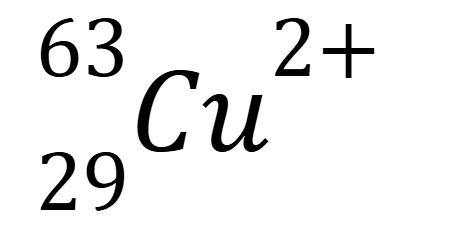
- Write the atomic notation for an atom with 29 protons, 34 neutrons, and 27 electrons.
- Write the electron configuration for potassium (), and then for the ion.
- Find the effective nuclear charges of both sulfur () and chlorine () and explain which one has a higher ionization energy and why.
Answers
- The three subatomic particles are the proton, neutron, and electron. Protons are positive, neutrons have no charge, and electrons are negative. Protons and neutrons both have a relative mass on 1 amu, and are of similar size, while electrons are much smaller and less massive than them.
- Having protons means our element must be Copper. We can add the number of protons to neutrons () to get our atomic mass, which is . Finally, we have 2 less electrons than protons, which means the overall charge of our atom is . The atomic notation should look like this:
3.
4. The effective nuclear charge of sulfur () is 6 (16 protons - 10 shielding electrons), and the effective nuclear charge of chlorine () is 7 (17 protons - 10 shielding electrons). Both sulfur () and chlorine () are in the same shell, so we know that chlorine has the higher ionization energy.