
Introduction
On top of understanding how an atom works and its different parts behave, it’s important to understand the techniques that helped to figure out that atom, along with being able to apply the information to what we already know.
Analyzing PES Graphs
Photoelectron spectroscopy is an experimental technique for finding the binding energy of electrons. The binding energy is the force of attraction between the electron and the nucleus. Photoelectron spectroscopy (or PES) graphs will show the number of electrons that correspond to each level of binding energy, and can help us to understand the coulombic forces at play inside an atom.
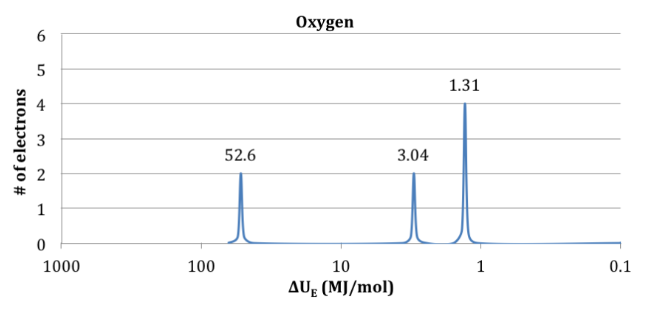
Here is a PES graph for oxygen. The -axis on the graph is the number of electrons, and the -axis is the binding energy of the electrons in . The -axis will typically be a logarithmic scale because of the large differences in binding energies of electrons, and will sometimes have a jump in the -axis to better show the different peaks on the graph.
Looking at each of the peaks on this graph and their heights, we can see that each of them corresponds to a different subshell. The peak on the left is the subshell, the middle one is the subshell, and the rightmost is the subshell. Counting the numbers of each, we can see that the and subshells are filled (each subshell only has one orbital and so can only hold 2 electrons), and the subshell is only partially filled, holding 4 out of the 6 possible electrons that it can have.
The energy level of each peak also helps to show the coulombic forces on each subshell. The peak for the subshell has the highest binding energy (or attractive force between the nucleus and electrons) because the subshell is the closest subshell to the nucleus and because there is the least electron shielding, meaning it has the highest charge and least distance possible. On the other end, the subshell with the least binding energy has the weakest charge and the greatest distance from the nucleus. The weakest peak is also the one that determines the ionization energy, as it takes the least amount of energy to take an electron away, and so is the first place where an electron will be taken away.
We can see these connections even further by looking at another PES graph.
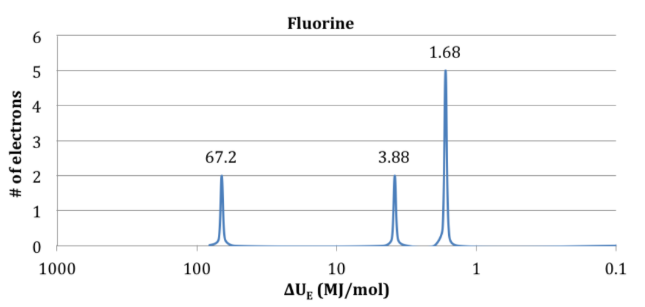
Looking at the peak for the subshell, we can see that the binding energy is stronger in a fluorine atom than in an oxygen atom. This can be understood with Coulomb's law, as the nucleus of a fluorine atom has one more proton than an oxygen atom, and so the charge is greater. Looking at the subshell, we can see two things. The peak is one higher on the y-axis, representing that it has 5 electrons instead of the 4 that an oxygen atom has, and the energy level of the peak is higher than in oxygen. This happens for the same reason as the subshell, but also is a way of showing the difference in ionization energy between the two atoms, as the higher binding energy of the fluorine atom also represents the fact it has a higher ionization energy than oxygen, and is consistent with the ideas of effective nuclear charge.
The last skill that's important to know is how to recognize elements based on their PES graphs.
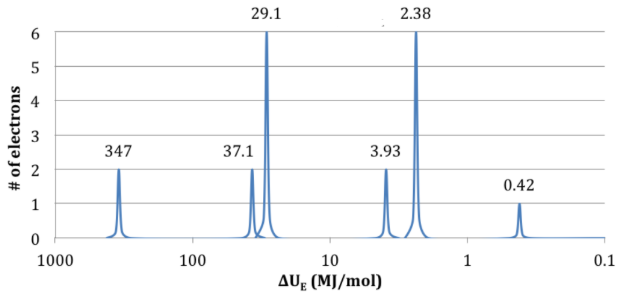
We start by counting each of the filled subshells. , , , , and all have their orbitals filled with electrons. This means our final subshell is the subshell. Looking at the height of the peak, we can see there is only one electron in the subshell. Therefore, the element that this PES graph represents is the only representing the first electron added to the subshell, which is potassium .
Practice
- Explain, using Coulomb’s law, why the binding energies of core electrons differ between elements.
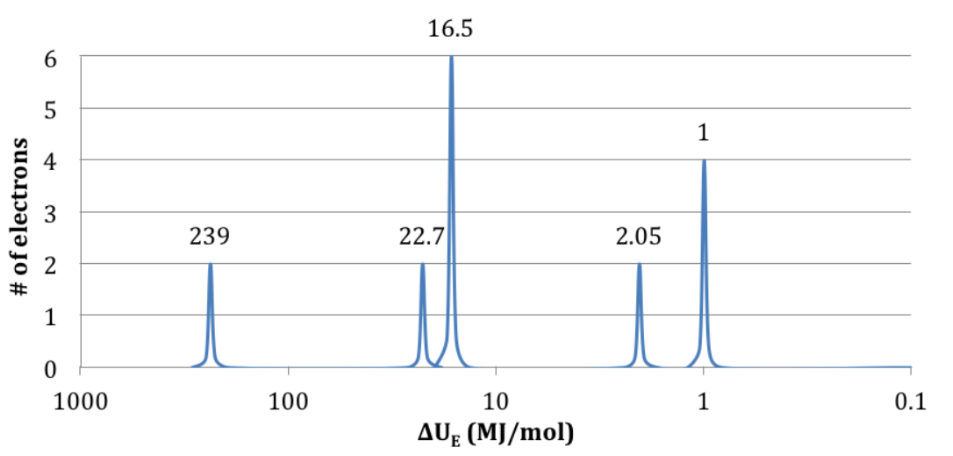
- Find the identity of this element based on its PES graph.
Answers
- The binding energies of core electrons differ between elements because of a changing charge in the nucleus. For example, if you add protons to the nucleus, which changes the element, you increase the charge, and therefore change the attractive force (binding energy) between the nucleus and an electron.
- Sulfur. This is because the subshell has 4 electrons in it.