
Introduction
The periodic table is a useful tool not just for seeing information about elements, but the patterns among elements. In this topic we will go over periodic trends, how you can use them to get a good idea of how an element behaves just based on its place on the periodic table, and connect them back to the ideas of atomic structure.
Ionization Energy
As discussed before, the ionization energy of an atom is the amount of energy required to remove an electron from it. The effective nuclear charge, or , is a good way of estimating the ionization energy, and the trends of ionization energy across the periodic table. In any given period, the effective nuclear energy increases going across it. Going down the period table, the ionization energy decreases, as while the effective nuclear charge may be the same as an element in a higher period, the distance of the outermost electron is farther away, and so the ionization energy is lower.
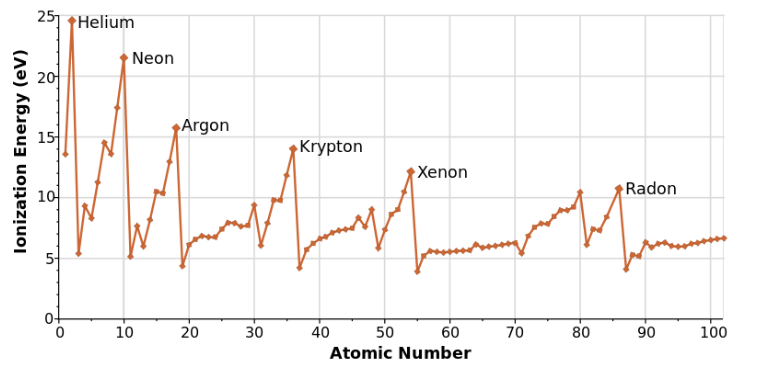
This graph helps show these trends. The highest peaks are the noble gases, which aligns with the fact that ionization energy increases going to the right. The peaks also decrease as you go farther down the periodic table, which aligns with the increasing distance from the nucleus.
Looking closer at the graph, you may notice that the ionization energy doesn’t perfectly follow this trend. To be specific, there are 2 places where the ionization energy is an exception to the effective nuclear charge (there are more in the and orbitals, but you do not need to know those). The first is when the added electrons fill up the s orbital and go into the orbital. This is because the orbital is farther away from the nucleus, and so has a lower ionization energy despite the greater charge in the nucleus. For example, boron () has a lower ionization energy than beryllium (), and aluminum () has a lower ionization energy than magnesium (). The other exception happens within the orbital. Remembering Hund's rule, one electron is added to each orbital in a subshell until they all have one electron, and then they are all completely filled up. When you first pair up electrons in an orbital (the 4th electron in a orbital), there is added electron-electron repulsion, which makes the attraction to that electron, and decreases the ionization energy. This can be seen with the fact that oxygen () has a lower ionization energy than nitrogen () and that sulfur () has a lower ionization energy than phosphorus ().
Atomic and Ionic Radii
The radii of atoms also have a noticeable trend across the periodic table. An atom’s radius is dependent on the distance of the farthest electron from the nucleus. Therefore, the radius will be larger if the electrons are in a farther subshell or if the charge of the nucleus of the outer electrons is relatively weaker. Across a period, the atomic radii of the different elements decrease because the effective nuclear charge of the atom increases. Going down through periods, the atomic radius increases, as the furthest electrons are in farther away subshells.
The relative charge of the nucleus on the outer electrons can also change if the atom is an ion. For example, if you have a positively charged ion, you have fewer electrons than the element’s base state. This means the effective nuclear charge of the ion has increased, which decreases the radius. For negatively charged ions, the opposite happens, and their radius increases.
Electron Affinity
An atom’s electron affinity is defined as the change in energy of an atom when it gains an electron. Atoms with high electron affinity will release a lot of energy when they gain an electron, which means the atom will be in a more stable state. This means that having a higher electron affinity will typically mean the atom will be in bonds where it gains an electron. With low electron affinity, it is the opposite. The atom will need to gain energy to add an electron, and so these atoms will most often give up electrons in bonds. The trend for electron affinity is that it goes up as you go across and up the periods.
Electronegativity
Electronegativity is a measurement of an atom's tendency to attract an electron. Elements with high electronegativity are said to want to gain electrons, while elements with low electronegativities often give up their electrons. The electronegativity of an atom is based on the effective nuclear charge of the nucleus and the distance from the electron that is being attracted. Elements further along a period will have higher effective nuclear charge and therefore greater electronegativity, as their pull on electrons is stronger. Lower periods on the periodic table will have their electrons be in further out subshells, increasing the distance and decreasing the electronegativity of the atom. Overall, this leads to a trend of increasing electronegativity as you go to the right and up on the periodic table, with the highest electronegativity being for fluorine ().