
Introduction
You might be wondering: What exactly are intramolecular forces? These are the forces that hold atoms together within a single molecule. They're not the same as intermolecular forces, which are introduced in Unit 3 and involve interactions between separate molecules.
It’s easy to mix up intramolecular and intermolecular forces, so here’s a helpful way to remember:
Intermolecular means between molecules, think inter as in “international,” or between nations.
Intramolecular means within a molecule; intra refers to something inside or internal.
Up to this point in Unit 2, we’ve looked at two types of intramolecular forces: covalent bonds and ionic bonds.
Potential Energy and Bonding
You might be asking yourself, how does potential energy relate to bonding? In chemistry, stability is key, and bonds with lower potential energy are more stable. That’s an important idea to keep in mind when exploring how bonds form and how strong they are.
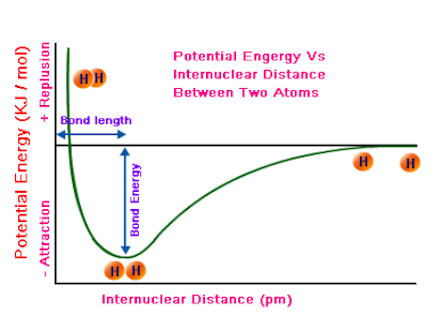
Because of this relationship, we can use energy diagrams to help visualize physical and chemical processes. A graph showing potential energy vs. the distance between atoms gives insight into how atoms interact. From this type of graph, you can identify several key features:
Equilibrium bond length: This is the distance between atoms where potential energy reaches its minimum. In simple terms, it’s the point where the atoms are most stable and "comfortable."
Bond energy: This refers to the energy required to break a bond and separate the two atoms. Conceptually, it’s the difference in potential energy between the atoms when they’re bonded (at equilibrium) and when they’re far apart.
Bond strength: This is directly related to bond energy. Bonds with higher bond energies are stronger and more stable. On the flip side, lower bond energies indicate weaker, less stable bonds.
Bond length: This is the actual measured distance between two bonded atoms.
Potential Energy and Covalent Bonds
In molecules with covalent bonds, bond length is affected by two main factors: the size of the atoms involved and the bond order.
Bond order refers to the type of bond formed between two atoms, whether it’s a single, double, or triple bond.
Here’s a quick breakdown:
| <b>Bond Order</b> | <b>Electrons in the Bond</b> | <b>Bond Length</b> | <b>Bond Energy</b> |
| <b>Single Bond (–) </b> | <b>2 electrons</b> | <b>Longest</b> | <b>Lowest</b> |
| <b>Double Bond (=) </b> | <b>4 electrons</b> | <b>Intermediate</b> | <b>Medium</b> |
| <b>Triple Bond (≡) </b> | <b>6 electrons</b> | <b>Shortest</b> | <b>Highest</b> |
A simple way to remember the number of electrons in each bond is to look at a Lewis structure; each line (or dash) represents two shared electrons between atoms.
So, as the bond order increases, the bond becomes shorter and stronger due to the greater number of shared electrons pulling the atoms closer together.
Triple bonds have the highest bond energy and are the shortest, which typically makes them the strongest type of bond. This increased stability also means they require more energy to break. However, it's important to keep in mind that bond stability isn’t determined by bond order alone; other factors like atomic size and charge also play a role.
Now that we've covered these concepts, let’s bring everything together by examining a potential energy graph, which visually represents how the energy between atoms changes with distance. This will help solidify your understanding of bond strength, bond length, and stability in a molecular context.
Breaking Down a Potential Energy Diagram
In covalent bonds, bond length depends on both the bond order (single, double, or triple) and the balance between attractive and repulsive forces.
In a potential energy diagram, the bond energy reflects how the highest potential energy comes from the repulsion between two atoms when they are too close together.
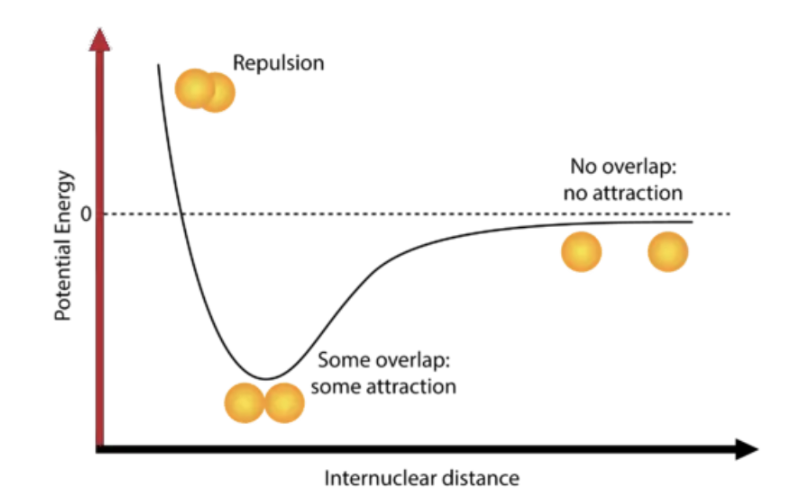
Let’s break down each of these stages:
Repulsion: When atoms are extremely close together and the distance between their nuclei is very small, strong electron-electron repulsion occurs. This makes the bond highly unstable and results in a potential energy greater than zero.
Some overlap/attraction: At this point, the atoms are at an ideal distance where attractive and repulsive forces are balanced. This is the most stable state, known as the equilibrium bond length. The potential energy is at its lowest here, and the bond is stable. The potential energy at this point represents the bond energy, or the amount of energy needed to break the bond.
No overlap/attraction: When the atoms are far apart and the distance between their nuclei is large, there is little to no interaction between them. As a result, no bond is formed, and the potential energy is close to zero.
Example with PE Diagrams
It’s helpful to understand these properties because you might be asked to identify where an element would appear on this type of graph.
For instance, if the diagram represents bonded chlorine atoms (), where would the bond appear compared to chlorine’s curve?
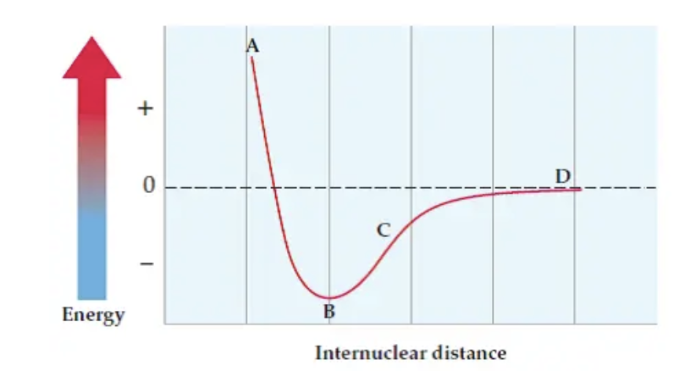
To answer this, we need to consider periodic trends and examine the graph’s axes:
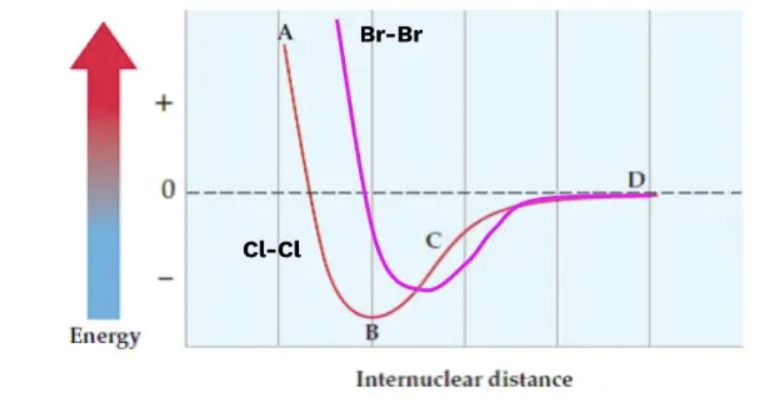
Internuclear distance: Which bond is longer, or ? The bond between atoms with a larger atomic radius will be longer. As you move down a group on the periodic table, the atomic radius increases. Since bromine is located below chlorine, the bond is longer than the bond. This helps you determine where to place the Br–Br curve along the x-axis.
Potential energy: Which bond is easier to break, or ? This ties into the concept of bond energy. A lower bond dissociation energy means a bond is easier to break. Bond energy generally decreases down a group because atoms become larger, resulting in longer and weaker bonds. Since bromine is below chlorine on the periodic table, the bond has a lower bond energy than the bond, making it easier to break. This tells you how to position the curve along the y-axis.
Since the bond is both longer and easier to break, its curve would be drawn higher up (indicating less bond energy) and further to the right (indicating a larger internuclear distance).
This type of question is a great way to check your understanding of periodic trends and bonding concepts. Here’s how the graph should appear:
Forces Within Ionic Bonds
Understanding the strength of ionic interactions involves the concept of Coulomb’s Law.
As covered in the previous unit, you don’t need to memorize the formula, but you should grasp what Coulomb’s Law means conceptually.
The bond energy between two charged particles (ions) depends on the size of their charges and the distance between their nuclei.
The larger the charges on the ions, the stronger the attraction, because a more positively charged nucleus pulls electrons more strongly.
The closer the two ions are, the stronger the attraction. To visualize this, think about magnets; they don’t attract each other when they are several feet apart; they need to be close to feel the pull.
According to Coulomb’s Law, the strongest interactions occur between small ions with high charges.
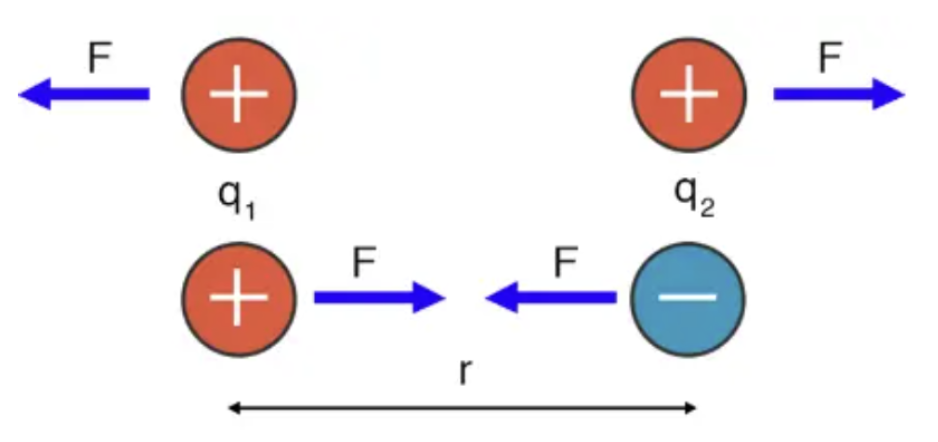
Check out the diagram above. You don’t need to focus too much on the variables, but here’s a quick overview: stands for force, and represent the sizes of the charges on the atoms, and r is the distance between the nuclei.
This image essentially illustrates that Coulomb’s Law explains why “opposites attract.” It’s a fundamental principle that shows up everywhere!
Attraction happens when the charges are opposite (one positive and one negative), while repulsion occurs when the charges are the same (both positive or both negative).