
Introduction
Atoms combine to form molecules, and in the case of ionic solids, they consist of two specific types of atoms: a positively charged cation and a negatively charged anion. Ionic bonding usually happens when a metal atom transfers one of its valence electrons to a nonmetal atom. The metal, after losing an electron, becomes a cation, while the nonmetal, after gaining that electron, becomes an anion.
These oppositely charged ions are held together by electrostatic attraction, and the strength of this interaction is influenced by Coulomb’s Law, which explains how the force between charged particles depends on their charges and the distance between them.
Structure of Ionic Solids
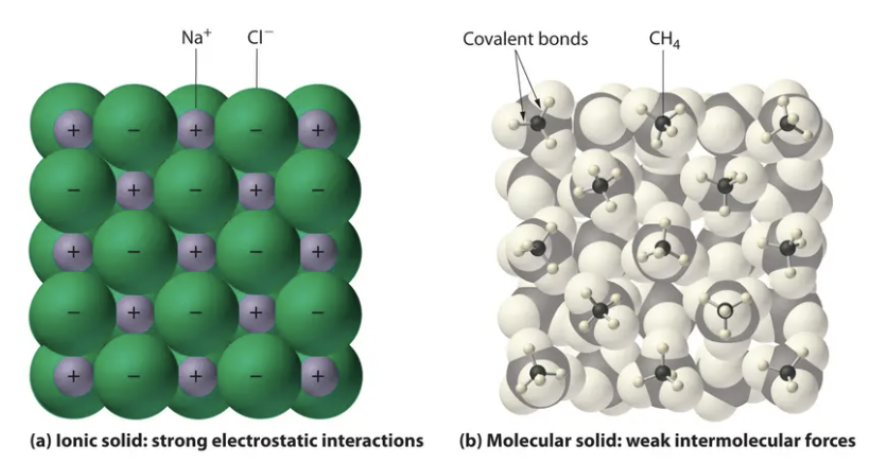
As previously discussed, ionic interactions can form solids that are brittle, hard, and have high melting points. This is because the ions are organized in a three-dimensional structure called a crystal lattice. In this arrangement, oppositely charged ions attract one another, with positive cations surrounded by negative anions and negative anions surrounded by positive cations. This pattern maximizes attractive electrostatic forces while minimizing repulsive forces between charges.
Another important feature of the crystal lattice is how ion size influences how well the ions pack together. When metals become cations, they lose electrons, causing a decrease in atomic radius. Conversely, when nonmetals become anions, they gain electrons, resulting in an increase in atomic size. You can observe this trend with sodium and chlorine: sodium forms a small cation, and chlorine forms a larger anion. This size difference allows the smaller cations to fit between the larger anions in the lattice. While not all ionic solids exhibit this perfect fit, ion size and arrangement significantly influence the strength of ionic interactions.
Representation of Ionic Solids
It’s important to understand that particle diagrams for ionic substances differ significantly from those of molecular (covalent) substances. Covalent substances are typically represented as discrete molecules, such as , where atoms are bonded together in a single unit. In contrast, ionic substances are shown as an extended network of positive and negative ions, arranged in a repeating pattern. Rather than individual molecules, ionic diagrams illustrate a lattice structure, emphasizing the continuous electrostatic attractions between cations and anions throughout the solid.
Explaining the Lattice Structure
The lattice structure of an ionic solid is the result of strong electrostatic forces between oppositely charged ions, positive cations, and negative anions. These forces are described by Coulomb’s Law, which states that the electrostatic force between two charged particles is directly proportional to the magnitude of their charges and inversely proportional to the distance between them.
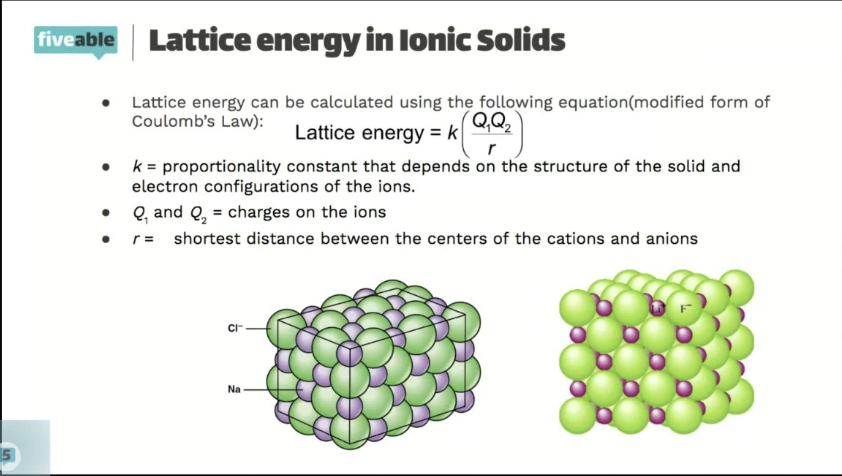
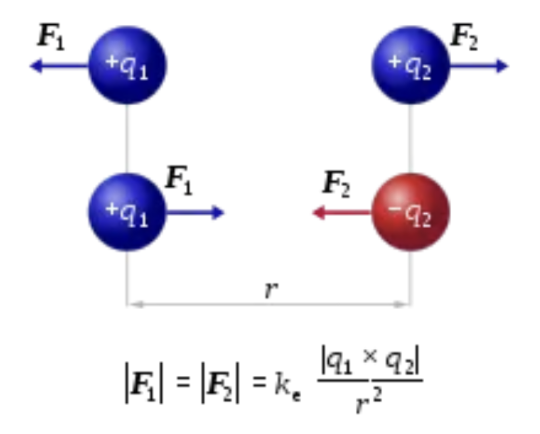
Two key factors influence the strength of these interactions:
- Magnitude of charge: The greater the charges on the cation and anion, the stronger the electrostatic attraction between them.
- Distance between the nuclei: The closer the ions are to each other, the stronger the attraction. This is where ion size becomes important. For example, small sodium ions () can fit closely between larger chloride ions (), reducing the distance between their nuclei. According to Coulomb’s Law, this shorter distance increases the strength of the attractive force between the ions, reinforcing the stability of the lattice structure.
Properties of Ionic Substances
Ionic substances are typically solids at room temperature and exhibit several defining physical properties due to the strong electrostatic forces within their crystal lattice. Here's a breakdown of their key characteristics:
- High melting and boiling points: Ionic solids require a large amount of energy to break the strong attractions between cations and anions. As a result, they have very high melting and boiling points.
- Poor electrical conductivity in the solid state: In a solid ionic lattice, ions are fixed in place and electrons are localized, meaning they cannot move freely to conduct electricity. This makes ionic solids poor conductors of both heat and electricity in the solid phase.
- Good electrical conductivity in liquid and aqueous states: When melted or dissolved in water, the ions are free to move, allowing the substance to conduct electricity efficiently. This is due to the mobility of charged particles, rather than electron delocalization, as seen in metallic bonding.
- Hard and brittle: Ionic solids are hard because of the strong electrostatic forces holding the ions in place.
Lattice Energy
Lattice energy is the energy released when gaseous ions come together to form an ionic solid. It’s a direct reflection of how strong the electrostatic attraction is between the oppositely charged ions in the crystal lattice.
And yes, Coulomb’s Law shows up again! It also helps explain lattice energy, since the strength of attraction (and therefore the energy released) depends on two familiar factors: the magnitude of the charges and the distance between the ions. So in a way, Coulomb’s Law is everywhere when it comes to understanding ionic bonding and structure.
Review of Coulomb's Law
Let’s ease into lattice energy by first reviewing how to determine which ionic compound has a higher melting point. This concept directly ties into lattice energy, so it's a helpful place to start!
Take vs. , for example. To compare their melting points, we begin by examining the charges on the ions. In both compounds, sodium forms a +1 cation () and fluorine/chlorine forms a –1 anion ( or ). Since the charges are the same in both cases, charge doesn't explain any difference in melting point.
Next, we consider ion size. According to periodic trends, fluoride () is smaller than chloride (). Because is smaller, it can get closer to , which increases the electrostatic attraction between the two ions.
As a result, NaF has a stronger ionic bond and therefore a higher melting point than NaCl, since more energy is required to overcome the stronger attraction.
Putting Everything Together
Lattice energy is influenced by the same two key factors we just used to compare melting points: ion charge and ionic size (or distance between ions). This connection is described by Coulomb’s Law, which ties directly into both melting point and lattice energy.
Just remember this simple rule: The smaller the ions and the greater their charges, the higher the lattice energy.
Because of this, an ionic solid with a high melting point generally also has a high lattice energy, since it takes more energy to break apart the strong electrostatic attractions holding the lattice together.