
Introduction
This unit centers around the structures and properties of both molecular and ionic compounds. Since we've already explored bonding types, intramolecular forces, and how ionic solids are structured, we’ll now shift our attention to the study of metals and alloys.
Metallic Bonding
Although ionic and covalent substances are more commonly encountered, it is also important to understand metallic substances and their unique structure, a lattice of metal cations immersed in a "sea" of delocalized valence electrons.
Sea of Electrons
When metals ionize, they lose their valence electrons and become positively charged cations. In metallic bonding, these cations are arranged in a structured array, while the freed valence electrons move freely around them, forming what’s described as a “sea of electrons.”
This means that the nucleus and inner (core) electrons of each metal atom remain fixed in place, but the valence electrons are highly mobile, giving rise to the fluid, sea-like behavior.
Unlike in most substances, where electrons are associated with a specific atom, in metals, the valence electrons are so mobile that they are not tied to any single atom.
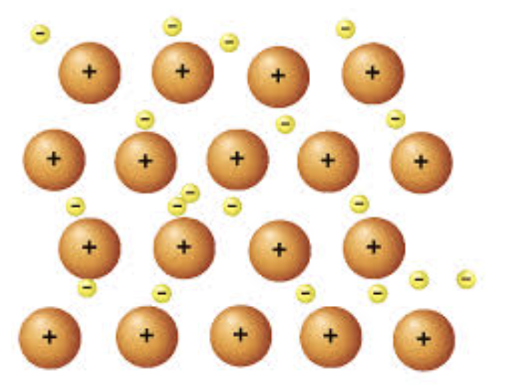
Because valence electrons in metals are free to move throughout the entire structure, metallic substances exhibit a set of distinct and useful properties:
Excellent electrical conductivity: The delocalized nature of valence electrons means they can move freely within the metallic lattice. This mobility allows metals to efficiently carry electrical current and conduct charge, an important feature we’ll revisit in future topics like redox reactions.
High melting and boiling points: Metallic bonds are exceptionally strong, requiring a significant amount of energy to break. That’s why metals like iron or gold have such high melting and boiling points.
Lustrous or shiny appearance: The free-moving electrons in metals uniquely interact with light. When light strikes the surface, these electrons reflect it, giving metals their characteristic shine.
Malleability and ductility: Metals can be hammered into thin sheets (malleability) or drawn into wires (ductility) without breaking. This is because their atoms are arranged in a flexible structure that allows layers of cations to slide over one another more easily than in ionic solids, which are more rigid and brittle.
Comparing Solids
When comparing the properties of different types of solids, keep the following chart in mind as a helpful reference:
Alloys
Metals can also combine with other elements to form alloys. Alloys are created when two or more elements, at least one of which is a metal, are mixed in their molten (liquid) state. As the mixture cools and solidifies, it forms an alloy. To achieve a specific alloy with desired properties, the elements must be combined in precise ratios. Each unique combination results in an alloy with its own distinct set of characteristics.
There are two main types of alloys you should be familiar with.
Interstitial alloys are formed when smaller atoms occupy the spaces, or interstices, between the larger atoms in a metal lattice. A well-known example of this is steel, an alloy you may not have realized is a mixture!
Steel is composed primarily of iron and carbon: Iron often serves as the base metal in interstitial alloys, while carbon is a common alloying element due to its much smaller atomic radius. In the case of steel, carbon atoms fit neatly into the small gaps between iron atoms in the crystal structure, strengthening the material without significantly changing its overall structure.
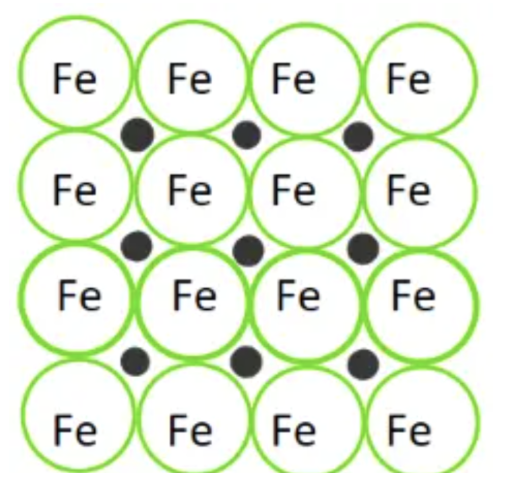
The properties of a steel sample depend heavily on the ratio of carbon to iron. By adjusting the amount of carbon used during its formation, different types of steel with varying characteristics can be produced.
Interstitial alloys like steel are especially known for their strength and hardness. This is largely due to the small size of the interstitial atoms, such as carbon, which fit tightly into the gaps between the larger metal atoms. This tight packing increases the overall density of the material. Think of it like filling in the empty spaces of a structure with tiny pieces. Here, the smaller atom actually keeps the metal from sliding, making the structure more compact, rigid, and durable.
Substitutional alloys are formed when atoms of one element replace atoms of another element that are similar in size within the metal lattice. Unlike interstitial alloys, where smaller atoms fill the gaps between larger ones, substitutional alloys involve replacing atoms, not adding more to the structure.
A classic example of a substitutional alloy is brass, which is made from copper and zinc. Copper serves as the base metal, and because zinc atoms are similar in size to copper atoms, they can substitute for them within the lattice. This replacement results in an alloy with its distinct properties while maintaining the overall structure of the metal.
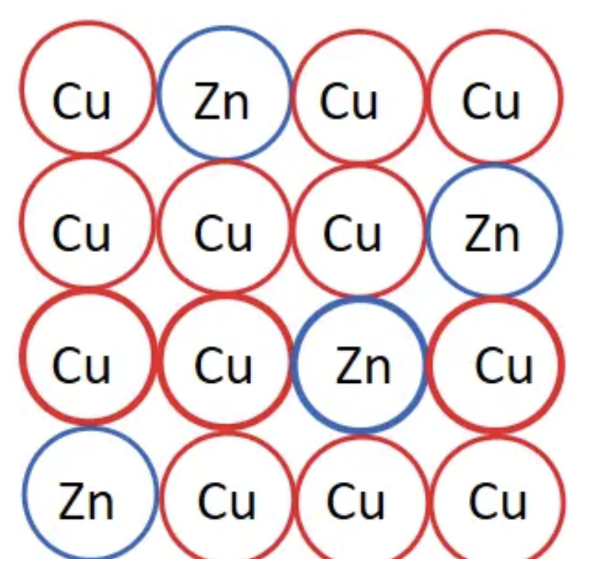
Substitutional alloys, such as brass, are well known for their strong electrical and thermal conductivity. These properties arise from the presence of delocalized electrons within the metal lattice, which can move freely throughout the structure. Even though some atoms are replaced in substitutional alloys, the overall metallic bonding remains intact, allowing electrons to flow efficiently and transfer both charge and heat effectively.
Interstitial vs. Substitutional Alloys
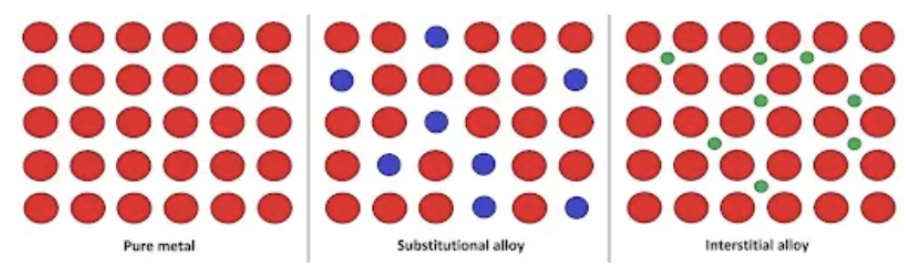
The key difference is that interstitial alloys involve adding smaller atoms that fit into the spaces between larger atoms, while substitutional alloys involve replacing atoms with others of similar size.
In general, alloys tend to be harder and stronger than pure metals because the added elements disrupt and distort the metal’s structure, making it more difficult for atoms to move. However, this distortion also means alloys are usually less malleable than their pure metal counterparts.
Practice
Do not scroll too much unless you wish to see the answers.
1. Which of the following diagrams most accurately represents an alloy composed of nickel (Ni) and boron (B)?

2. Copper and zinc atoms share the same atomic radius. With this in mind, which of the following diagrams most accurately represents an alloy composed solely of copper and zinc atoms?

Answers
Answer for #1:
Diagram A is correct because it shows smaller atoms (likely representing boron) fitting into the spaces between larger atoms (nickel), which matches the definition of an interstitial alloy. Since boron atoms are much smaller than nickel atoms, they occupy the interstitial spaces rather than substituting nickel atoms, making this the best representation of a Ni-B alloy. The other diagrams either show atoms of similar size substituting or unrelated arrangements that don’t fit the characteristics of an interstitial alloy.
Diagram B is incorrect because this image shows two distinct types of atoms completely separated into layers, which would indicate a mixture, not an alloy, where atoms are combined in the same metallic structure.
Diagram C is incorrect because the circles are marked with “+” signs, suggesting they represent ions in an ionic compound, not a metallic alloy composed of two metals or a metal and a metalloid like Ni and B.
Diagram D is incorrect because this diagram shows a regular structure of alternating atoms, which is more representative of a compound of a substitutional alloy, not an interstitial alloy like Ni-B, since they have different atomic radii.
Answer for #2:
Diagram A is incorrect because this diagram shows an interstitial alloy, where smaller atoms fit into the gaps between larger ones. However, copper and zinc have the same atomic radius, so interstitial alloying is not possible here.
Diagram B is correct because copper and zinc have nearly identical atomic radii; they form a substitutional alloy, where zinc atoms can directly replace copper atoms in the metallic lattice. Diagram B shows a uniform arrangement with atoms of the same size but different identities, accurately representing this type of alloy.
Diagram C is incorrect because the diagram shows alternating charged atoms, which resemble an ionic compound rather than a metallic alloy made of two metals sharing a "sea" of electrons.
Diagram D is incorrect because this shows only one kind of atom without any substitution, so it also represents a pure element and not a mixture of copper and zinc.