Introduction
Now that we understand the structure of an atom and the properties of electrons, we can move on to learning how to draw molecules. This will help us see how an atom’s structure affects the way it bonds.
What are Lewis Diagrams?
Lewis diagrams, also called Lewis structures, are a way to represent molecular structures by showing the valence electrons and bonds in a molecule. They are one of the most important concepts in this unit and the course overall, since knowing how to draw them makes it possible to represent almost any molecule and explore countless other possibilities.
These diagrams help predict a molecule’s shape and the types of chemical reactions it might take part in. They follow the octet rule, which states that atoms generally bond in a way that gives them a complete valence shell with eight electrons.
Lewis diagrams are an example of a localized electron model, meaning the electrons stay in specific places within the structure rather than moving freely. In these structures, valence electrons are grouped into two main categories:
- Lone pairs are pairs of electrons that stay around one atom and are not shared with any others.
- Bonding pairs are pairs of electrons shared between atoms, usually shown as a dash in the diagram.
Drawing Lewis Dot Structures (LDS)
Ionic Lewis dot structures are simple to draw because ionic bonds are formed through the transfer of electrons.
Start by writing the compound’s empirical formula so you know which elements are involved and how many atoms of each there are.
Next, show the metals and nonmetals with their correct number of valence electrons. Once you become familiar with this process, you can also picture this step mentally.
Transfer the valence electrons from the metal to the nonmetal, which can also be done mentally once you get used to it.
Finally, place brackets around the Lewis dot structures of the resulting cation and anion, and write the charges outside the brackets.
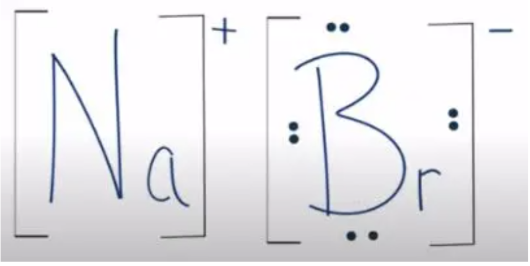
Example: (Sodium Bromide)
The formula shows that there is one atom of sodium and one atom of bromine in the structure. Looking at the periodic table, sodium has 1 valence electron and bromine has 7. When they bond ionically, sodium transfers its 1 valence electron to bromine, giving both atoms a complete octet. This forms a sodium cation and a bromide anion. In the final drawing, the charges are shown outside the brackets around each ion.
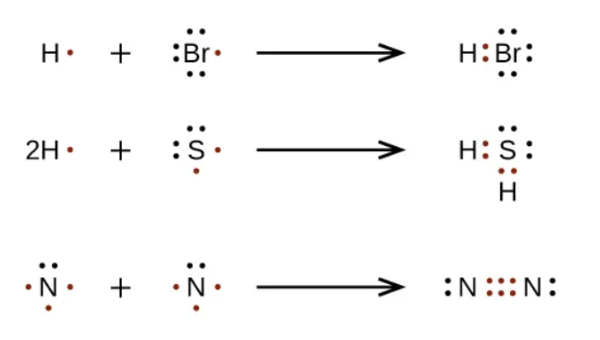
Covalent Lewis dot structures are a bit trickier to draw because the electrons are shared between atoms.
Here is a step-by-step process to follow:
- Start by looking at the empirical formula and adding up the total number of valence electrons.
- Identify the central atom, which is usually carbon or the atom that is not hydrogen.
- Place the surrounding atoms around the central atom and connect them with single bonds.
- Complete the octets for each atom, keeping in mind that most atoms are most stable with 8 electrons.
-
Count the electrons you have placed so far.
- If there are too many electrons, remove lone pairs from adjacent atoms and replace them with double or triple bonds.
- If there are too few electrons, add more to the central atom, following the exceptions to the octet rule.
We will look at a few examples next to practice these steps in action.
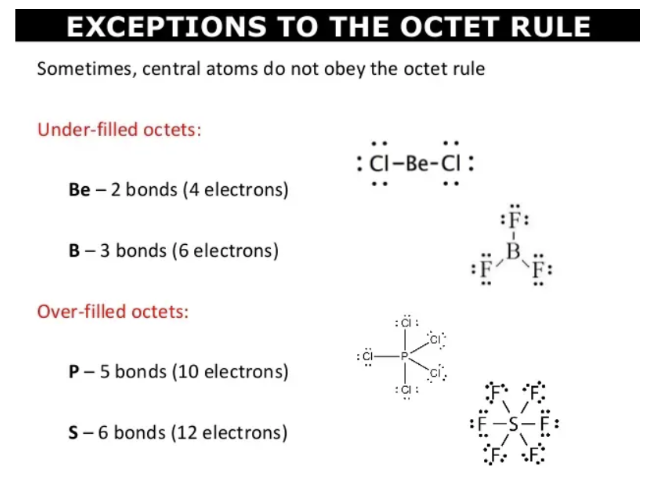
Exceptions to the Octet Rule
There can be exceptions to the rules for drawing Lewis dot structures, so it is important to watch for them.
Some atoms have fewer than 8 electrons in their valence shell when stable. For example, hydrogen can hold a maximum of two valence electrons, beryllium can hold up to four, and boron can hold up to six.If your drawing shows too few electrons, you may break the octet rule for the central atom only if the element has an atomic number of 14 or higher. In that case, you can add extra electrons to the central atom to reach the correct total number of valence electrons.Some atoms have an odd number of valence electrons, which means they cannot follow the octet rule perfectly because there will always be an unpaired electron.Some compounds require multiple bonds between atoms when there are not enough electrons to complete the octets. For instance, has a carbon atom bonded to two oxygen atoms, each connected with a double bond.
Here are examples of the first two situations:
Examples of Lewis Structures
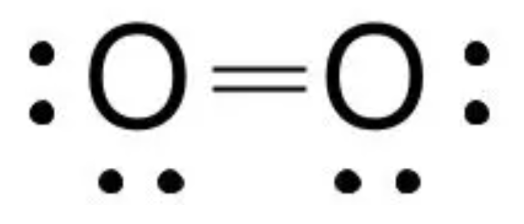
Drawing a Lewis dot structure for :
Here’s the thought process you should follow when working through this:
First, check the periodic table. Oxygen is in group 16, which means it has 6 valence electrons.
With two oxygen atoms, the total number of valence electrons should be 12.
Since there are only two atoms, we can place them next to each other without worrying about a central atom.
Draw a single bond (one dash) between the two oxygen atoms to represent two shared electrons.
Next, add three lone pairs to each oxygen atom so both appear to have a full octet. At this point, the structure will have 14 electrons, which is two more than the total we calculated earlier.
To fix this, change the single bond to a double bond by removing one lone pair from each atom and replacing it with two more shared electrons between the atoms.
Finally, count the electrons again. With a total of 12 and both atoms following the octet rule, the drawing now represents the correct Lewis dot structure for .
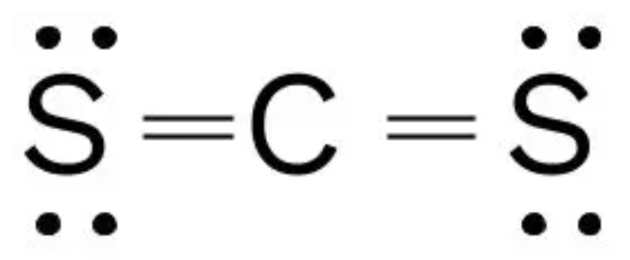
Drawing a Lewis dot structure for :
Start by checking the periodic table. Carbon has 4 valence electrons, and each sulfur atom has 6. With one carbon and two sulfur atoms, that adds up to 16 total valence electrons.
Place carbon in the center since it is less electronegative than sulfur.
Position the two sulfur atoms on either side of the carbon and connect them with single bonds.
At this point, you have used 4 of the 16 total electrons.
Add lone pairs to each atom to give them full octets. With this step, the structure will temporarily show 20 electrons, which is more than the 16 we calculated.
To fix this, remove lone pairs from each sulfur and replace them with shared electrons to form two double bonds between carbon and sulfur.
The final Lewis diagram shows carbon in the center with double bonds to each sulfur atom, and each sulfur having two lone pairs.