
Introduction
Sometimes, a molecule cannot be represented by only one Lewis structure. When a structure can be drawn in more than one valid way, it is said to exhibit resonance. An easy way to understand resonance is by comparing it to mixing paint.
Resonance
When you sketch the two or three possible resonance structures of a molecule, together they represent the whole molecule. The true structure is best described as an average, or hybrid, of these resonance forms. As a result, the molecule may have fractional bond orders, such as or .
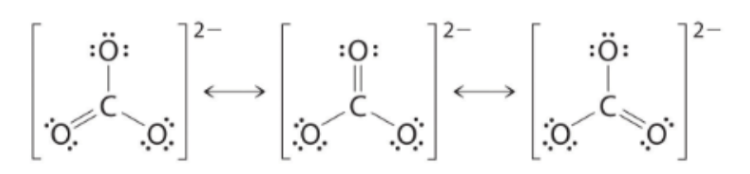
A common misconception is that resonance structures represent molecules that can actually switch between different bond arrangements. In reality, resonance is simply a way of illustrating a molecule in different forms to emphasize that the true structure is an average of those representations in space. This idea will become clearer as we examine several examples.
How do you know when a structure has resonance?
Let’s work through the Lewis dot structure (LDS) of the polyatomic ion .
First, we need to count the total number of valence electrons in the ion. Nitrogen contributes 5 valence electrons, and each oxygen atom contributes 6.
Since there are three oxygens, that gives us: .
Because carries a –1 charge, we must add one additional electron, giving us a total of 24 valence electrons to represent in the Lewis structure.
Next, place nitrogen as the central atom, since there is only one nitrogen present. Then, arrange the three oxygen atoms around nitrogen and connect each of them with a single bond. Finally, complete the octets of the oxygen atoms by adding lone pairs of electrons.
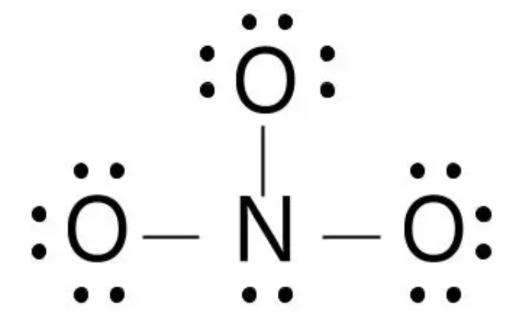
Now, count the total number of valence electrons in the structure. You’ll notice there are 26, which is two more than we should have. To fix this, we can replace a single bond and a lone pair with a double bond. However, if we tried to make all the bonds double bonds, we would run out of electrons. This is where resonance becomes important: instead of changing every bond, we adjust just one of them to a double bond.
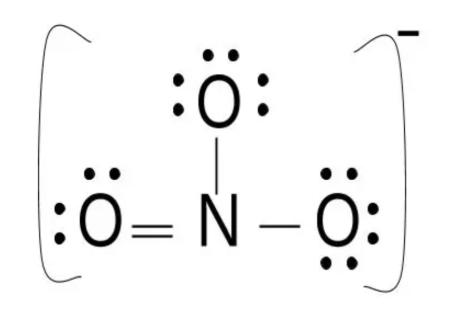
Now let’s count again: we have exactly 24 valence electrons! This gives us one valid way of drawing the Lewis dot structure for . But how do we decide which bond should be the double bond?
The simple answer is that it does not matter. Any of the three bonds could be the double bond. In reality, all three possibilities exist simultaneously, which is the essence of resonance. On paper, this means there are three equivalent ways to draw the structure.
All of these structures are acceptable. On the AP Exam, however, you would need to draw all three side by side and use the specific resonance arrows () between them.
In reality, the molecule does not have two single bonds and one double bond. Instead, it has a bond order of . Since we cannot draw fractions of a bond, we use resonance structures to represent this averaged bonding.
Bond Order?
How do we know the bond order is ? The easiest way to calculate it is to divide the total number of bonds by the number of positions for bonds. In this case, there are 4 bonds spread across 3 positions, giving a bond order of . A bond is stronger than a single bond but weaker than a double bond. This fractional bond is what is represented by the three resonance structures. *Note that the bond order is , but this doesn’t mean there are bonds so to speak.
As mentioned earlier, on the AP Exam, you should draw all possible resonance structures side by side, using double-headed arrows between each. You can also write the word “resonance” on the page to show your understanding and help organize your answer.
It’s also important to note that bonds in resonance are equal in length, in which we can derive from our earlier explanation of bond orders.
Formal Charge
Formal charge is the charge assigned to an atom in a molecule, based on the assumption that electrons in all chemical bonds are shared equally between the atoms. It shows how the number of electrons around an atom in a molecule compares to the number it would have as a neutral, isolated atom. Formal charge helps us determine the most likely arrangement of electrons.
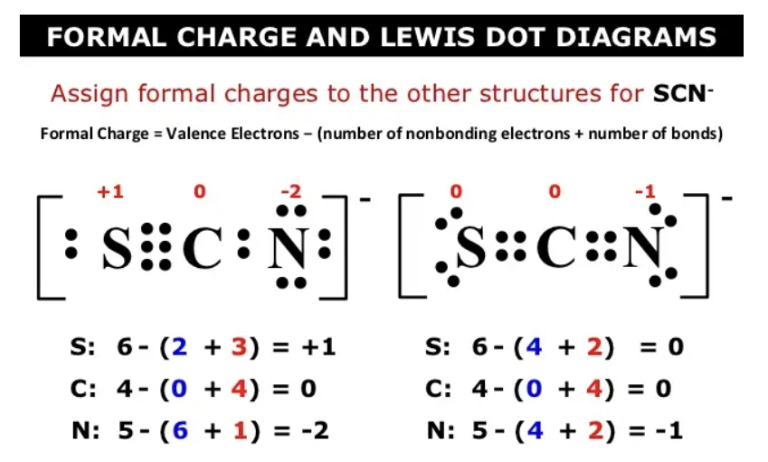
How do you calculate formal charges?
Formal charge = (# of valence electrons) – (# of lone electrons) – (# of bonds)
This method might not be the most technical, but it’s simple and easy to remember!
Looking at the ion in the image above, here’s how they calculated the formal charge for sulfur: Sulfur has 6 valence electrons. In the structure shown, it has 2 lone electrons and is connected to carbon by what appears as 3 single bonds (even though it’s actually a triple bond). Using this method, sulfur ends up with a formal charge of in this representation of .
When do I check the formal charge of an atom?
It’s always a good idea to double-check your formal charge calculations, since it’s easy to make a mistake. This is especially important for elements beyond element 14, as these can sometimes break the octet rule.
Example with Formal Charge
Let’s draw the Lewis dot structure (LDS) of the phosphate ion, .
First, count the total number of valence electrons. Phosphorus has 5, each oxygen has 6, and there are four oxygens, plus 3 extra electrons for the –3 charge:
valence electrons.
Next, place phosphorus in the center and arrange the four oxygen atoms around it. Connect each oxygen to phosphorus with a single bond, then complete the octets of all the oxygen atoms with lone pairs.
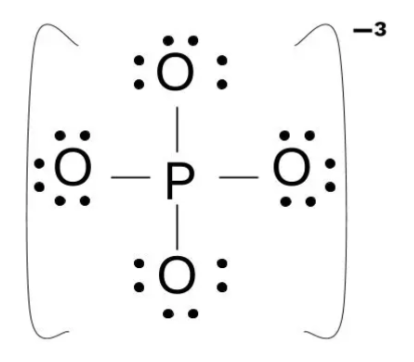
At first glance, this Lewis dot structure seems perfect, with 32 valence electrons accounted for. However, phosphorus is element 15, so we should check the formal charges to ensure the electron placement is correct.
Calculating the formal charges:
- Phosphorus: 5 valence electrons – 0 lone electrons – 4 bonds =
- Oxygen: 6 valence electrons – 6 lone electrons – 1 bond =
When evaluating formal charges, the goal is to have the central atom with a formal charge of 0 and the most electronegative atoms carrying negative formal charges. A formal charge of 0 indicates that the electrons are localized and the structure is more stable.
To lower the formal charge on phosphorus to 0, we can introduce a double bond with one of the oxygen atoms.
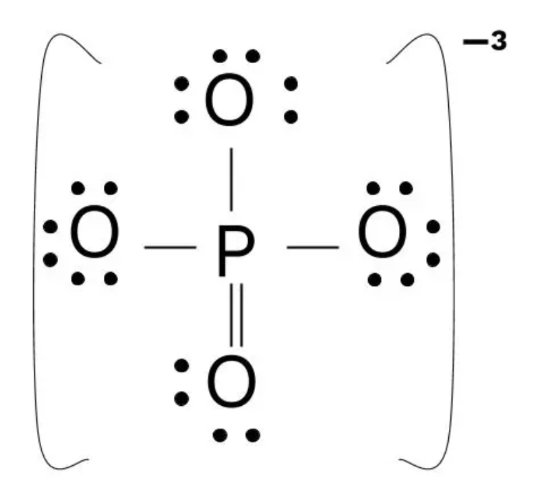
Instead of having no atoms with a formal charge of 0, we now have two atoms with a formal charge of 0. This indicates that the electrons are correctly placed, resulting in a stable structure.
Stability Preferences:
- Structures with formal charge closest to 0 are preferred
- Any negative formal charge should be on the most electronegative atom
The phosphate ion also exhibits resonance, so you should draw all four possible resonance structures. The bond order for the P–O bonds in this ion is , reflecting that the bonds are stronger than a single bond but weaker than a double bond.
Quick Tip: A simple way to verify your formal charge calculations is to check that the sum of all formal charges equals the overall charge of the ion. Since three of the oxygen atoms each have a formal charge of , the total sum is , which matches the overall charge of the polyatomic ion.