
Introduction
Welcome to this article on Intermolecular and Interparticle Forces. In this article, we’ll explore the interactions between molecules and particles. We will explore some of the basics of different bonding and structures to see how these affect the interactions between molecules. We will dig deeper into these fundamental concepts in molecules, showing real-life world examples, and using your knowledge learned to do some practice questions.
Intramolecular vs. Intermolecular Forces
Most important thing to note: intermolecular forces are not the same as intramolecular forces. Intramolecular forces refer to the chemical bonds: the ionic, metallic, and covalent bonds that hold atoms together inside a compound or a molecule. Intermolecular forces are between molecules; they are used to determine how molecules behave when interacting with one another. Larger IMFs have consequences such as higher melting and boiling points, higher surface tension, higher heat of vaporization, increased viscosity, and increased vapor pressure (higher volatility).
Melting point refers to the temperature at which the rates of freezing and melting are the same. Boiling point refers to the temperature at which the rates of evaporation and condensation are the same. If there is the word “normal” that goes before melting and boiling points, it just means that the melting and boiling points are measured at an ambient (referring to the surroundings) atmospheric pressure of .
Surface tension is defined as the tendency of a liquid with strong IMFs to shrink to its lowest possible area. At the particulate level, a molecule within a liquid is pulled equally in all directions by its neighboring molecules. At the surface, the molecule is only subject to neighboring molecules pulling sideways and inward. The stronger the IMFs, the greater the inward pull. As a result, the liquid pulls itself to the tightest possible shape, usually a spherical shape, to minimize the surface area. Therefore, the stronger the IMFs, the higher the surface tension.
Heat of vaporization is the amount of heat necessary to boil one mole of a liquid. To transition from liquid to gas, the molecules must first break loose from the attractive IMFs. The stronger the IMFs, the more difficult it is for a particle to have enough kinetic energy to escape to the gas phase. Therefore, the heat of vaporization increases as IMFs are increased.
Viscosity refers to the stickiness of a liquid and its resistance to flow. At the particulate level, the flow of a liquid is measured by the ability of particles to slide past one another. As molecules of a liquid with high viscosity tend to stick to one another, the molecules are more likely to cling to each other. Therefore, the higher the IMFs, the thicker and more viscous the liquid becomes.
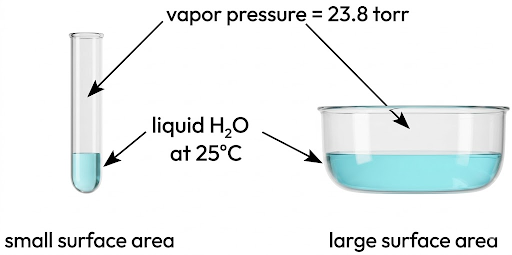
Vapor pressure is the pressure exerted by the gas above the phase boundary between liquid and gas phases. While vapor pressure is independent of the surface area exposed, amount of liquid, or the external pressure, it is affected by temperature and the strength of IMFs.
Lastly, to better understand how IMFs work, we need to learn about partial charges, denoted by for a partial positive charge and for a partial negative charge. The former, , is used when a certain part of the molecule lacks electron density. The latter, , is used when a certain part of the molecule has excess electron density.
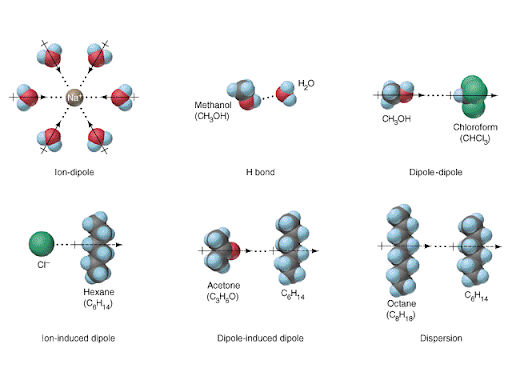
In total, there are of five types of intermolecular forces (IMFs) that you have to know. They are:
- London Dispersion Forces (LDFs)
- Dipole-dipole interactions
- Hydrogen bonds
- Ion-dipole interactions
- Dipole-induced dipole interactions.
Types of Intermolecular Forces (IMFs)
London Dispersion Forces
London Dispersion Forces (LDFs) exist among all molecules. They result from temporary shifts in electron clouds that create instantaneous (temporary) dipoles. As the molecule increases in size, the size of the electron clouds increases, which results in a stronger LDF. In large molecules, LDFs tend to be the strongest IMF.
To understand why LDFs have the largest influence in IMFs for larger molecules, we must look at polarizability. Polarizability is the tendency of molecules to generate induced electric dipole moments when subjected to an electric field. Polarizability of a molecule increases with the molar mass in general, because the presence of additional electrons implies a bigger size of the electron cloud. Additionally, the strength of the LDF increases with a larger surface area of contact between molecules because of the larger polarizability.
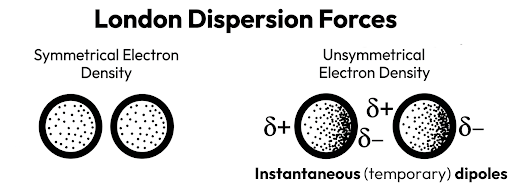
As evidenced by the diagram above, the temporary (fluctuating) dipoles caused by random distributions of electrons in the electron clouds are responsible for the attractive dispersive forces between molecules.
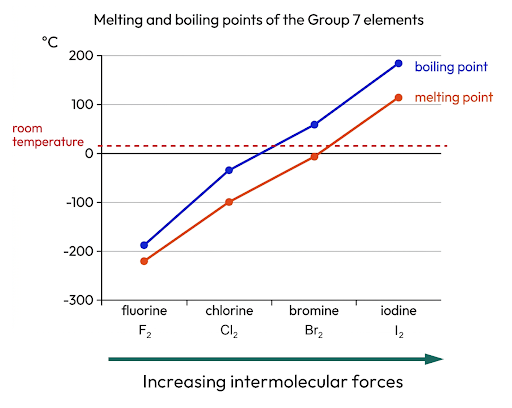
The larger the size of the molecules, the larger the electron clouds, and the larger the IMFs. The increased IMFs result in higher melting and boiling points for the case of molecular halogens.
Lastly, the effect of LDFs is enhanced by the presence of pi bonds. This is due to the nature of pi bonds, which are more diffuse than sigma bonds and occupy more space than the sigma bonds. The larger relative size contributes to larger polarizability, hence an increased LDF.
Dipole-Dipole Forces
Polar molecules have a nonzero net dipole moment resulting from an unequal distribution of electron density within the molecule. This unequal charge distribution creates permanent dipoles, in which one region of the molecule carries a partial positive charge () and another carries a partial negative charge (). A dipole moment is a vector quantity, meaning that it has both magnitude and direction, and it is represented by an arrow pointing from the less electronegative atom toward the more electronegative atom.
To determine whether a molecule is polar, both bond polarity and molecular geometry must be considered. A large difference in electronegativity between bonding atoms results in polar bonds. In addition, an asymmetrical molecular shape may prevent the individual bond dipoles from canceling out. Meanwhile, highly symmetrical molecules often have bond dipoles that cancel completely, resulting in a net dipole moment of zero despite the presence of polar bonds. The magnitude of a molecular dipole moment generally increases with increasing electronegativity differences between atoms and with molecular geometries that lead to an uneven charge distribution. The polarity of a molecule is determined by the vector sum of all individual bond dipole moments, which may produce either a nonzero or zero net dipole moment.
Examples of molecules with nonzero net dipole moment include ammonia (, water (), and dichloromethane ().
Examples of molecules with zero net dipole moment include diatomic fluorine(), carbon tetrachloride () and carbon dioxide().
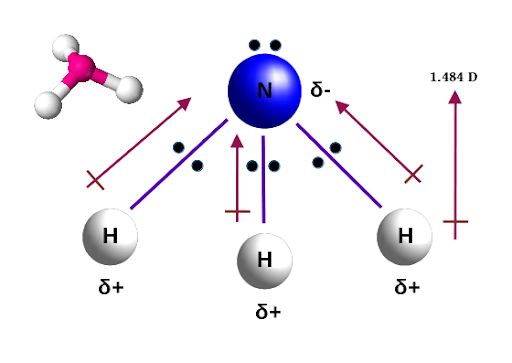
Image Source: NH3-Dipole-Moment | WikiMedia Commons

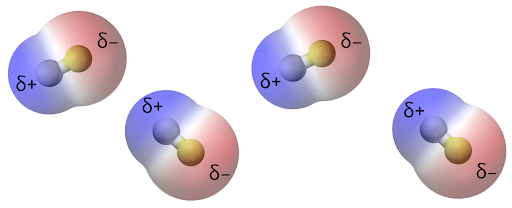
Dipole–dipole interactions arise when polar molecules align themselves so that the partially positive () region of one molecule is electrostatically attracted to the partially negative () region of a neighboring molecule. These IMFs originate from the coulombic attraction between permanent dipoles and are generally stronger than LDFs shown by individual dipoles themselves, although they are significantly weaker than covalent bonds or ionic bonds. Dipole–dipole interactions usually occur between polar molecules and are always attractive. The overall strength of the dipole-dipole interactions depends on several factors, including the magnitude of the molecular dipole moments and the relative orientation of the molecules. In general, molecules with larger dipole moments and more favorable alignments experience stronger dipole–dipole attractions. An example of gaseous hydrogen fluoride is shown to illustrate a special case of dipole-dipole interactions and to provide a segue to the next subtopic, which will be on hydrogen bonding.
Hydrogen Bond
Hydrogen bonding is a special type of dipole-dipole interaction. Hydrogen bonds are defined as an intermolecular force that forms between hydrogen atoms covalently bonded to the highly electronegative atoms (, , and ) and the negative end of a dipole formed by the electronegative atom (, , and ) in a different molecule or a different part of the same molecule.
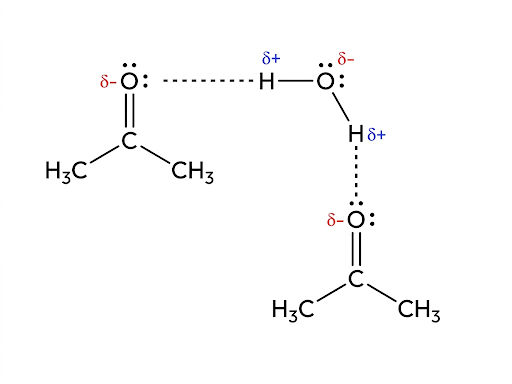
In hydrogen bonding, there are hydrogen-bond acceptors and hydrogen-bond donors. On one hand, the hydrogen-bond acceptors are lone pairs on oxygen, nitrogen, or fluorine atoms that accept the partially positively charged dipole on hydrogen. On the other hand, the hydrogen-bond acceptors are hydrogen atoms that are covalently bonded to oxygen, nitrogen, or fluorine atoms.
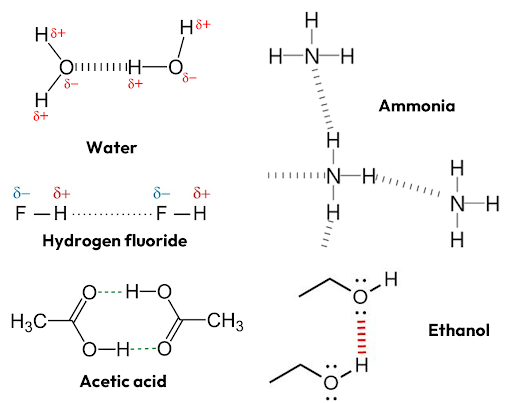
Examples of pure substances that have hydrogen bonds include:
- Water ()
- Ammonia ()
- Hydrogen fluoride ()
- Acetic acid ()
- Ethanol ()
Examples of solutions that show hydrogen bonding include:
- Glucose() dissolved in water
- Ethanol () in water
- Ammonia in water
- Amino acid chains (polypeptides) in water
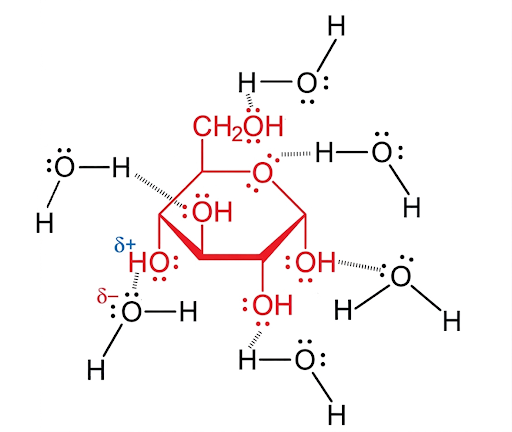
It is important to note that hydrogen bonding is an intermolecular force, not an intramolecular force.
Ion-Dipole Forces
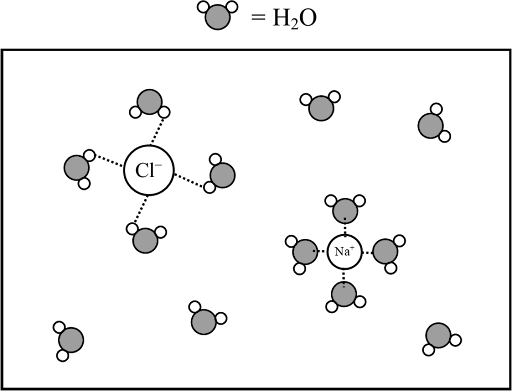
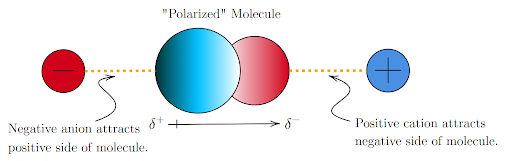
Ion-dipole forces are electrostatic attractions between an ion and a polar molecule. Since polar molecules have permanent dipoles and ions have full charges, these two interact very strongly. This type of interaction is often seen when an ionic compound such as table salt ($@\ce{NaCl}) dissolves in water. Ion-dipole forces are essential for dissolving ionic compounds in polar solvents like water. It is important to note that the shorter the distance and/or the larger the charge density, the stronger the ion-dipole interactions. Finally, the strength of this force plays a key role in determining solubility, because stronger ion-dipole interactions make a substance more likely to dissolve.
Dipole-Induced Dipole Interactions
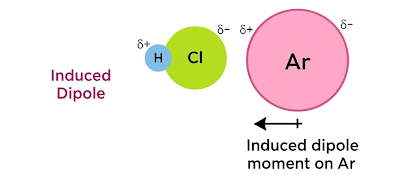
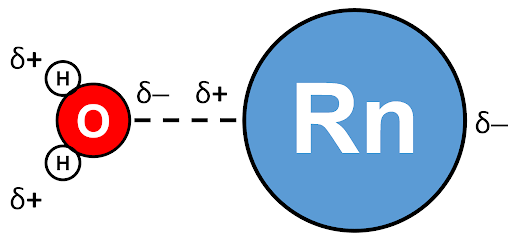
A dipole-induced dipole interaction occurs when a permanent dipole (such as the ones discussed in dipole-dipole interactions and hydrogen bonding) induces a temporary dipole nearby it. This interaction is always attractive. Two examples of dipole-induced dipole attractions are shown:
Noncovalent Interactions
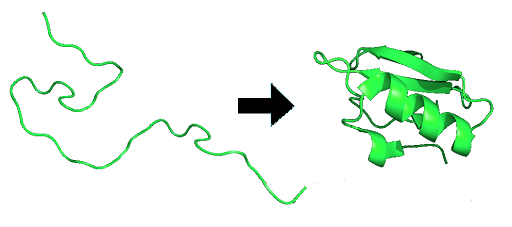
Noncovalent interactions involve not only IMFs, but also the interactions within the same molecule. An example of this is a polypeptide chain (protein) folded in certain ways, two of the most prominent ones being alpha-helices and beta-pleated sheets. Although these interactions are not considered intermolecular forces as they occur within the same molecule, these are still part of noncovalent interactions, which is a broader term that contains intermolecular forces (IMFs).
Ranking of Intermolecular Forces
We can rank the IMFs in the following list in the order of decreasing strengths.
Ion-Dipole interactions > Hydrogen Bonding > Dipole-Dipole > Dipole-Induced Dipole interactions
Since the size of LDFs depends on the size of the molecule, we have to separate LDFs into its own category. This is because, for large molecules, the attractions due to LDFs may exceed dipole-dipole interactions. An example of this is carbon tetrachloride () and hydrogen chloride (), wherein $ actually has a higher boiling temperature than .
Practice Problems
For question 1-8, indicate the strongest type of intermolecular forces shown by the following substances.