
Introduction
Welcome to article 3.2 on Properties of Solids. In this article, we will cover the relationship among the microscopic properties of substances, different interactions between particles, and various structures of solids. You will learn real-world examples throughout the lesson and later test your knowledge with some practice questions.
Types of Solids
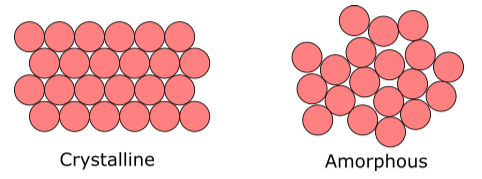
In AP Chemistry, there are two main forms of solids:
- Amorphous: considerable disorder (randomness) in their particle structure, real life example is glass
- Crystalline: Tightly packed particles in a more rigid arrangement, such as (table salt)
- When describing crystalline solids, the term lattice structure is used, referring to a 3D grid that describes the locations of particles within the solid.
Types of Crystalline Solids
There are 4 types of crystalline solids, with each having its own distinctive characteristics.
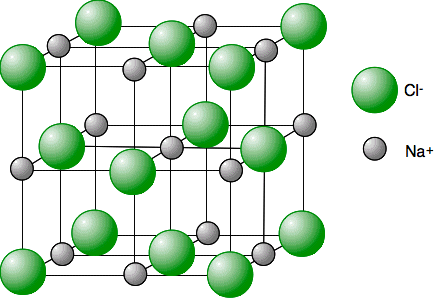
Ionic Solids have ions held together at lattice points, usually held together by strong ionic bonds (like ). Some characteristics of ionic solids are that they are held together by opposite charges, they have high melting/boiling points, they are hard/brittle, and they ONLY conduct electricity in the aqueous/molten state(since electrons become delocalized).
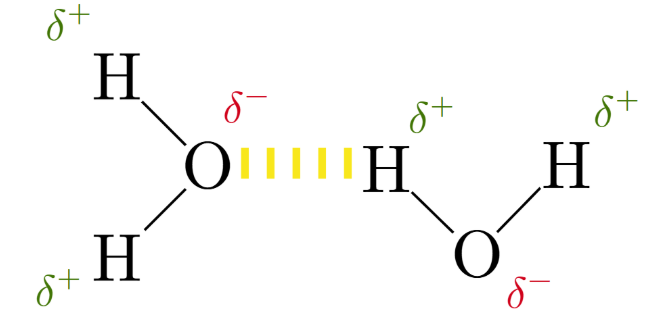
Molecular Solids have covalently bonded molecules at each of the lattice points(held together by IMFs (intermolecular forces) with examples such as sugar and ice. However, there are two types of molecular solids, with dipoles or w/o dipoles. Solids with dipoles tend to have dipole-dipole forces that are stronger than London dispersion forces, but hydrogen bonding is stronger than dipole-dipole forces. Additionally, the stronger the intermolecular force, the higher the melting/freezing point. On the other hand, solids without dipoles are usually gases at 25C (standard temperature for AP Chemistry); they only have London dispersion forces, the strength of the IMF (intermolecular force) depends on the amount of electrons/size of the molecule, and larger molecules like don’t have dipoles but still remain solid.
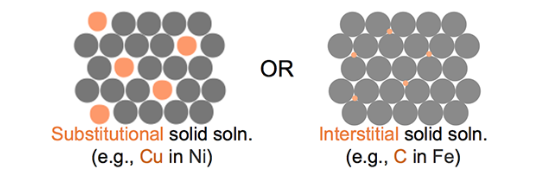
Metallic Solids are solids that have delocalized electrons (freely moving around), which allows metals to be good conductors of heat/electricity (e.g. , , any metallic element). Think of delocalized electrons as the “sea of electrons” since they can move around freely and can move from atom to atom, which causes their properties to be reshaped. Additionally, metallic solids are malleable (the ability to be hammered into sheets) and ductile (the ability to be made into a wire). Metals can also mix with one another to form an interstitial alloy, where the smaller metal particles fit into the gaps of the larger metal particles, or if they are around the same size, they form a substitutional alloy where the particles replace one another(shown below)
Network Covalent Solids have atoms that are together in large networks by extremely strong covalent bonds (e.g. diamond, graphite, and silicon dioxide). Carbon is a special network solid with three different allotropes (forms): coal, diamond, and graphite. Diamond acts as a heat/electricity insulator due to its structure, whereas graphite on the other hand, despite the same composition, conducts electricity since its particles are arranged in layers, allowing them to slide past one another (as shown below).
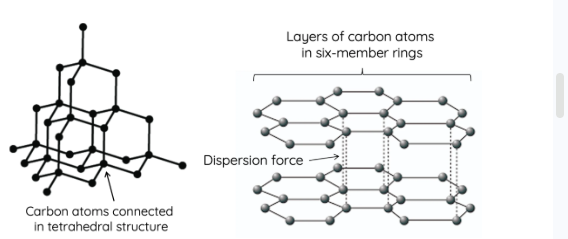
Although a poor conductor of electricity, graphite allows electricity to pass through to a certain extent because electrons can pass through the flat layers of carbon (delocalization of electrons), while in diamond the electrons are trapped in a fixed lattice structure.
Summary
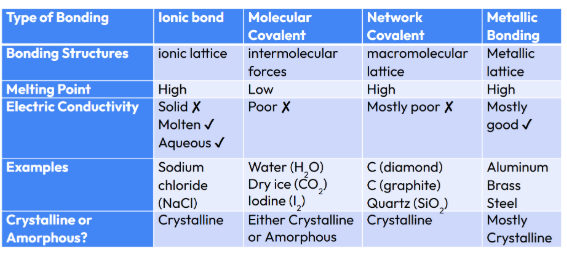
The chart below offers a summary of the characteristics of different kinds of solids mentioned in this article.
Practice Problems
Further Readings
https://www.chem.fsu.edu/chemlab/chm1046course/solids.html
https://study.com/learn/lesson/crystalline-amorphous-solids-properties.html