Introduction
Welcome to this article on Solids, Liquids, and Gases. In this article, we will explore how physical states of matter (solid, liquid, and gas) relate to particulate-level models. We will explore how intermolecular forces influence properties like boiling point and melting point and understand the different molecular arrangements found in solids. There will be real-world examples to help understand these concepts, and we will end with practice questions to apply your knowledge.
Solids
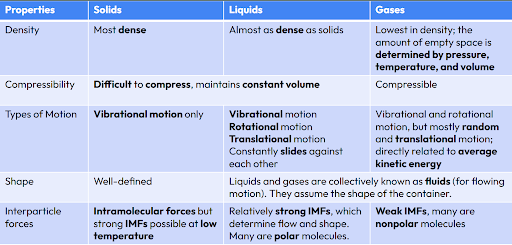
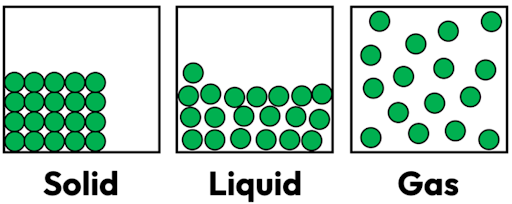
We have seen earlier in Topic 3.2 that solids can exist as crystalline or amorphous. In crystalline solids, their particles are arranged in a regular three-dimensional structure. In amorphous solids, the particles lack an orderly pattern and lack a repeating pattern in their arrangements. In both, however, the motions are very limited because they are all packed together, with most movement being vibrations. This arrangement means there is no translational movement within particles of the solid. The structure depends on interparticle interactions (like IMFs) and the packing efficiency of the particles.
Liquids
In liquids, particles also tend to be in close contact; however, the liquid particles have a lot more freedom to slide across each other, while solids do not show this kind of translational motion. The liquid particles are always in constant motion, mostly through collisions and sliding past one another. The way liquid particles move depends on factors such as polarity, hydrogen bonding, and temperature, all of which are influenced by the strength of the intermolecular forces (IMFs).
Both solids and liquids have similar molar volumes because their particles are always in close contact. Because both solids and liquids maintain a closed, compact arrangement, they are sometimes described as condensed matter or condensed phases.
Gases:
In the gaseous phase, particles are in constant, random, and continuous motion and are spaced far apart compared to their molecular size. They undergo frequent collisions, and their motion depends on conditions such as temperature, pressure, and volume. Unlike solids and liquids, gases experience the weakest intermolecular forces (IMFs), allowing the particles to move freely with minimal intermolecular attraction. As a result, gases do not have a definite shape or volume and instead assume the shape and volume of their containers under the given conditions of temperature, pressure, and volume.
Solids and Liquids Behave Differently than Gases:
Solids and liquids behave differently from gases because, with their particles being closer together, intermolecular forces play a bigger role in determining the molecular pressure and spacing. The stronger the IMFs, the more tightly and compactly molecules are held together, which influences their properties. The stronger the IMFs, the more energy required to overcome the energy required to move particles away from one another.
Physical Properties Affected by Intermolecular Forces
| Property | Effect of High IMFs | Explanation |
|---|---|---|
| Boiling Point | Increased | As molecules experience larger intermolecular forces, the heat energy required (temperature) to overcome the intermolecular forces increases. |
| Melting Point | Increased | In addition to the strengths of IMFs, certain patterns in molecular packing and molecular symmetry also determine the melting points, because the melting point is determined by how well the molecules can fit into the lattice structure. |
| Viscosity | Increased | A stronger IMF increases the resistance to flow between the molecules. This makes the liquid thicker and stickier, |
| Vapor Pressure | Decreased | The particles on the surface of a liquid are less likely to attain enough translational kinetic energy to escape to the gas phase. |
| Surface Tension | Increased | Stronger intermolecular forces (IMFs) result in a greater net inward pull on the surface molecules. As the magnitude of these cohesive forces increases, the liquid minimizes its surface area more effectively, resulting in higher surface tension. |
Summary
A brief summary of what we discussed in this article follows in the table below.