
Introduction
Welcome to AP Chemistry Topic 3.4 on Ideal Gas Laws. By the end of this lesson, you will have learned how to explain the relationship between the macroscopic properties of a gas or mixture of gasses using the Ideal Gas Law. You will also learn that the partial pressure of a gas is proportional to its mole fraction (represented by the symbol ) using Dalton’s Law and how graphical representations of pressure, moles, temperature, and volume can describe behavior.
The Ideal Gas Law:
The Ideal Gas Law is an equation used to relate pressure (P), volume (V), temperature (T), and moles(n). The Ideal Gas Law is represented by the equation . The ideal gas law assumes that a gas uniformly fills any container (meaning it is evenly dispersed), it mixes completely with any other gas, and it exerts pressure on its surroundings. However, it assumes that gas molecules have no volume and do not exert IMFs on another. The Ideal Gas Law is most accurate at high temperatures because the strength of IMFs decreases as temperature decreases AND low pressure since the attractive IMFs become negligible. Lastly, remember to only use the Ideal Gas Law for gases.
Whenever you are using the ideal gas law, some units must always be expressed in certain units:
- Volume must always be converted to Liters
- Temperature must always be in Kelvin (from celsius add to your original number, e.g. = ).
For pressure and ideal gas constant (R), the units change based on the wording of the problem:
- If a problem asks for the pressure in atm, then you would use the ideal gas constant of .
- You would use this variant of the ideal gas constant, , if you are trying to find energy (in Joules).
- You would use this variant of the ideal gas constant, , if the pressure is given as kPa.
- Pressure can be converted into the following: = = =
- Standard States (also known as Standard Ambient Temperature and Pressure) = (), , and (1 mole per liter, or 1-molar concentration).
- Standard Temperature and Pressure (STP) = () and
Formulas Within the Ideal Gas Law
Within the ideal gas law, there are several formulas that you can use depending on the situation or variables (temperature, pressure, moles, mass, volume, or density) given by a problem.
| Boyle’s Law | Temperature and number of moles are constant; pressure and volume are inversely related. | or | |
| Charles’ Law | Pressure and number of moles are constant; volume is proportional to temperature (in Kelvin). | or | |
| Gay-Lussac’s Law | Volume and number of moles are constant; pressure is proportional to temperature (in Kelvin). | or | |
| Combined Gas Law | Moles constant; relates pressure, volume, and temperature changes. | | |
| Avogadro’s Law | Temperature and pressure constant; volume proportional to moles of gas. |
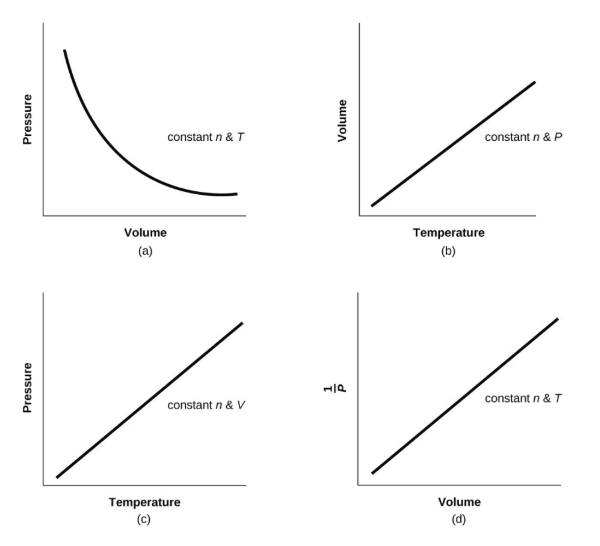
Image Source: Relating Pressure, Volume, Amount, and Temperature: The Ideal Gas Law | LOUIS Sandbox
Depiction of relation between ideal gas law variables at varying conditions: a) Boyle’s Law, b) Charles’ Law, c) Gay-Lussac’s Law, and d) Combined Gas Law.
On the AP exam, do not expect questions that ask you the name of each law that governs gases. Rather, expect questions that test you on the applications of such laws. Some problems can also ask you about density () or molar mass (). For these problems you can still use ideal gas law with minor algebraic manipulations. For example, if you were asked to provide a molar mass, you would rearrange the Ideal Gas Law in the following way:
Alternatively, if you were asked to find the density, you would need to rearrange the Ideal Gas Law equation in this way:
The Dumas Method of Determining Molar Mass
The Dumas Method allows us to find the molar mass of a volatile liquid. To perform the experiment, we pour enough liquid into a pre-weighed Erlenmeyer flask of known volume and cover the flask with aluminum foil with a small pinhole.
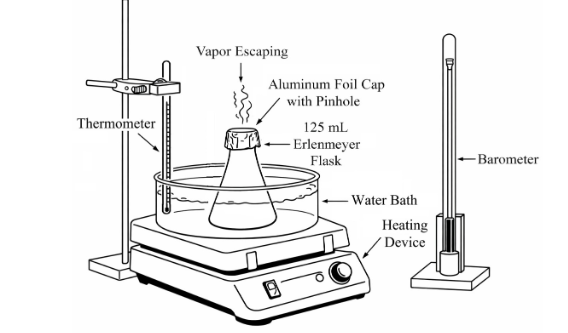
We then put the flask into a hot water bath to drive out the air. After all of the liquid sample has turned into vapor, we remove the heating and let the Erlenmeyer flask cool down to condense. The Erlenmeyer flask containing the condensed liquid is then weighed. Only the mass of the condensed liquid is important. As long as we put sufficient liquid in the Erlenmeyer flask, it is okay to skip the recording of the initial mass of the volatile liquid.
Let’s try a guided example for Dumas’s method. Consider the following data table.
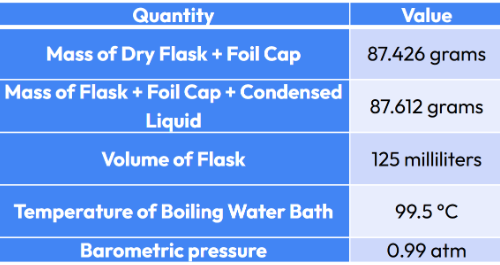
Answer the following questions.
1. What is the mass of the condensed liquid?
Answer: The mass of the condensed liquid is just .
2. What is the number of moles of the liquid, using the Ideal Gas law PV = nRT?
Answer:
3. What is the molar mass?
Answer: .
Dalton’s Law of Partial Pressures
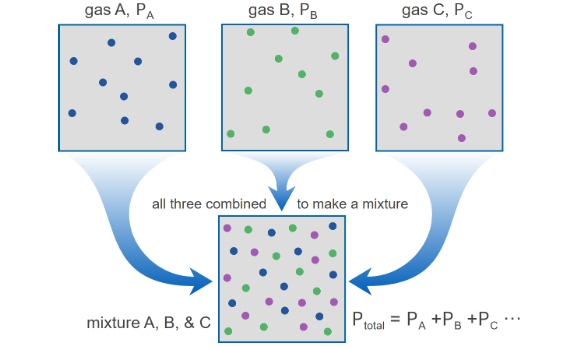
The ideal gas law is used for one species of a gas, whereas Dalton’s Law of partial pressures is used for multiple species of gases in the same container. Dalton’s Law of partial pressures states that the pressure exerted by each component of the gas is independent of the other components. Within Dalton’s Law there are two formulas to use:
- To find the total pressure of the system, add the pressure of each gas to find the total pressure; in other words, .
- The other formula is , which is used to find partial pressure exerted by the -th gas, where represents the moles of the -th gas divided by total moles of kinds of gas, a variable that is known as the mole fraction, which is written as .
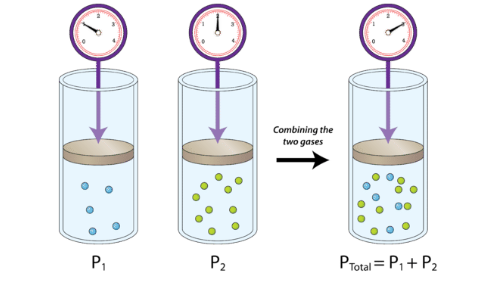
Representation of Dalton's Law
Image Source: Dalton's Law of Partial Pressures - Equation, Definition and Example | CK-12 Foundation
Practice Problems
Further Reading
9.2 Relating Pressure, Volume, Amount, and Temperature: The Ideal Gas Law | Chemistry