
Introduction:
Welcome to this article on AP Chemistry 3.7: Solutions and Mixtures. In this article, we will explore the concept of combining substances to form homogeneous and heterogeneous mixtures. We will examine the idea of “like dissolves like” to guide why some solutions form while others don't. We will end this off with concepts through practice questions to strengthen our understanding of how these solutions and mixtures behave when combined.
Defining Solutions
A solution is a homogeneous mixture that maintains a uniform composition and consistent properties throughout the entire sample. Counterintuitively, solutions are not limited to a liquid solvent with a dissolved substance. Solutions can form between many different phases, including two solids, two gases, or even a solid and a gas, as long as the mixture remains homogeneous.
Solute is the substance that is dissolved. Solvent is the substance that dissolves the solute. Whichever substance has a greater number of moles is the solvent.
Heterogeneous mixtures can easily be separated, usually through filtration, while homogeneous mixtures (solutions) dissolve and irreversibly mix. It is usually very difficult to completely separate a solution into its pure substituents, although separation methods like distillation and chromatography exist.
While there are numerous types of solutions (the most important example of which is metallic alloy), we will mainly focus on aqueous solutions, which means that a water-soluble solid or a liquid miscible (capable of being mixed) with water is dissolved in excess water.
Heterogeneous vs Homogeneous:
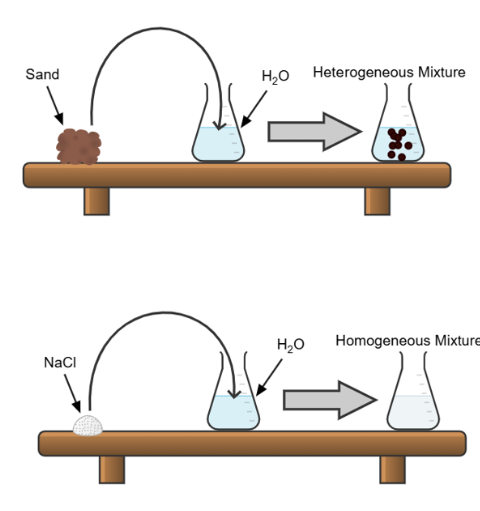
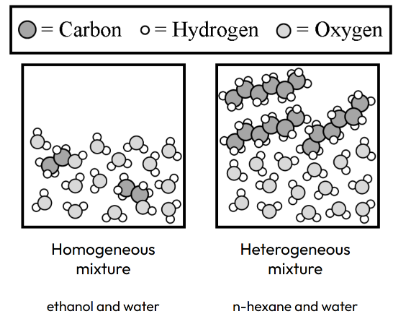
What is the difference between homogeneous and heterogeneous? Homogeneous mixtures are solutions by definition, and solutions have the same composition throughout. Heterogenous mixtures have differences in composition, which include but are not limited to consistency and density.
Defining Molarity
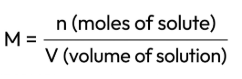
The equation for molarity (symbolized or ) shows the concentration of a solution, which is given by the moles of solute divided by liters of a solution. The “solute” is the substance being dissolved, while the solution is the total volume after the solute has been mixed with the solvent. The denominator refers to the volume of the entire solution, not just the volume of the solvent being added. This means that the volume occupied by the solute must also be considered. A volumetric flask is a useful glassware that assists the dilution of a solution, which is a method of decreasing the concentration of solutions by adding water. In addition, the volume must be in liters (), so be mindful of the units!
Molarity is slightly dependent on temperature since the volume of water is dependent on temperature. To circumvent this issue, chemists also have another measurement called the molality, but this is outside the scope of AP Chemistry.
Dilutions and Stock Solutions
A dilution is a technique that decreases the strength of a solution with a higher concentration by adding water. The formula for dilution is expressed as: . This equation arises from the conservation of mass, where the number of moles of a chemical at the start of the dilution must remain the same after the dilution. In this equation, you must make sure that is the total volume of the final solution, not the volume of water added to dilute the solution.
A stock solution is a highly concentrated solution that sits on the chemistry laboratory shelf that may be used to generate solutions of weaker concentrations by serial dilutions. It is convenient to store stock solutions at high concentrations because a highly concentrated stock solution occupies less volume and is easy to store.