
Introduction:
Welcome to AP Chemistry Topic 3.6 on Deviations from Ideal Gas Law. In this lesson, you will learn the relationship among non-ideal gas behaviors, volumes, and intermolecular forces (IMFs). You will also learn how the ideal gas law does not satisfactorily explain the behavior of actual gases, as deviations can occur from conditions such as IMFs between molecules.
Review of Ideal Gas Law
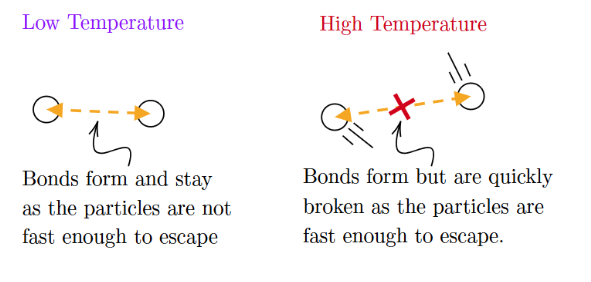
As covered in Topic 3.4, the ideal gas law () models the behavior of gases under specific conditions. This model assumes that gas particles have negligible volume and experience no intermolecular forces (IMFs). However, the ideal gas law is only an approximation to the real gases; in other words, the ideal gas law deviates from reality when gas particles occupy a significant fraction of the container’s volume or when attractive IMFs become significant. All real gases exert IMFs, so the conditions that best approximate ideal behavior are high temperature and low pressure. High temperature favors ideality because the high kinetic energy of the particles overcomes attractive IMFs. Low pressures result in the system approaching ideality because the particles are spaced far apart, making their individual volumes negligible when compared to the empty space of the container.
The Behavior of Real Gases and Graphical Analysis
As mentioned earlier, no gas behaves ideally, mainly due to the volume of the particles and the influence of IMFs. The behaviors that cause the deviations are listed below:
- At low temperatures, particles move more slowly, increasing the significance of intermolecular forces and violating the assumption that no attractive forces are present.
- At high pressures, particles are forced closer together, so their finite volume becomes significant relative to the container volume, violating the assumption of negligible particle volume.
- Due to intermolecular attractions, real gas particles strike the container walls with less force and frequency than ideal particles would. This effect causes the observed pressure of a real gas to be lower than predicted by the ideal gas law at moderate pressures.
- Conversely, at extremely high pressures where the volume of the particles themselves is no longer negligible, the particles have less "free space" to move. This overcrowding causes the measured pressure to be higher than predicted by the ideal gas law.
The following graph provides another look at the differences between a real gas and an ideal gas.
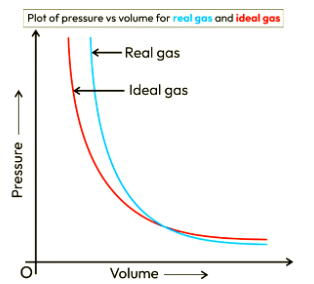
Two main features of the graph above include:
- At the far left (high pressure): The blue line (representing a real gas) is to the right of the red line (representing an ideal gas). This shows that for a given pressure, the real gas occupies a larger volume than predicted because the molecules themselves occupy physical space. To visualize this, draw a horizontal line and compare the volumes.
- At lower pressures (where the lines cross): You can see the real gas volume actually dips slightly below the ideal line due to the attractive IMFs pulling the particles together.
Summary
The key take-home messages for this lesson are:
- Gases at lower pressures and higher temperatures deviate the least from ideal gas behavior.
- Gases that have relatively strong IMFs and/or large size deviate the most from ideal gas behavior.