
Introduction
Welcome to AP Chemistry 3.11: Spectroscopy and the Electromagnetic Spectrum. By the end of this topic you should be able to explain the relationship between a region of the electromagnetic spectrum and types of molecular or electronic transitions correlating to that region. In this article, we will examine the relationship between microwave, infrared, and UV/visible light with various electron transitions.
The Electromagnetic Spectrum
The electromagnetic spectrum is the range of all types of electromagnetic radiation, organized by their frequencies or wavelengths. Electromagnetic radiation is radiant energy that exhibits both wave-like and particle-like properties and travels through a vacuum at the speed of light. Forms of electromagnetic radiation include gamma rays, X-rays, ultraviolet (UV) light, visible light, infrared (IR) light, and radio waves. A trend throughout the electromagnetic spectrum is that as frequency and energy increase, wavelength decreases, and vice versa. The equations that illustrate this relationship are and . Combining these equations results in .
.png?alt=media&token=cf181155-3409-497b-ba0c-24cfbd30257d)
Image Source: The Electromagnetic Spectrum | LibreTexts Chemistry
Types of Electromagnetic Radiation and Spectroscopy
Spectroscopy is the study of how matter interacts with electromagnetic radiation. When atoms or molecules absorb or emit radiation of specific wavelengths, they undergo transitions between quantized discrete energy levels. Depending on the energy involved, these transitions may be electronic, vibrational, or rotational in nature. Analysis of the resulting absorption or emission patterns allows scientists to identify substances and determine their molecular structure.
.png?alt=media&token=40e2c0a3-add4-40f9-b97b-42bc4bdb22b5)
Data provided by Oklahoma State University, PES for Elements 1-21.
Image Source: PES Data | Oklahoma State University
- X-ray radiation has enough energy to remove electrons from atoms, including both valence electrons and tightly bound inner shell electrons. When a gaseous atom in its ground state is irradiated with X-rays, an electron may absorb enough energy to be ejected from the atom. The minimum energy required to remove an electron from a particular energy level is known as its binding energy (). One important application of X-ray radiation is Photoelectron Spectroscopy (PES), alternatively known as X-ray Photoelectron Spectroscopy (XPS). By measuring the kinetic energies of emitted electrons, PES provides information about the binding energies, electron configurations, and electronic structure of atoms and molecules.
.png?alt=media&token=53322dba-e1ae-4689-adcd-e7735a51ad0b)
To start some reactions, a high-energy light from the ultraviolet spectrum is required.
.png?alt=media&token=2a7b1de2-ca6c-4d3b-a4a0-1b79a00ecf61)
Image Source: Electronic Spectra: Ultraviolet and Visible Spectroscopy | LibreTexts Chemistry
Short Aside for the Description of the Image above:
A list of all possible orbital transitions due to ultraviolet and visible light radiation is displayed above. Electrons are sufficiently small particles that can also behave as a wave. Because of the wave-like behavior of electrons, the waves associated with different atoms can interact with one another when atoms approach each other. Orbitals are regions of space where there is a high probability of finding an electron. When atomic orbitals combine, they can form molecular orbitals that extend over multiple atoms. The asterisk (*) next to an orbital indicates that it is an antibonding orbital. Antibonding orbitals are formed when electron waves from different atoms combine out of phase, causing destructive interference. This destructive interference creates a node, a region between the nuclei where the probability of finding an electron is very low or zero. Because there is less electron density between the nuclei to hold the atoms together, electrons occupying antibonding orbitals destabilize the bond and weaken the attraction between the atoms. As more electrons occupy antibonding orbitals, the bond becomes weaker, and if enough antibonding orbitals are filled, a stable bond may not form at all.
- Ultraviolet (UV) and visible light radiation can promote electrons from lower-energy orbitals to higher-energy orbitals. In some cases, high-energy UV radiation can also break weak covalent bonds with relatively low bond dissociation energies. UV-Vis spectroscopy provides information about the energy differences between electronic energy levels and orbitals within atoms and molecules. One common application of visible light spectroscopy is the colorimeter, which measures the absorbance of colored solutions. The resulting data can be analyzed using the Beer-Lambert Law (c.f. Topic 3.13), which states that absorbance is directly proportional to the concentration of the absorbing species and the path length of the sample.
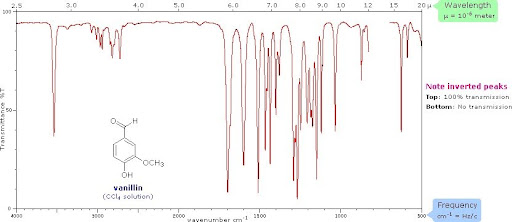
Image Source: Infrared Spectroscopy | Chemistry MSU
- Infrared radiation leads to transitions in molecular vibrational levels. The method of Infrared (IR) Spectroscopy provides us with the infrared spectrum, which can be used to deduce the types of bonds and bond order. Bond order is defined as the number of bonds, wherein a single bond has a bond order of 1, a double bond has a bond order of 2, and a triple bond has a bond order of 3.
.png?alt=media&token=18f8c451-b3eb-47e0-b267-fa3f7f65a77c)
Image Source: Vibrational Spectroscopy | LibreTexts Chemistry
-
Microwave radiation causes transitions in quantized rotational energy levels of molecules, and these transitions can be recorded in a rotational spectrum by using rotational spectroscopy. For a molecule to exhibit a rotational spectrum, it must possess a permanent dipole moment that can interact with the oscillating electric field due to the radiation. Rotational spectroscopy allows the analyses of bond lengths and molecular geometry of polar molecules.
- A real world example of microwave radiation is the heating of water in a microwave oven. In response to the microwave radiation, the water molecules continuously attempt to align with the direction of the oscillating electromagnetic field. This causes changes in rotational movement and spatial orientation of water molecules, and due to this movement, the water molecules constantly collide against one another, converting electromagnetic radiation into heat. Therefore, the average kinetic energy of the water increases, and the temperature rises.