
Introduction
Welcome to Topic 3.12 Article on Properties of Photons. In this topic, we will study the duality of the behavior of photons as waves and as particles and calculate the wavelengths, frequencies, and energy levels of different photons.
Wave-Particle Duality of Light
In 1900, Max Planck argued that energy due to electromagnetic radiation comes in discrete units of energy called “quanta.” Later, Louis de Broglie proposed in 1923 the dual property of light. This postulate argues that sufficiently small particles can behave as both a wave and a particle. In the form of an equation, de Broglie waves are expressed as , where is the Planck’s constant, , is the momentum of the particle, is the mass of the particle, is the speed of the particle, and is the wavelength of the electromagnetic radiation.
When electromagnetic radiation is described as a wave, it is characterized by its wavelength, defined as the distance between two successive crests or two successive troughs. The SI unit of wavelength is the meter ().
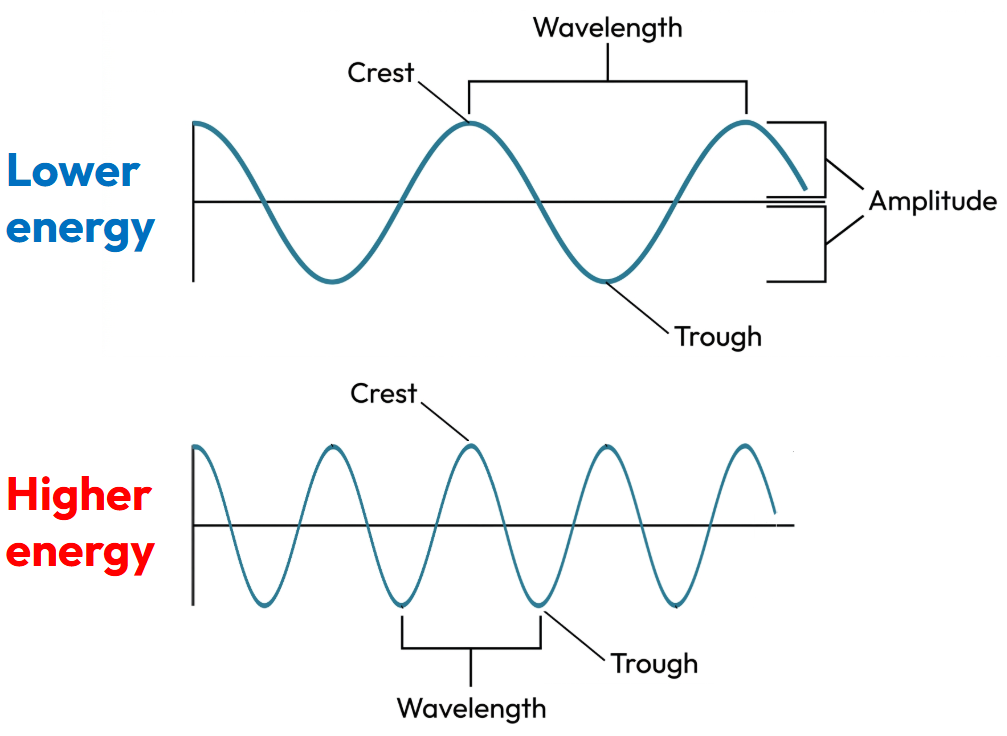
In this diagram, two waves of the same amplitude are shown. The wavelength is the distance between two crests or two troughs.
A wave of light also has a frequency, or the number of cycles of the wave per second. One way to visualize this is to think of the wave moving to the side at a fixed speed and count how many crests pass through a certain point in one second. It is clear that having crests closer together (that is, having a lower wavelength) will cause the frequency to be higher. This means that frequency is inversely proportional to wavelength. The units for frequency are cycles per second, or hertz. Hertz can be notated as either or .
What are Photons?
Electromagnetic radiation can also be described as a stream of particles called photons. Each photon possesses an energy that is directly proportional to its frequency. Atoms, ions, and molecules can absorb photons whose energies match the differences between their quantized energy levels. When a particle absorbs a photon, one of its electrons may be promoted from a lower-energy state to a higher-energy (excited) state. Eventually, the electron may return to a lower-energy state, releasing energy in the form of a photon or through non-radiative processes such as collisions with neighboring particles. In the last article, we saw a diagram of electronic transitions. These jumps in electron energy levels are due to photon absorption.
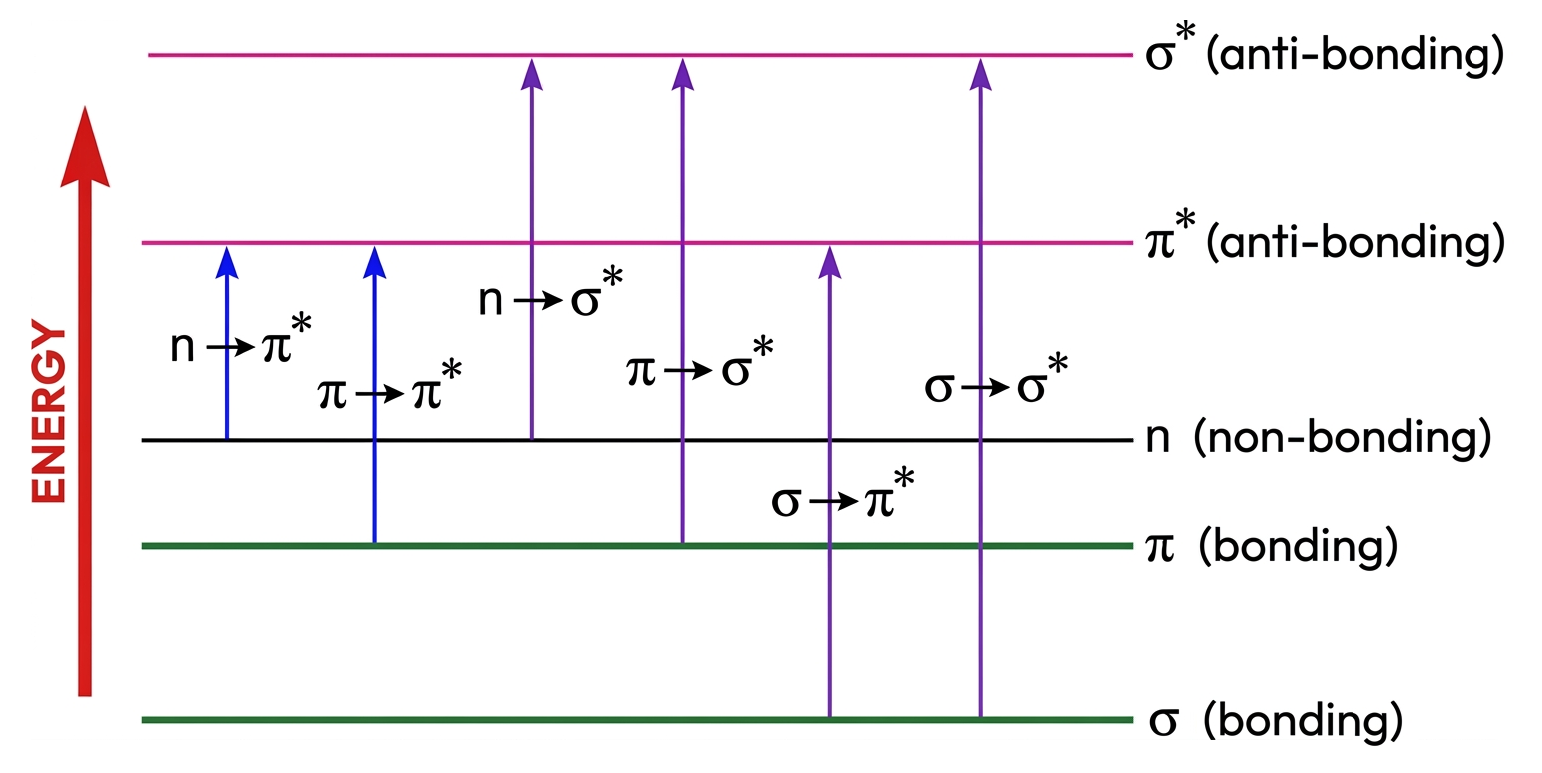
Photo Courtesy of: Organic Chemistry by Wade, Chapter 16 Section 9: Structure Determination in Conjugated Systems - Ultraviolet Spectroscopy.
Calculating with Photons:
The first formula you will need to calculate with is . is the speed of light, . The variable is wavelength, measured in meters; and is frequency, measured in Hz. Because the speed of light is constant, this equation lets you calculate the frequency if you have the wavelength, and the wavelength if you have the frequency. This equation is also able to represent the fact that wavelength and frequency are inversely proportional, which can be shown by rearranging the equation to be either or .
The other equation used for calculating is . is energy, measured in joules; is Planck’s constant, around ; and , similarly to the last equation, is frequency, measured in Hz. This equation is useful for calculating the energy of a photo given its frequency, and vice versa. If you are given the wavelength and want to know the energy, you will have to first use the equation to find the frequency, and then plug the frequency into to find the energy.
The last thing to note is that the equation or refers to the energy of one photon. To calculate the energy of one mole of photons, you would have to multiply the energy by the Avogadro’s constant, which is . You commonly see these questions in photoelectron spectroscopy free response questions.