
Introduction
Welcome to this module on AP Chemistry Unit 9.2: Absolute Entropy and Entropy Change. In this article, we look at quantitative aspects of entropy and learn how we can calculate values of entropy of the reaction by examining relevant data on standard molar entropies. In other words, we take advantage of the fact that entropy is a state function and calculate the entropy of reaction from the absolute standard molar entropies (entropies measured at , , and ) of the products and the reactants.
The Third Law of Thermodynamics
In the earlier module for unit 9.1, Introduction to Entropy, we learned that the entropy of a perfectly crystalline solid at an absolute temperature of 0 Kelvin is defined to have zero absolute entropy. This is the Third Law of Thermodynamics, which establishes the baseline for various entropies of substances.
Calculation of Entropy of Reaction
Similar to the heat of reaction calculated from the differences of enthalpies of formation, we can construct an analogous equation for the entropy of reaction, which can be calculated from taking the differences of absolute entropies of the products and reactants. We can write a similar equation for entropy because entropy is a state function, which means that only the products and the reactants contribute to the entropy of the reaction.
The equation reads: , where represents the stoichiometric coefficients of the respective products, represents the stoichiometric coefficients of the respective reactants, and represents the absolute standard molar entropy of the product or the reactant.
For practice problems, we are going to take a look again at the reactions for which we predicted the signs of the entropies of the reaction. The first one has been done for you.
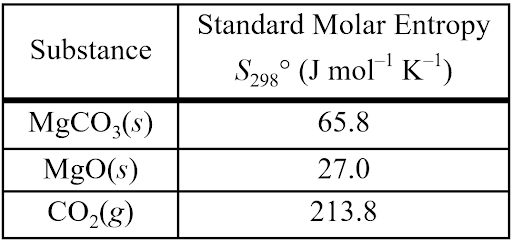
Example: Calculate the of the decomposition reaction of magnesium carbonate, . Use the data presented in the table above.
Solution: .
Practice Problems
NOTE: BlackLusterSoldier created all images in this section. All values are approximate.
Directions:
For Questions 1-3: Using the tables attached for the values of standard molar entropies, calculate the of the following reactions. Your units should be in .
For Questions 4 & 5: Using the tables attached for the values of standard molar entropies and the entropy of the reaction, calculate the missing of the following reactions. Your units should be in .