
Introduction
Welcome to this module on AP Chemistry Unit 9.1: Introduction to Entropy. In this article, we will study the qualitative aspects of entropy and how they relate to entropy as a measure of dispersal of matter and energy. Next, we will explore how entropy changes with phases, volume, and temperature. The conceptual explanation of entropy will conclude with the second law of thermodynamics.
Definition of Entropy
Entropy is a measurement of dispersal. In particular, entropy is related to the dispersal of matter and energy, which is determined by the microstates, or the number of possible arrangements that represent the energy of a system. If there are more microstates in a system, the system has a higher entropy. Mathematically, entropy is proportional to the logarithm of accessible microstates. In other words, the higher the number of accessible microstates, the higher the entropy. The equation for entropy with respect to the number of microstates reads as:
where is the entropy, is Boltzmann’s constant defined as , and represents the number of accessible microstates.
Absolute Entropy at Different Phases
The absolute entropy of a substance varies with different phases. The absolute entropy describes the entropy of a substance compared to the entropy of a perfectly crystalline solid at an absolute temperature of 0 Kelvin, which is defined to have zero absolute entropy. This baseline for entropy is a restatement of the Third Law of Thermodynamics. In terms of increasing absolute entropy, solids have the lowest absolute entropy, followed by liquids, followed by gases.
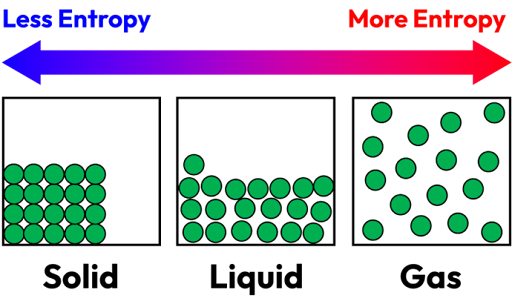
Image created by BlackLusterSoldier
Entropy of Gases
The entropy of gases is dependent on the volume that the gas particles occupy, at constant temperature. For gases occupying different volumes, we assume that in the order of increasing volume, and there are particles in total. An example below illustrates the rank in absolute entropy of three systems , and , in which system has the smallest entropy and system has the largest entropy out of all particle diagrams.

Image created by BlackLusterSoldier
Why does the entropy increase as volume increases? Increasing volume increases the space that gas molecules can move and thus increases disorder. Decreasing volume decreases the space that gas molecules can move and thus decreases disorder. For example, a gas expanding after being pumped into the vacuum experiences an increase in entropy. The trend of increasing absolute entropy as the volume increases at constant temperature confirms that entropy is a measure of dispersal of matter.
The Dependence of Entropy on Temperature
Higher temperatures imply higher absolute entropy. This is a direct result of Kinetic Molecular Theory (KMT) in Unit 3 Topic 5. According to KMT, gas particles at higher temperatures have a broader distribution of translational kinetic energy, and energy is more evenly distributed among all possible microstates. All of these points are supported by the Maxwell-Boltzmann distribution of gases, so KMT supports the observation that heating a gaseous substance increases its absolute entropy.
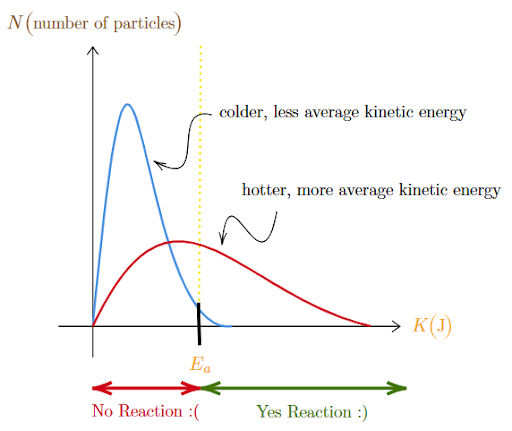
Image created by Raymond Zhang
Entropy of Reactions
To find if the entropy increases or decreases in a chemical reaction, consider the number of moles on each side of the reactants and products in the following order.
- Gases
- Aqueous species
- Liquids
- Solids
The side with the greater entropy is the side with the greater number of moles of gases, aqueous species, liquids, and solids. We will look at examples of chemical reactions with increasing entropy () or decreasing entropy ().
Entropy of reaction increases :
Entropy of reaction decreases :
Second Law of Thermodynamics
The second law of thermodynamics states that in an isolated system, entropy can never decrease. This means that:
For any spontaneous (irreversible) process,
While for a reversible process,