
Introduction
Welcome to the FiveHive article for Unit 2.1 of AP Physics 1!
In this article, we are covering systems, including definitions and core concepts, as well as the idea of a center of mass and how it could be utilized. Information from this topic will be used as a foundation for future topics.
As usual, we will only cover the topics included in the CED for unit 2.1.
Systems
A system in physics refers to an object or group of objects chosen for analysis.
A system in physics refers to an object or group of objects chosen for analysis. These objects may interact with each other and with things outside the system.
If all components of an interaction are within the system, that interaction is internal.
Depending on what you want to study, you can choose which objects to include or leave out from your system. For example, if you’re studying a person on a raft, you may define a system as:
- The person
- The raft
- Both together
Each choice will affect how the system is analyzed.
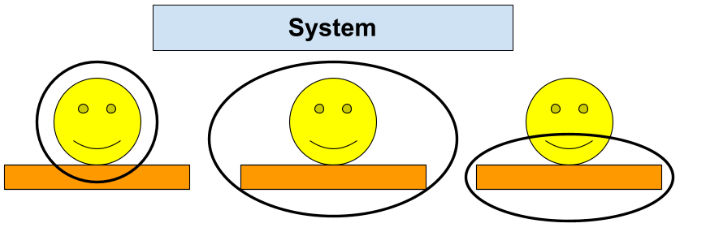
If multiple objects within a system move together or don't influence how the system interacts externally, they can often be treated as a single object. However, these objects may behave differently from each other and from the system as a whole.
The arrangement and connections between objects also play a role in how forces or energy (Which you will learn about in unit 3) are transferred within the system.
Even though a system is defined by what it includes, external forces can still influence its behavior and how calculations are carried out.
Center of Mass
The center of mass is the point that represents the average position of the total mass within a system.
As such, for many calculations, this position could be used as representation of the system and making the system a single object.
For a regular uniform object, it's typically the center of the object itself.
Similarly, objects with symmetrical mass distributions would have their center of mass along lines of symmetry.
However for irregularly shaped objects such as a baseball bat, the center of mass is skewed towards the side with more mass, which in this case is the barrel of the bat.
The equation is: , which means: , adding more objects as needed.
(Reference Table)
(Summation Expanded)
It must be noted that the center of mass may not always be within any object in a system, like how the center of mass of a hoop or ring would be in the empty space in the middle.