Introduction
Welcome to the FiveHive article for Unit 2.2 of AP Physics 1!
In this article, we will go over forces, which are a core concept used in future topics. They are also required for free-body diagrams. which are used to visualize forces on an object or system.
As usual, we will only cover the topics included in the CED for unit 2.2.
Forces
A force is a vector quantity measured in newtons () caused by interactions between objects and systems. A Newton in terms of other units is a , meaning it also has a direct correlation with the mass and acceleration of objects.
Forces can only be caused by interactions with other objects or systems, as an object cannot accelerate on its own. Standard interactions of forces like a push or a pull from objects touching each other are actually larger scale interactions caused by electric fields around atoms that prevent them from actually “touching” each other, and these are called Contact Forces.
Free-Body Diagrams
A free-body diagram is a sketch that shows all the forces acting upon a single, isolated object. If a system is being analyzed, a separate diagram must be made for each object in a system.
They are often used to figure out equations that are necessary to represent a situation.
Typically, free body diagrams are drawn from a single point representing the object, which is usually on the center of mass of the object with arrows representing force vectors extending out from that point in the direction that the force is applied.
Aligning the coordinate system to either be parallel or perpendicular to the object’s acceleration makes it easier to apply equations
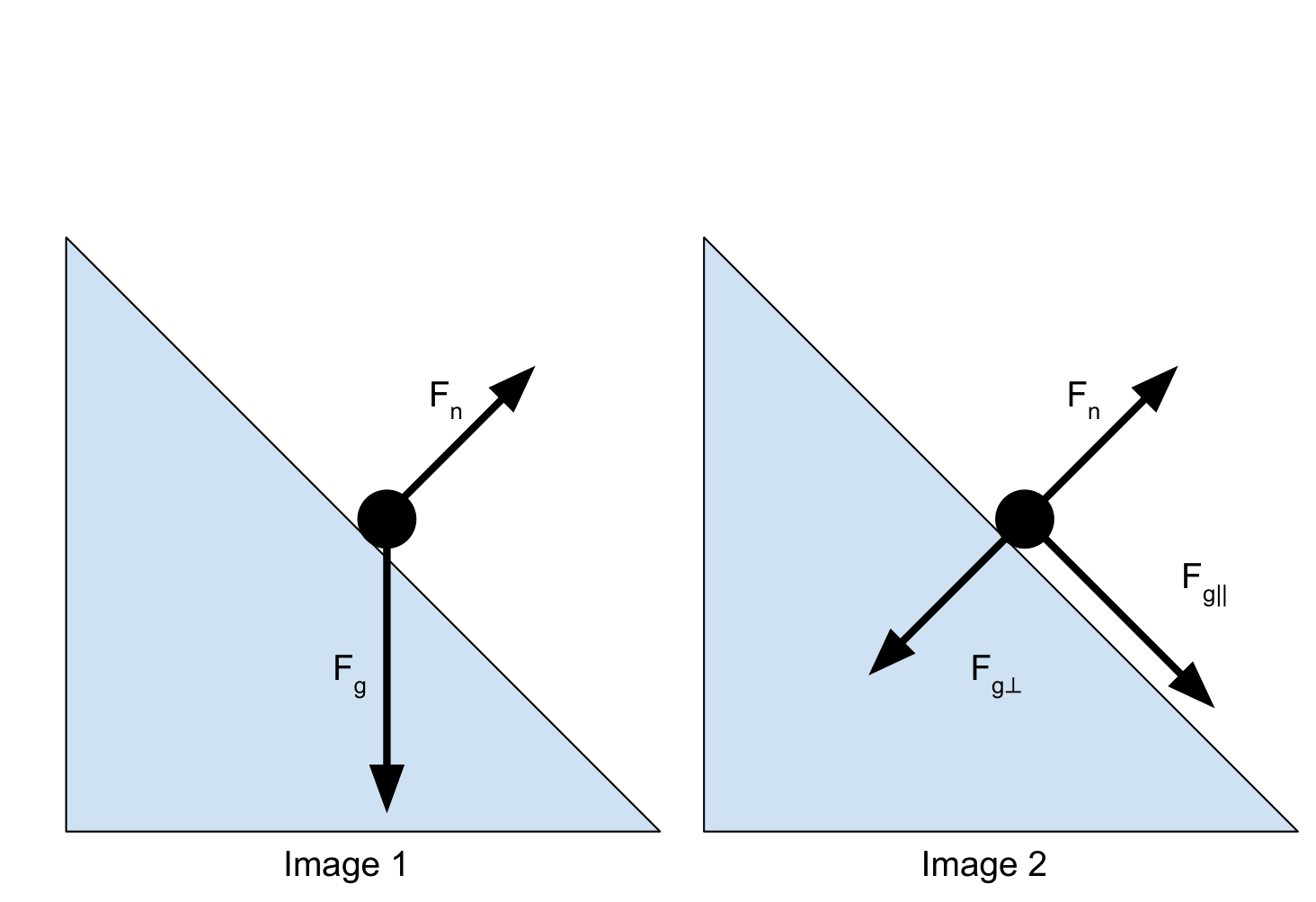
For instance, as the first diagram shown below is a commonly seen free body diagram of an object on an inclined plane. Since gravity and normal force (you will learn about this in future units) are the only forces present on the object, they are the only ones currently depicted. However, it is not very helpful for equations so it is often broken down into components, here depicted in the second diagram gravity broken into parallel and perpendicular components to utilize in equations. Note: You will only be asked to draw the forces (image one) on a free-body diagram and not components (image 2).