
Introduction
Welcome to the FiveHive article for Unit 2.3 of AP Physics 1!
In this article we are going over Newton’s Third Law, an important topic for conceptual understanding of future interactions, as well as flexible connectors that introduce tension as a force.
As usual, we will only cover the topics included in the CED for unit 2.3.
Newton’s Third Law
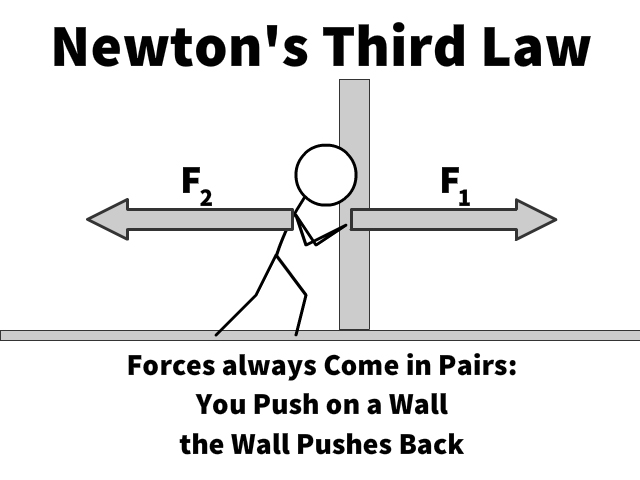
Newton’s Third Law is commonly described with one statement: Each action has an equal and opposite reaction. This means that if you were pushing on a wall with of force, the wall is also pushing back on you with of force. The two objects applying the equal and opposite forces are often called an action reaction pair.
In formula form, this can be written as . This states that object B’s force on object A is equal to object A’s force on object B. The negative sign is needed because it shows how the forces point in opposite directions.
This also means that within a system, if one object acts upon another object, the movement of the center of mass does not change as the forces are equal in magnitude and opposite in direction. This is otherwise known as an internal force, which is a force that is exerted from a system and only acts on objects within that system.
Tension
Tension is a force applied by flexible connectors. This could be string, rope, cable, chains, and similar objects. One feature that unites these objects is that they can only pull, not push as they would go slack upon any attempts to push using them.
In physics, an ideal string is one that does not stretch and has negligible mass. In these ideal strings, tension is equal throughout the string. However, in non-ideal strings that contain mass, tension could differ between parts of a string. For example, a dangling string would need to have the top portions exert more force than the bottom as it would need to support the weight of the string below it as well.
In this topic, you may also deal with ideal pulleys that redirect the positions of the strings. Ideal pulleys do not have mass, and allow string to change the direction of applied force without adding friction and decreasing its force.