
Unit 2.4 - Newton's First Law
Introduction
Welcome to the FiveHive article for Unit 2.4 of AP Physics 1!
This article covers Newton’s First Law of Motion, net forces, and the idea of translational equilibrium. These concepts will be used to reinforce ideas previously introduced in the course as well as prepare you for future topics.
As usual, we will only cover the topics included in the CED for unit 2.4.
Net Force and Translational Equilibrium
Net force is defined as the vector sum of all individual forces acting on a system. As such, to find the net force on an object or system, you would add up every force vector applied to said object or system. In other words, the sum of all the components and the sum of all the components together would result in the net force.
Translational equilibrium is a state where the net force acting on the system is (here represents a vector with all components being ), with the derived equation being . In most cases, you are given a system in translational equilibrium and need to solve for one or more of the forces acting upon the system. Below is an image demonstrating forces that could result in translational equilibrium.
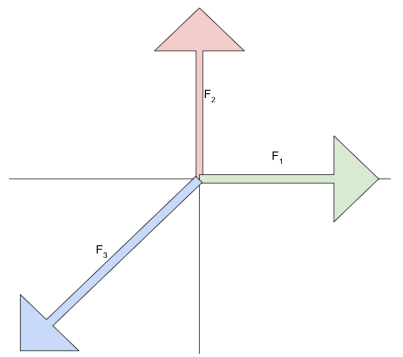
There may be situations where some forces are balanced in one direction, but not the other. In that case, the velocity will only change in the direction where the force was not balanced.
Newton’s First Law
Newton’s First Law of Motion is often simplified into one statement: Unless an external force acts upon the object, an object in motion stays in motion and an object at rest stays at rest. Therefore, as long as there are no forces acting on a system, its velocity will not change. This also applies to moving objects as if a box was sliding on a frictionless surface without obstacles, it would continue sliding forever at the same rate.
To confirm this, observers would need to be from an inertial reference frame (a reference frame that is unmoving or moving at a constant rate; for more information on reference frames, see Unit 1.4). Otherwise, if the observer was experiencing acceleration, the observer would see forces and accelerations acting upon objects that aren’t present.