Introduction
Welcome to the FiveHive article for Unit 2.7 of AP Physics 1.
This article will cover both types of friction: static and kinetic. You will learn the properties of both types of friction, as well as how to calculate them. This topic will show up often during the test, meaning you should thoroughly understand the material.
Kinetic Friction
Every time 2 contacting surfaces move relative to each other, kinetic friction is exerted. This friction force is exerted in the opposite direction to motion. Additionally, friction force does not depend on the contact surface area.
The formula for kinetic friction is , where:
is the force of kinetic friction on the object
is the coefficient of kinetic friction (Depends on the material properties of the 2 surfaces)
is the normal force– a force exerted on the object that is perpendicular to the surface in contact with the object and directed away from the surface
Static Friction
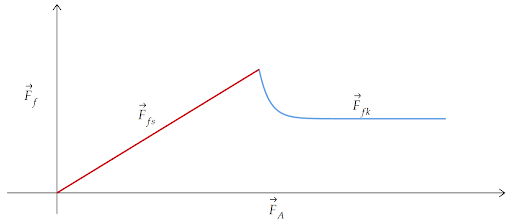
Static friction occurs between 2 objects that are not moving relative to each other. Similarly with kinetic friction, the magnitude of static friction does not depend on the contact surface area. The coefficient of kinetic friction is usually smaller than that of static friction.
The formula for static friction is very similar to kinetic friction and is , where:
is the maximum force of static friction on the object
is the coefficient of static friction
is the normal force acting on the object
If you push on a static object with more and more force, you will eventually overcome the force of static friction, and the object will start moving. Before the applied force overcomes the static friction, there would be an instance where the static friction would be equal to the force attempting to move the object. Additionally, the coefficient of static friction is typically greater than the coefficient of kinetic friction for a given pair of surfaces.