
Introduction
Welcome to the FiveHive article for Unit 2.8 of AP Physics 1.
This article will cover ideal springs and the forces exerted by them. You will learn the properties of ideal springs, as well as how to calculate spring force. In addition to showing up on the test, this topic will also be used in later units.
Ideal Springs
In physics, we often use assumptions and approximations to make everything easier, and springs are no exception. An ideal spring is defined as a spring with negligible mass and exerts a force proportional to how far it is stretched or compressed (relative to its length when relaxed). To put it in simple terms, if I stretch the spring twice as far, it will pull back with twice as much force. Unless the question explicitly states otherwise, you may treat all springs in AP Physics 1 as ideal springs.
The force exerted by a spring is given by the formula , where: is the restoring force exerted by the spring
is the spring constant, a measure of how stiff the spring is, measured in Newtons per meter . A spring constant of means you would need to use a force of to extend it .
is the spring’s displacement from its equilibrium position.
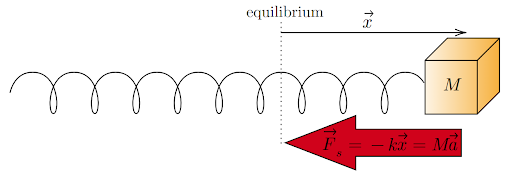
The negative sign in the formula shows that the restoring force acts in the opposite direction of displacement. For example, if I stretch a spring to the left, the restoring force will pull to the right. Because of this restoring nature, the spring’s force always points towards its equilibrium position. More on this in Unit 7!