
Introduction
Welcome to the FiveHive article for AP Physics 1: Unit 3.2 - Work!
This article will go over work, a core concept that you should expect to see a lot during the test.
Work
Work is defined as “the amount of energy transferred into or out of a system by a force exerted on that system over a distance.” Work is a scalar quantity and is measured in units of Joules (). Though work can be positive, negative, or zero, it is important to remember it does not have a direction.
The formula for work is
Where:
- is the constant force applied on an object.
- is the displacement of the object
- is the angle between the force vector and the direction of displacement.
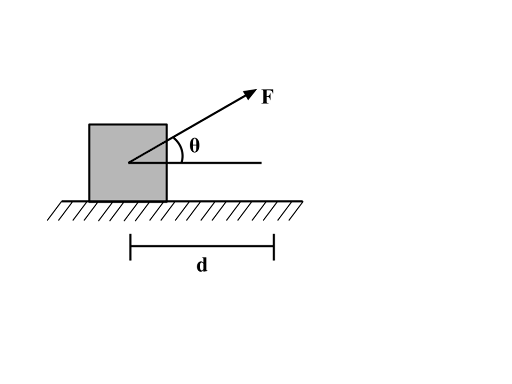
This means only the component of force parallel to the direction of the object’s motion is doing work, while the component perpendicular does not do any work. Additionally, work can also be shown as the area under a graph of force with respect to displacement.
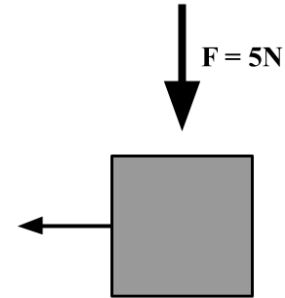
Example 1:
Suppose a box is sliding along a frictionless surface, and a steady force is applied on the box downwards. Even though I am applying a force over a distance, that force is perpendicular to the box’s direction of motion and actually does zero work.
Conservative and Nonconservative Forces
A conservative force is a force where the work done does not depend on the path taken and only depends on the starting and ending configurations of the object. In other words, if an object goes in a loop and comes back to where it started, a conservative force will not change the object’s energy.
Gravity, spring force, and electric force are examples of conservative forces. For example, take a child sliding down a frictionless slide. It doesn’t matter how the slide bends, twists, or turns; the work done by the child is still the same. Furthermore, if the child were to climb back up the slide, their energy would be the same as before they went down the slide. Meaning, the work done by the force of gravity is equal to zero.
On the other hand, a nonconservative force is a force where the work done does depend on the path of the object. Examples of non-conservative forces include friction and air resistance.
Work - Energy Theorem
You might have noticed that work and kinetic energy have the same units and wondered if they are related. It turns out the change in an object's kinetic energy is equivalent to the net work done. In other words:
This is a lovely equation to use when you have a system of changing force with respect to time—if you know the system mass as well as the final and initial velocity, you can calculate the work done on the system without any calculus!