
Introduction
Welcome to the FiveHive article for AP Physics 1: Unit 3.3 - Potential Energy!
This article will go over potential energy, a core topic that will be applied in many scenarios, including conservation of energy.
Potential Energy
Before we get into how to calculate potential energy, let’s first go over the basics. The potential energy of an object is a scalar quantity that depends on the position of objects in a system. Essentially, potential energy depends on where the objects in a system are located and how they interact. Similarly to kinetic energy, potential energy is measured in Joules (J).
It is important to know that in a system of more than two objects, the total potential energy is the sum of the potential energy of each pair of objects within the system.
Forms of Potential Energy
There are 2 forms of potential energy you will have to learn: gravitational potential energy and elastic potential energy.
Note: A system with two or more objects only has potential energy if the objects interact with each other through conservative forces.
Gravitational potential energy is simply the energy stored by an object due to its position in a gravitational field. Given a uniform gravitational field, the formula for gravitational potential energy is , where:
- is the gravitational potential energy
- is the mass of the object.
- is the acceleration due to gravity
- is the height of the object
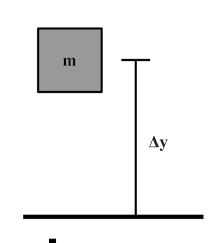
Note that we can define a certain height as having zero potential energy to help simplify calculations. For example, when measuring the potential energy of a ball on a desk, we can define the ground as having zero potential energy. This means we can calculate the energy of the ball relative to the ground instead of relative to the center of the earth.
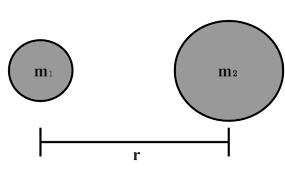
There is a second formula for gravitational potential energy that may show up on the test. The formula is , where:
- is the gravitational potential energy of a system
- is the gravitational constant ()
- and are the masses of 2 approximately spherical masses
- is the distance between the center of masses of the masses
It is also interesting to note that the negative in this formula indicates that there must be external energy that is required to pull two masses infinitely apart. This formula applies to gravitational interactions over large distances, such as between planets or stars. Note that as approaches a large value, the gravitational potential energy approaches zero—this makes sense as there no longer are any significant interactions between the two planets. We cover this again in topic 6.6.
Moving on, spring potential energy is the energy stored in a spring as a result of its deformation. This is calculated with the formula , where:
- is the spring potential energy
- is the spring constant
- is the distance the spring is stretched or compressed from its unstretched length

Even though the formula for spring potential energy looks like the formula for translational kinetic energy, they represent completely different types of energy. Spring potential energy is due to the compression or stretching of a spring, while kinetic energy is associated with the motion of an object.