
Introduction
Welcome to the FiveHive article for AP Physics 1: Unit 3.4 - Conservation of Energy!
This article will go over conservation of energy, an important topic that will test your knowledge from multiple previous units.
Systems and Energy
You might have previously learned that energy cannot be created or destroyed, and it can only change forms. Now, you’ll learn how to quantify how energy changes form and calculate exactly how much energy an object will have in different forms.
Before we get into conservation of energy, we need to start with the simplest case, which is a system composed of a single object. This system can only contain kinetic energy, as potential energy comes from interactions between multiple objects. Let's define a system with an object. The system is strictly single-object, so gravity acts as an external force doing work on said system. However, if you add another object (like Earth) to the system, gravitational potential energy can now be stored. Potential energy depends on how the system is defined. On the other hand, a system containing multiple objects that interact with conservative forces (see 3.2 for a refresher) can contain both potential and kinetic energies.
Mechanical Energy
Mechanical energy is simply defined as the sum of a system’s potential and kinetic energies. For example, the mechanical energy of an airborne airplane would be the sum of its gravitational potential energy and kinetic energy.
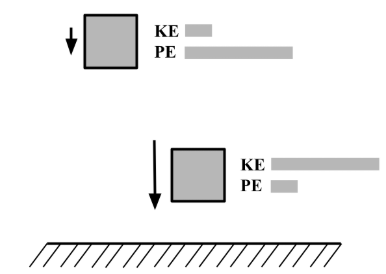
If one kind of energy in a system changes, another kind must change by the same amount, so that the total amount of energy stays the same, provided that no energy has entered or escaped the system. Similarly, if the total energy of a system changes, that must mean the same amount of energy has either left or entered the system. Essentially, energy cannot be created or destroyed; it can only change forms or move between systems.
Lastly, if the work done on a system is zero while no nonconservative forces act on it, the total mechanical energy of that system stays constant. However, if external work is done on a system, that must mean energy was transferred between the system and the environment. To see why, take a look at the work energy theorem, which says that the net work done on a system is equal to the change in kinetic energy. If net work is nonzero, kinetic energy changes. More specifically, if external, nonconservative work is done, it changes the total mechanical energy of said system.
To solve problems regarding conservation of energy, use the formula where:
- is initial kinetic energy
- is initial potential energy
- is final kinetic energy
- is final potential energy
Depending on the problem, you may have to use different ways to calculate potential energy. For instance, a problem about a falling object might mean while a problem about springs might mean