
Welcome to this article on Torque! In this article, we’ll explore how Torque governs the movement of objects, provide real-world examples, and test your understanding with practice questions.
Torque is a quantity that measures the tendency of a force to rotate an object. It is basically the rotational equivalent of force. So basically, let me sum this up for you in a way that makes more sense than just a definition. Say you have a slightly open door and you push straight near the hinge of the door with a force of 20 N. Nothing happens. If you push the same door with the same force straight near the handle of the door (far away from the axis of rotation), the door opens easily. Try it yourself! Now, you may wonder why this is the case. Torque is what causes this phenomenon. The standard unit for torque is Nm (Newton-meter). The formula for torque is:
As you can see, a higher radius produces a higher torque with the same applied force. You can also see that torque also depends on the angle between the radius and the applied force (). This can range from to . As you probably already know, the value of sine increases from to . Let me give you yet another door example (I like doors). If you push on the thin side of a door, nothing happens. This is because the angle would be (). On the other hand, if you push on a door from the radius, as I said in the first example (straight), you get a high torque (depending on the radius, of course).
Now let’s learn what the lever arm is. The definition of the lever arm is the perpendicular distance between the axis of rotation and the line of action of your applied force. So basically, if you were to take your force and make a line out of it that extends infinitely in both directions, the closest distance between the axis of rotation and that line is the lever arm. Do not confuse this: the lever arm is not always the same as the radius. The radius is simply the distance from the axis of rotation to the point at which the force is applied. Now, you can also use this formula to find torque if you are given the lever arm:
, where is the lever arm.
This brings us to our next big idea for this topic: torque only results from the force component perpendicular to the radius. If we split a force applied at an angle into its components, there is a component of force acting perpendicular to the radius, and there is a component of force acting parallel to the radius. The component of force acting parallel to the radius only pushes or pulls against the pivot point, which, as we said before, does not cause rotation. It may cause compression or tension, but not rotation.
Let’s learn a bit more key info about torque that should make intuitive sense now.
- Maximum torque is produced by perpendicular forces
- Rotational equilibrium occurs when the net torque is zero
- Adding up all the torques in a system is another way to find the net torque
- Net torque is directly proportional to angular acceleration
- You can also use the equation if you know the perpendicular component of the force
The last thing you need to know about this topic is force diagrams. Force diagrams are similar to free body diagrams and are used to analyze torques exerted on a system. Just like free body diagrams, force diagrams show the relative magnitudes and directions of forces exerted on a system. The important difference of force diagrams compared to free-body diagrams is that they show where the force originates from, unlike free-body diagrams, which show all forces as originating from the object's center of mass.
Wow, that was a lot! This may all seem very overwhelming, so here is an image that shows the key components of a torque problem that we discussed in this article. In the image, there are two separate masses of mass each on a rotating board of mass that provide separate torques:
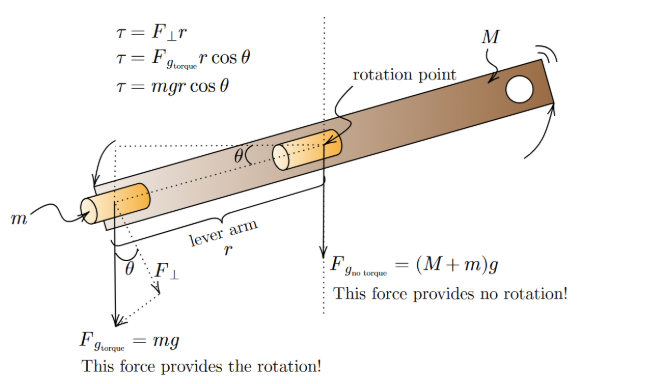
You may be shocked that in the diagram above, we use cosine instead of sine. This is a funny trick that the AP exam loves to play—sometimes, using cosine is correct! The key is to think, "What trigonometric function do I need to get the perpendicular component of force relative to the lever arm?" In this example, we use cosine, which gives us the “adjacent” over the "hypotenuse" that the diagram shows.
Example: A -meter-long lever is pivoted at its center. A force is applied downwards at one end, meter from the pivot, at a angle.
Find: The torque applied.
Solution:
Now you try :3
A student pushes perpendicularly on a door with a force of at a perpendicular distance of from the hinges. Calculate the torque applied.
Solution: