
Welcome to this article on Rotational Inertia! In this article, we’ll explore how rotational inertia governs the movement of objects, provide real-world examples, and test your understanding with practice questions.
Rotational inertia (or moment of inertia) measures an object’s resistance to rotation. It is basically the rotational equivalent of mass; therefore, it is essential to calculate angular acceleration from torque (). It depends on mass and mass distribution. Objects of the same mass that have their mass farther away from the axis of rotation have a higher rotational inertia. We can see this in the formula for rotational inertia:
The term shows that mass rotating farther away from the axis of rotation increases the rotational inertia quadratically. This equation also shows us that the SI unit of rotational inertia is , since has units of and has units of .
The total rotational inertia of a collection of objects rotating around the same axis of rotation is the sum of all of their rotational inertias. On the AP exam, you are expected to do this up to 5-point masses. This is represented by the equation
Where , , and represent the rotational inertia, mass, and distance from the axis of rotation of each point mass.
Here are some common formulas for rotational inertia that will be given to you for the AP Exam:
For a thin rod rotating about its center:
For a thin rod rotating about one end:
For a solid disk/cylinder rotating about its center:
For a hollow cylinder (hoop) rotating about its center:
For a solid sphere rotating about its center:
For a hollow sphere rotating about its center:
You don’t have to memorize these formulas, if a question requires you to use them, they will be given to you.
Here is a real-world example: say you have a door. You attach to the door near the hinge. It will be easier to open and close the door in this case than if you attached the nearer to the edge of the door. This is because mass closer to the axis of rotation provides less resistance to rotation.
Based on these facts, it should make sense that the rotational inertia of an object is lowest when the axis of rotation passes through the center of mass than any other parallel axis. If you’re rotating an object about its center of mass, the parts of the object will be as close to the axis of rotation as possible, minimizing the effort required to rotate it.
The last thing you need to know about rotational inertia is that there is a theorem that gives the moment of inertia about any axis parallel to an axis through the system’s center of mass. This is called the Parallel Axis Theorem:
Where is the rotational inertia to be found about the new axis of rotation, is the rotational inertia of the object through its center of mass, is the total mass of the object and is the distance between the new axis of rotation and the axis of rotation through the center of mass, seen below:
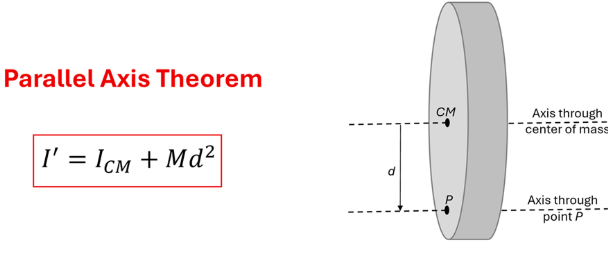
If the rotational inertia of the disk above is equal to when it is rotating about its middle, the new rotational inertia when rotating about point P which is a distance d away from the central axis will be . For example, if , , and , the rotational inertia about the center of mass is and the rotational inertia about the new axis is .
This aligns with our expectation that if the mass of an object is further away from the axis of rotation, the rotational inertia will increase, as there is more mass further away from the new axis than the old axis.