
Welcome to the FiveHive article for Unit 5.5 of AP Physics 1!
This article will cover equilibrium, both linearly and rotationally, along with the methods needed to understand it.
As usual, we will only cover the topics included in the CED for unit 5.5.
Rotational Equilibrium
Just as objects could be in equilibrium in translational terms, they can also be in equilibrium in the rotational sense. Rather than the object moving at a constant velocity or being stationary, an object in rotational equilibrium does not change in angular velocity. However, this doesn’t mean that it is rotationally stationary, as the object could also be maintaining its rotational velocity and spinning forever at constant speed. Since the rotational equivalent of force is torque, the torques in an object would need to balance out such that the net torque is equal to zero for it to be in rotational equilibrium.
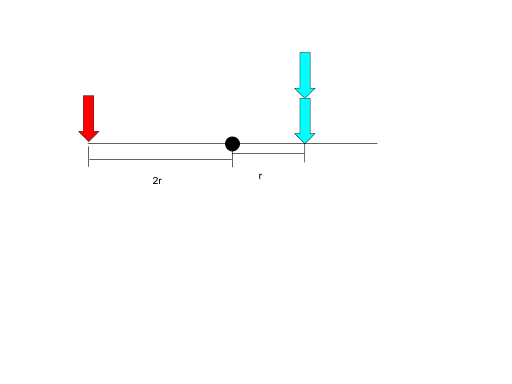
Image Source: Made by Insomnia
The force diagram above would be an example of an object in rotational equilibrium, as the torques generated by both the blue and red forces are equal in value, but opposite in rotational direction, resulting in their sum being zero, or . If they weren’t balanced, the angular velocity then must change. However, just because rotationally it might be in equilibrium, it might still be moving translationally. For example, on the diagram above, if the axis of rotation weren't fixed, the entire bar wouldn’t rotate, but it would still be sliding downwards. In the case that both rotational and translational equilibrium are met, it would be in a state of static equilibrium.