
Introduction
Welcome to this article on Conservation of Angular Momentum! In this article, we’ll explore how conservation of angular momentum governs the movement of objects and test your understanding with a practice question.
The first thing you need to know is that the total angular momentum of a system () remains constant if the net external torque is zero. This is because, just like net force is defined as the change in momentum, net torque is defined as the change in angular momentum. If there is no torque, there is no change in angular momentum (angular momentum is constant). Angular momentum is conserved in all interactions. If the net torque exerted on a system is nonzero, angular momentum is transferred between the system and the environment.
The total angular momentum of a system rotating about an axis is the sum of its constituent angular momenta. This follows the same additive principle seen in other conserved quantities. If you sum up all the angular momenta in a system, that is the system’s total angular momentum. Keep in mind that angular momentum has direction (clockwise or counterclockwise). Choose one direction as positive (e.g., counterclockwise = positive, clockwise = negative) so that opposing momenta naturally cancel out when summed.
To demonstrate the conservation of angular momentum of a collision, here is an example scenario:
(scenario written by riptide31415)
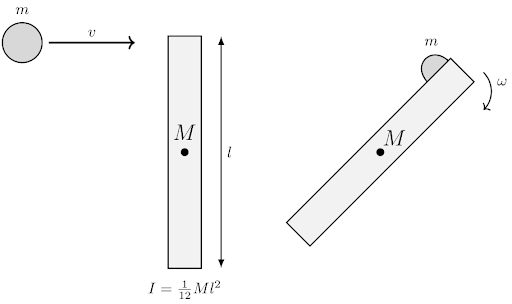
In the scenario above, a ball of mass is travelling to the right at speed and impacts a stationary block of mass , length , and rotational inertia at the top of its left side. The block is free to rotate about a pivot at its center. The ball and the block experience a perfectly inelastic collision, sticking together and rotating with angular speed after the collision. In order to find , we can use angular momentum conservation, setting the initial angular momentum of the system to be equal to the final angular momentum of the system.
The angular momentum of the system before the collision is equal to the sum of the angular momenta of the ball and the block.
Note: It may seem weird that the ball, which does not appear to be rotating, has any angular momentum at all. However, you should remember from topic 6.3 that any object that has tangential velocity with respect to an axis of rotation has angular momentum, even if it does not appear to be rotating. Since the ball is moving tangentially with respect to the center of mass of the block, which is our axis of rotation, the ball has angular momentum before the collision.
The initial angular momentum of the ball can be calculated using the equation . Right before the collision, the ball is away from the center of mass of the block (which is the axis of rotation), so we can substitute . Also, the angle between the position vector (relative to the center of mass of the block) and the velocity of the ball is 90 degrees, so . Therefore, .
The initial angular momentum of the block is 0 since it is not moving.
In order to find the final angular momentum of the system, we have to find combined rotational inertia of the ball and the block. The rotational inertia for a point mass is , where r is the distance from the axis of rotation. Since the ball is a distance away from the axis of rotation, the rotational inertia of the ball post collision is . The rotational inertia of the block is given as . The total rotational inertia of the system is the sum of these two, .
Since , the final angular momentum of the system is .
Solving for :
Therefore the final angular velocity of the ball and block is .
Piggybacking off of the idea that the total angular momentum of a system remains constant if the net external torque is zero, any change in a system’s angular momentum must come from an interaction between the system and its surroundings. As you already know, angular impulse represents the change in angular momentum of a body. The angular impulse exerted from one body to another body is equal and opposite to the angular impulse exerted from that body to the first body. This is due to Newton’s Third Law. Also, if the total angular momentum of a system changes, that change would be equivalent to the angular impulse exerted on the system. This is because angular impulse, as we stated before, literally equals the change in angular momentum of an object or system.
The angular speed of an object may change without the angular momentum of the system changing if the system changes shape by moving mass closer or farther from the axis of rotation. This is because of rotational inertia’s dependence on distance from the axis of rotation (radius). If rotational inertia increases, angular velocity must decrease, and if rotational inertia decreases, angular velocity must increase. This is to keep angular momentum constant.