
Introduction
Welcome back to AP Precalc! Today, we will be discussing Topic 1.11: Equivalent Representations of Polynomial and Rational Expressions. Without further ado, let’s get started!
Factoring
You probably learned how to factor a polynomial back in Algebra. For example, . We can find the zeroes of a function using this factored form; all we need to do is check each of the terms and find which -value makes them equal to .
For example, the zeroes of are , since at and at .
By factoring the polynomials in the numerator and denominator of a rational function, we can use the information we get from the zeroes to determine additional characteristics of the polynomials.
Remember that, for a rational function:
- If both the numerator and denominator have a zero at , then there is a hole at .
- If the numerator has a zero at , but not the denominator, then there is a zero at .
- If the denominator has a zero at , but not the numerator, then there is a vertical asymptote at .
Finding End Behavior
When finding the end behavior of a rational function, we only need to look at the term with the highest degree from the numerator or denominator.
Firstly, if the degree of the numerator is greater than the degree of the denominator, then the limit as x approaches infinity of the function is either positive or negative infinity. To find out whether the function approaches positive or negative infinity, find the limit as x approaches infinity of both the numerator and denominator, if both approach positive infinity or both approach negative infinity, then the function approaches positive infinity. Otherwise, the function approaches negative infinity.
If the degree of the numerator is equal to the degree of the denominator, then the limit as x approaches infinity of the function is the leading term of the numerator divided by the leading term in the denominator. For example, if the function is , the limit as approaches infinity is .
Lastly, if the degree of the denominator is greater than the degree of the numerator, then the limit as the function approaches infinity is .
In the case of a polynomial, just treat it as if it’s over , and solve the same way.
Polynomial Long Division
We can divide polynomials like we would divide normal integers, using a similar technique. Repeat the following process until the degree of the dividend is less than the degree of the divisor.
- Consider the leading term in the dividend, or the polynomial that is being divided. Multiply the divisor, the polynomial that is dividing the dividend, by some value such that the leading term in the dividend and divisor are the same.
- Add the term that we multiplied by to the quotient, and then subtract our dividend by the divisor multiplied by the term we added to the quotient.
For example, let’s divide by
So therefore, with a remainder of .
We can use this to find the slant asymptote of a function. What is that? Well, consider the function : its graph is shown below.
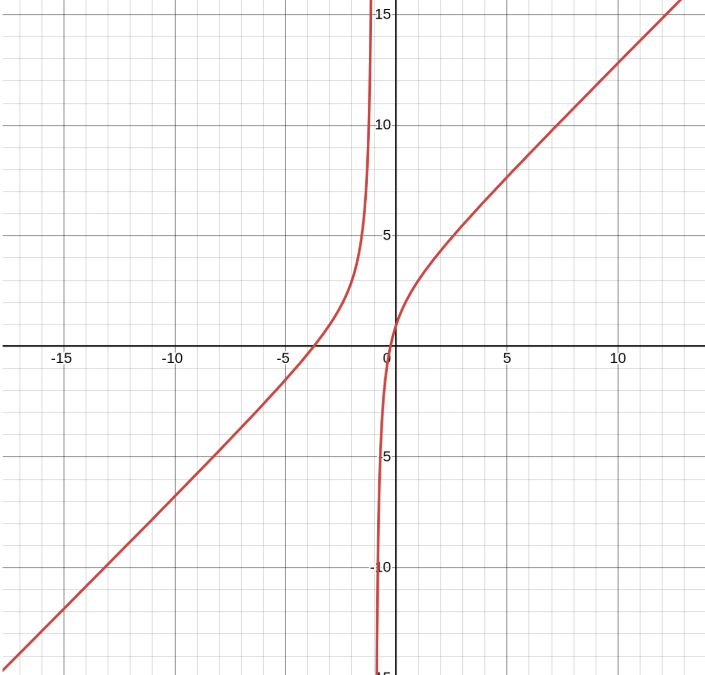
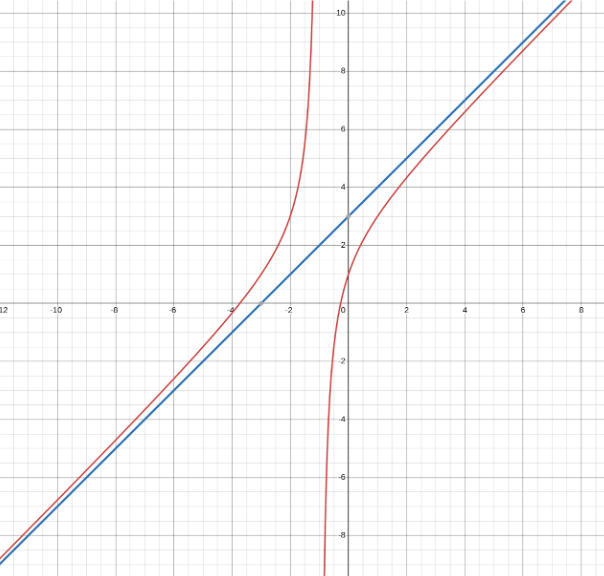
Using what we already learned in Finding End Behavior, we know that the function approaches infinity as approaches infinity. However, we might notice that it seems like the function is approaching a line as it increases, and this is called the slant asymptote. If we additionally show the graph function we got earlier from long division, , we can see our rational function approaches it:
Binomial Theorem
Let’s say you’re given the following question.
> What is the coefficient of the term in the expansion of .
Of course, you could manually expand out the polynomial, but that would be tedious. The simpler solution is to use Pascal’s Triangle / Binomial Coefficients.
Visual Way:
Let’s create Pascal’s Triangle. We create each row based off of the previous row
- Start off with just a .
- To create the next row, first add a 1 to the next row. Then, for each pair of adjacent elements in the current row, add their sum to the next row. Finally, add a 1 to the end of the row.
- For example, if the row is currently , then the next row will be .
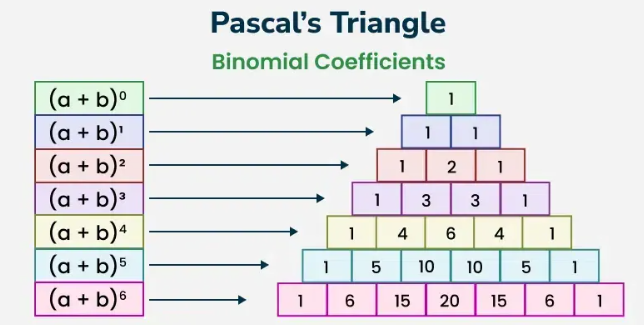
The first couple rows of Pascal’s Triangle are as follows.
A couple of tricks to check if you made a mistake:
- The sum of each row should be a power of two. Specifically, in the th row (where the first row is the th row, the sum of that row is .
- The rows are symmetrical.
Each row also corresponds to the expansion of a polynomial of that degree. For example, the function .
Using this, we know the term in the expansion of is going to be , so its coefficient will be .