
Introductions
Welcome back to AP Precalculus! In this article, we will be discussing the holes of rational functions. Without further ado, let’s get started!
Vertical Asymptotes and Holes
So… remember back in Topic 1.9 (the previous topic) when we covered vertical asymptotes? One of the big things we needed to understand was the multiplicity of a root. For example, take this function:
In the numerator, notice how it will become if . Since the power is , there can only be one occurrence of this root, so the multiplicity for the root at for the numerator is . However, the denominator will become if . Since the power is , there are two occurrences of that root, being . This means that the multiplicity for the root at for the denominator is .
If we take a function that has the same root, we can compare the multiplicity of the numerator and denominator to find out if the function has a vertical asymptote. For example:
Take . At , notice that the numerator has a multiplicity of and the denominator has a multiplicity of 1. Since the numerator has a higher multiplicity, there is no vertical asymptote. However, look at . Notice that the numerator has a multiplicity of and the denominator has a multiplicity of . Since the denominator has the higher multiplicity, there will be a vertical asymptote.
One more point I need to mention is that if we plug in and without changing the function we were given, we will get .
We know that a vertical asymptote occurs at , but is there anything special that happens at ? Well… yes!
Let’s take a look at the function, and I want to highlight the spots of and .
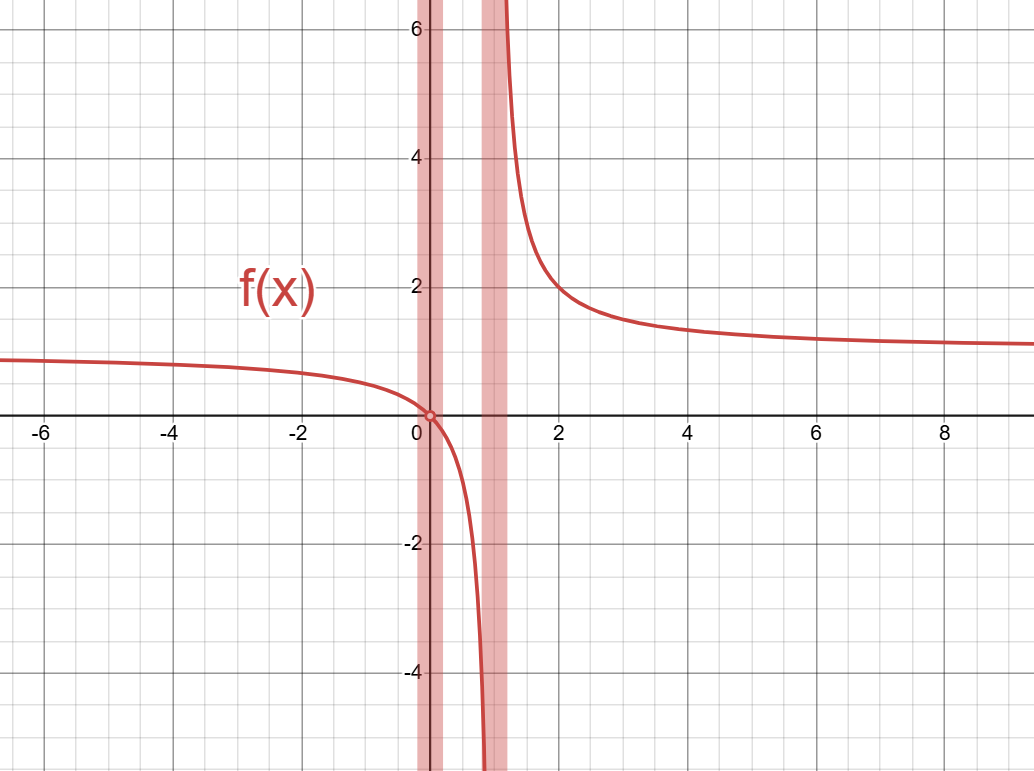
As expected, at , there was going to be a vertical asymptote. However, look closely at . It seems like there is a hole in the function. Let’s zoom in a little more and see if this is the case.
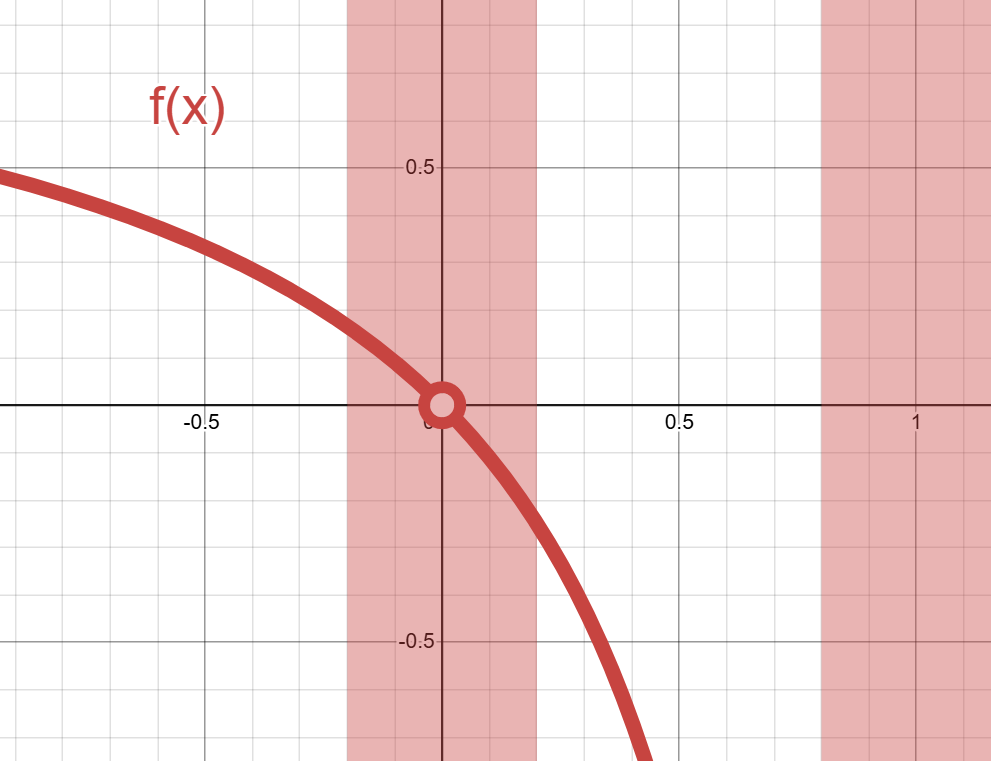
There indeed is a hole in the function! However, why does this occur? Well, remember that at , the multiplicity of the numerator was greater than the numerator. This means that whatever factor in the denominator is causing the root will be cancelled out by the numerator!
For example, is our function we’re working with, and the factors causing the root are the factor. If we cancel out from the top and bottom, we get . Notice that because the numerator’s multiplicity is greater, the factor will remain in the numerator while the factor in the denominator disappears.
If this occurs, then this is called a hole. If the numerator has a greater multiplicity at a root than the denominator, a hole will be formed!
Same Multiplicity
What if the numerator and denominator have the same multiplicity?
Let’s take the function . Firstly, we can factor the top and the bottom to see if we can cancel out anything.
It seems like in this function, , , and are going to be the spots where there is a hole or a vertical asymptote. We can be certain that it will be either of these two options (hole or vertical asymptote) for each -value, because the function is a rational function that is undefined at those spots.
What is the multiplicity of the root for the numerator and denominator? Seems like there is an factor in both, and both the numerator and denominator have a multiplicity of . We’ve discussed cases where one was greater or less than the other, but now what? Well, if we plug in into the original function we will still get .
However, since the factors cancel out in the numerator and denominator, we don’t have a vertical asymptote.
This means that out of the two options, we must have a hole! This means that if the numerator and denominator have equal multiplicity of the same root, that root will still be a hole! So, the function at has a hole!
To solve for the other roots, we can simply recognize that there is an and factor present in the denominator, but not in the denominator. This means that since the denominator has higher multiplicity than the numerator for these roots, then and are spots where the function has a vertical asymptote.
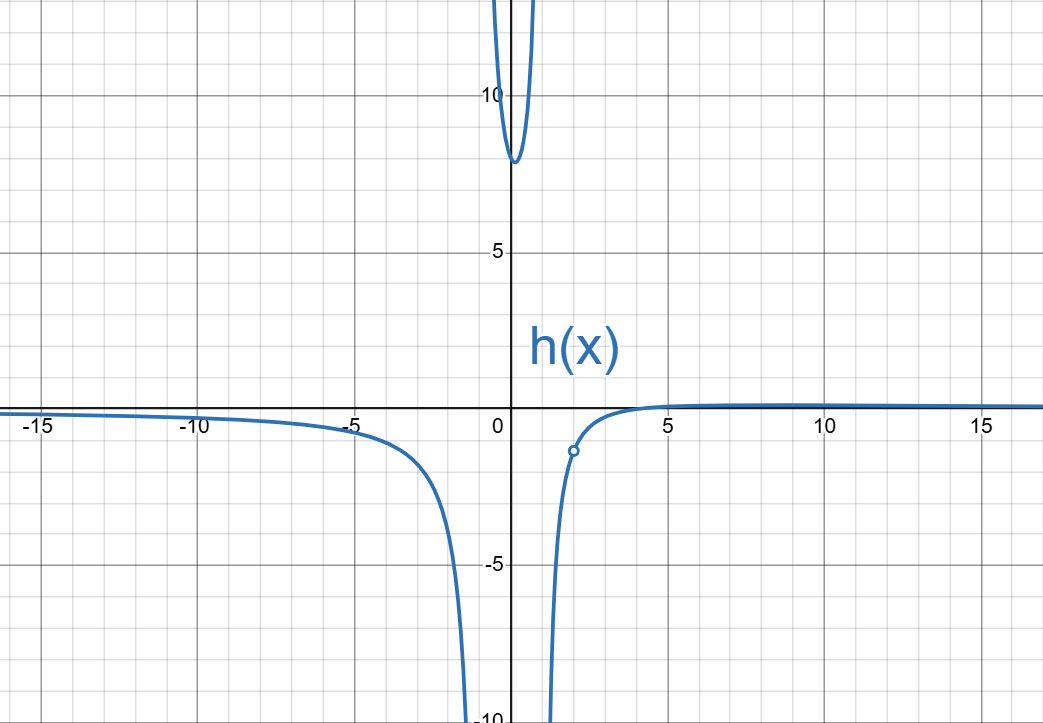
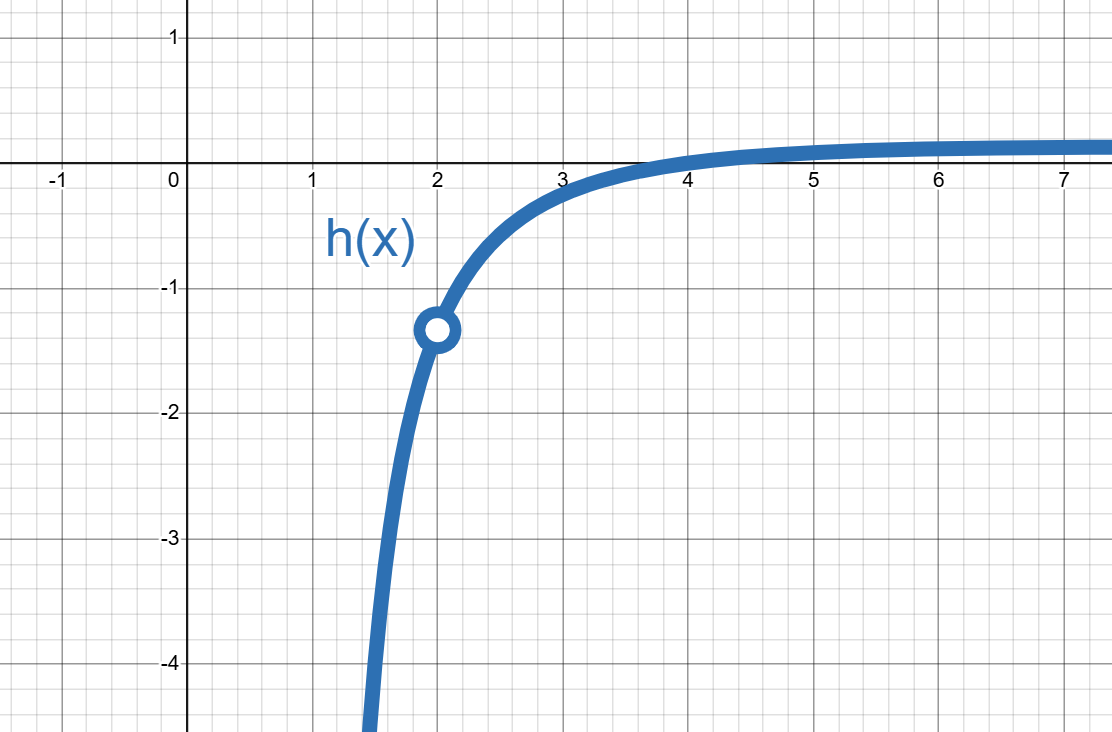
If we zoom in on , then we can see the hole more visibly.
Closer To The Gap
Let’s still keep talking about this function for a second.
The original function is definitely going to be if we plug in two. But… What happens if we plug in a number AFTER we simplified the function? There’s nothing really stopping us..
So, the hole has a -value of ? Technically, yeah! We can’t say that , because is undefined. We algebraically manipulated the function, and actually changed its domain by cancelling out the factors! This is why we could plug in into the simplified form without any problems! As such, this is a good way to get into limits.
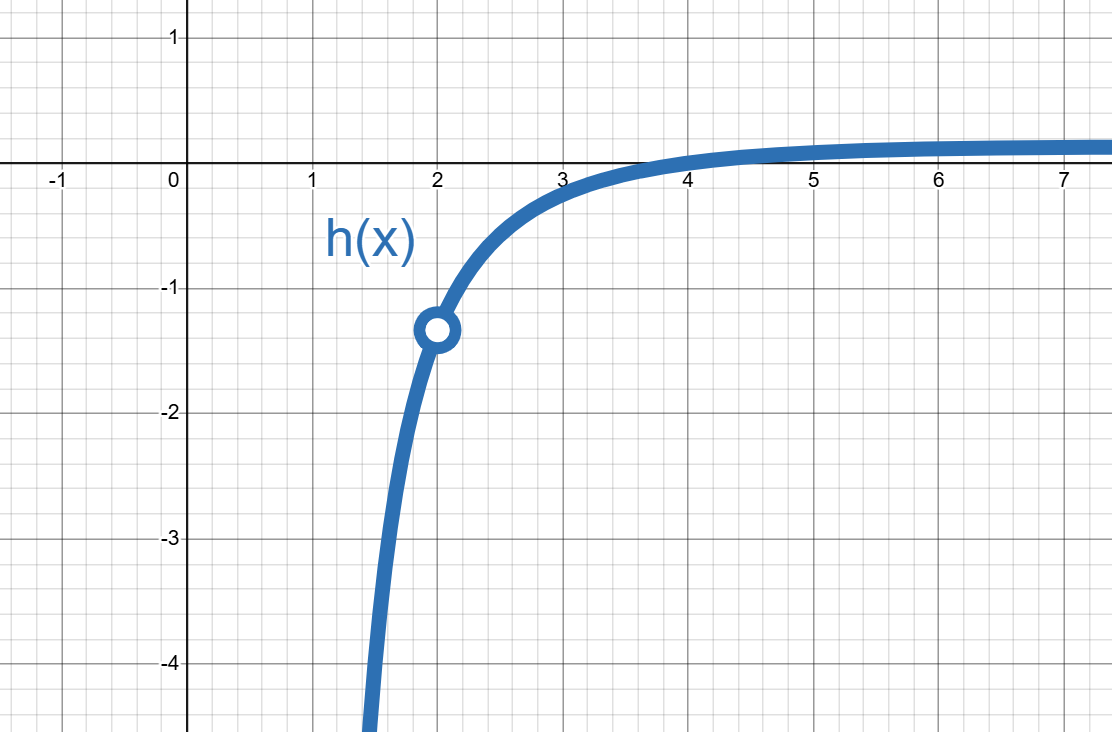
Notice that the function at , or the hole, is at around . Even though the function can’t describe this, we can use limits! This means that we can say:
Take a moment to digest this statement.
Let’s do another example. Find the holes and vertical asymptotes, and then find the limit as approaches these holes of the function
Firstly, we can factor as usual.
It seems like because we were able to cancel out the factor in the second step, there is a hole at . Remember, the multiplicity of the numerator and denominator were the same, which is an indicator for a hole.
Since we are left with in the denominator, this indicates a vertical asymptote at , since plugging in results in the denominator being equal to .
Finally, let’s try to figure out the limit as approaches the hole, or the following expression.
Well, we can simply plug it into our simplified form where the result won’t be . This means that:
The function may not equal at , but the limit as it approaches does equal from both sides. Time for you to apply your knowledge!
Also I should clarify that we can still write the function as . We just have to indicate that is not valid, because we lost that information in the new simplified form. This means the proper way to write it is . You will need to know about domain restrictions, but we’ve covered that in the past so you should be relatively comfortable with it.