
Introduction
Welcome back to AP Precalculus! Today, we’ll be learning about vertical asymptotes; it’s a very short lesson, but it’s important to know for the AP Exam. Without further ado, let’s get started!
Vertical Asymptote
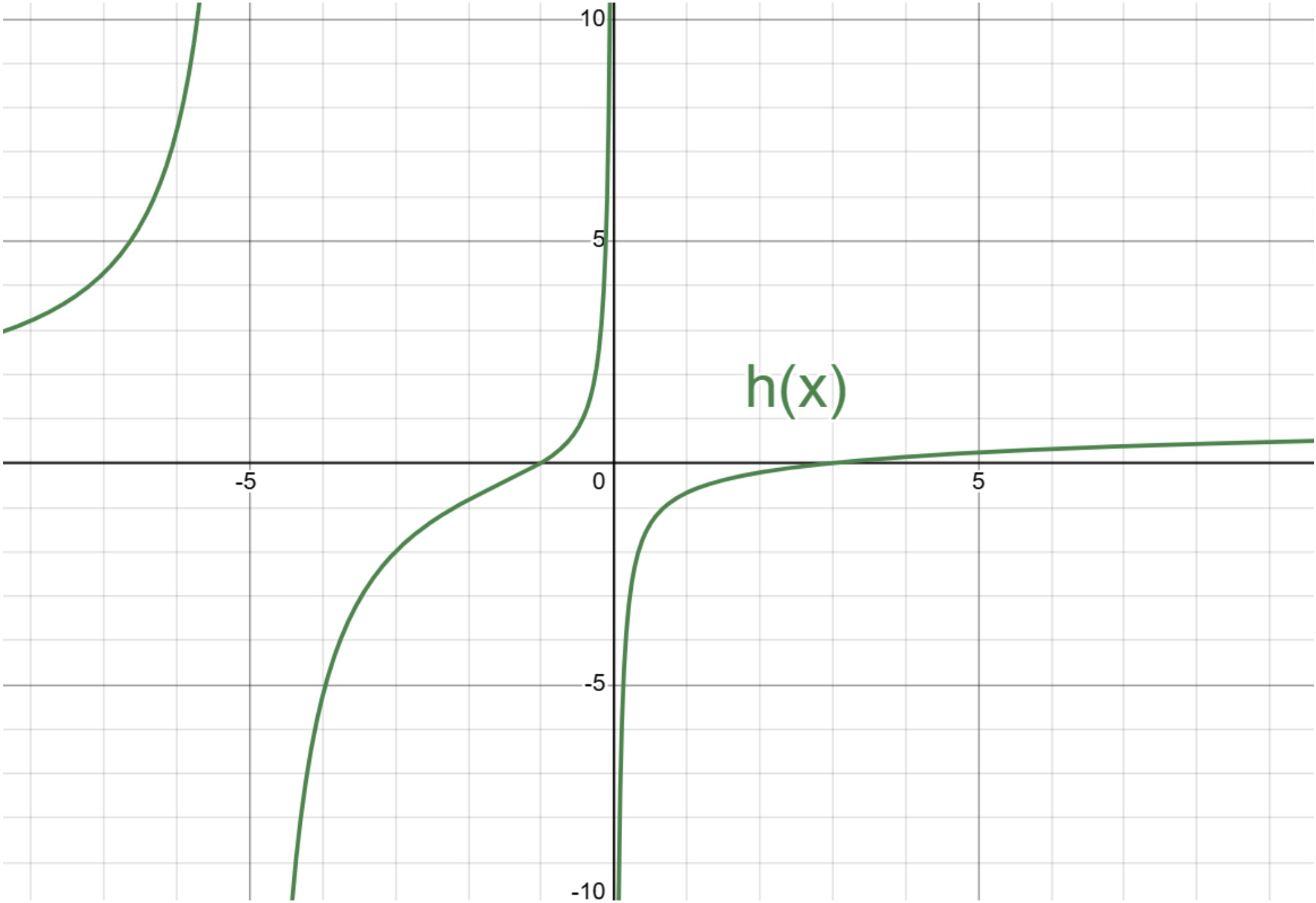
Let’s take a look at the graph of the function .
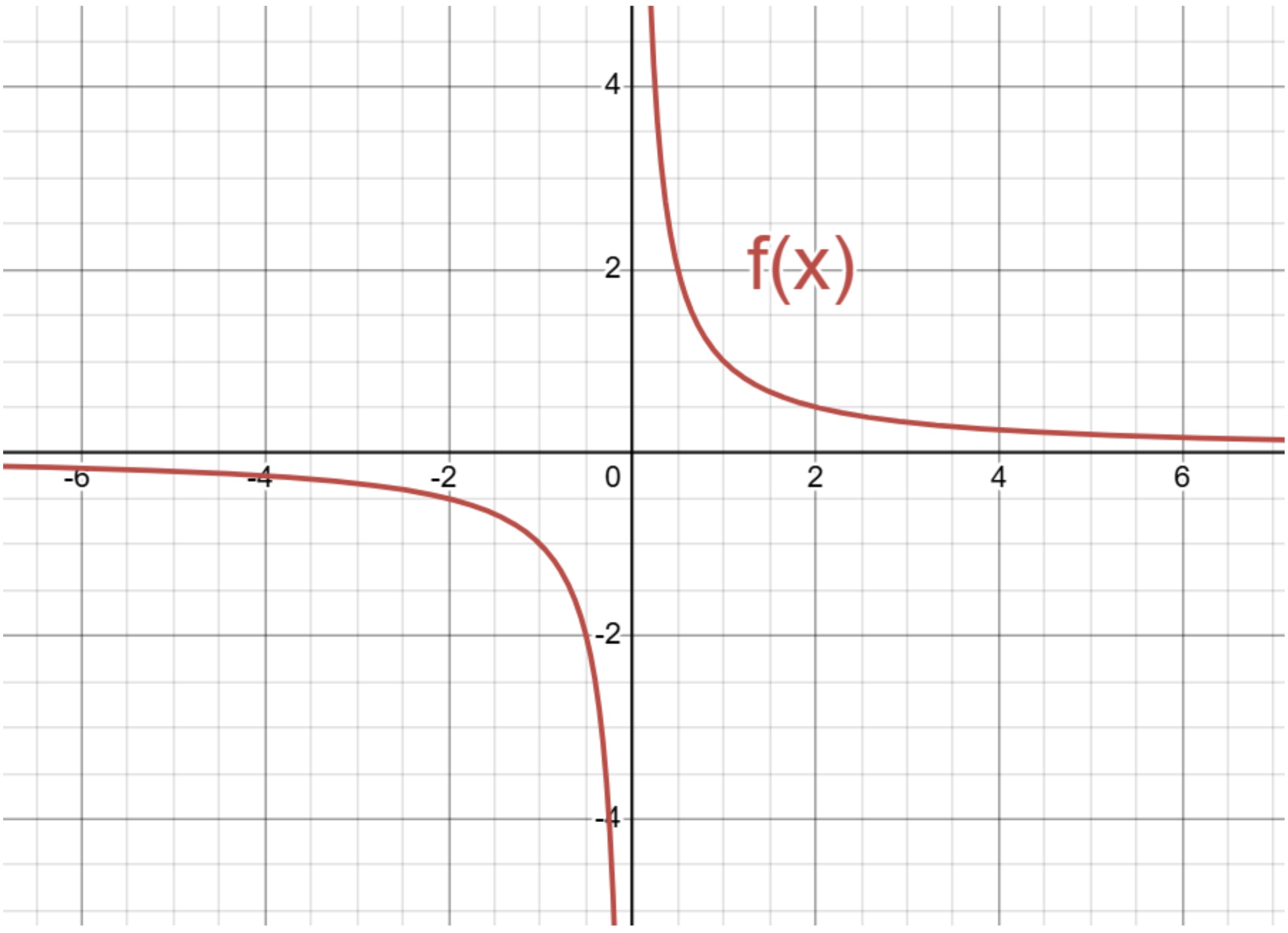
Notice that there is a peculiar event occurring at what looks like to be at . If we plug in into , we find that the function is not defined when (since , which is undefined). However, as gets closer to , either approaches or . From the left side of , it goes all the way down to negative infinity. From the right side of , the function goes all the way to positive infinity.
Notice that an asymptote occurred when the function was undefined. This very often occurs in rational functions, and happens in places where the denominator of the function is . Because , at , you would get an undefined value. Let’s take another look at another example.
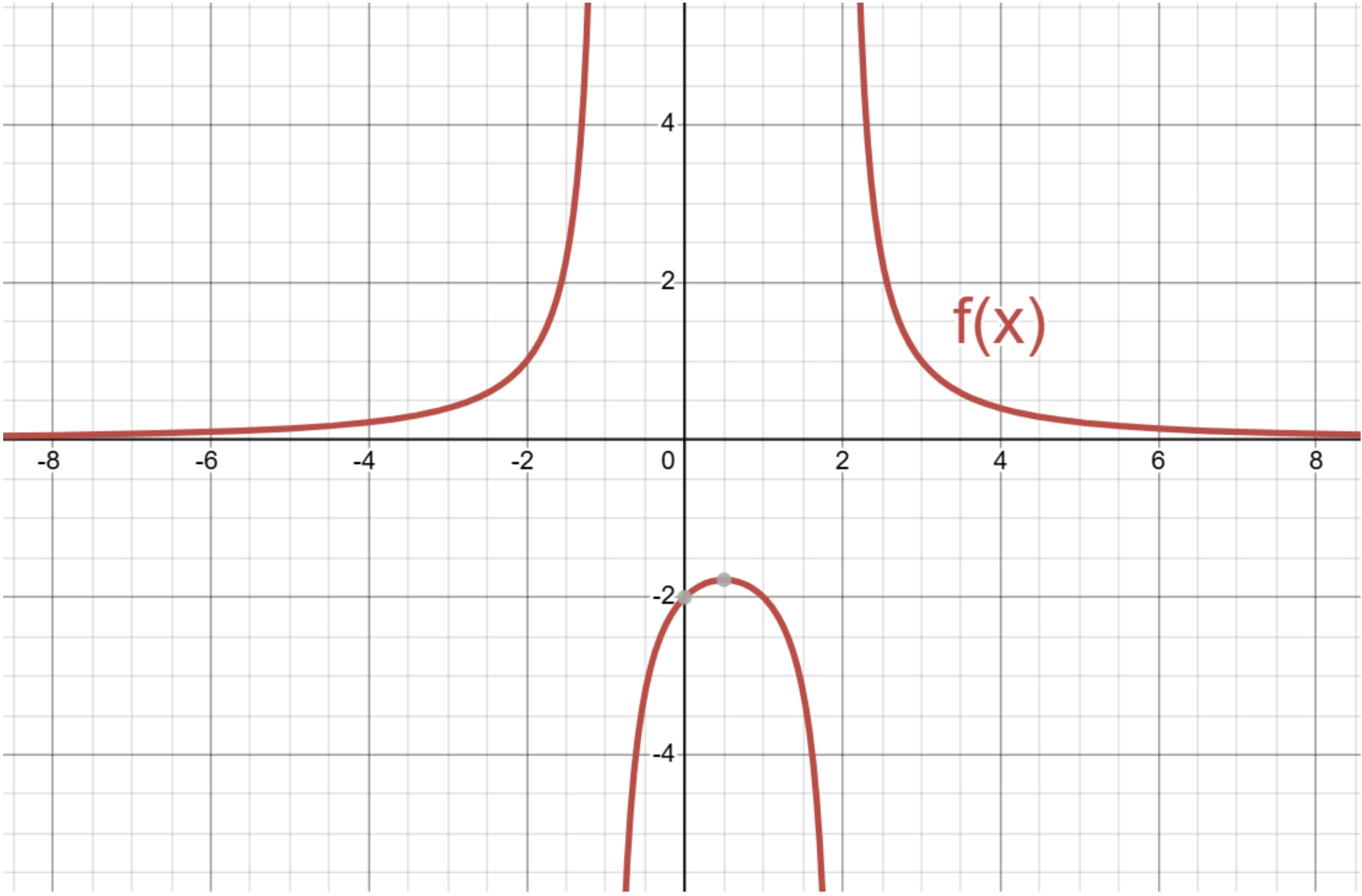
This is . Notice that at and , there seems to be a similar situation. If we plug in and into the function, we get . The function is undefined at . At , . Again, the function is undefined because the denominator is equal to zero at those -values.
We’ve been vaguely discussing this phenomenon, but let’s give it a name. I think we should name it a vertical asymptote.
A vertical asymptote will usually occur at spots where the function is undefined. For rational functions, which is the only thing we will look at right now, it is when the denominator is zero.
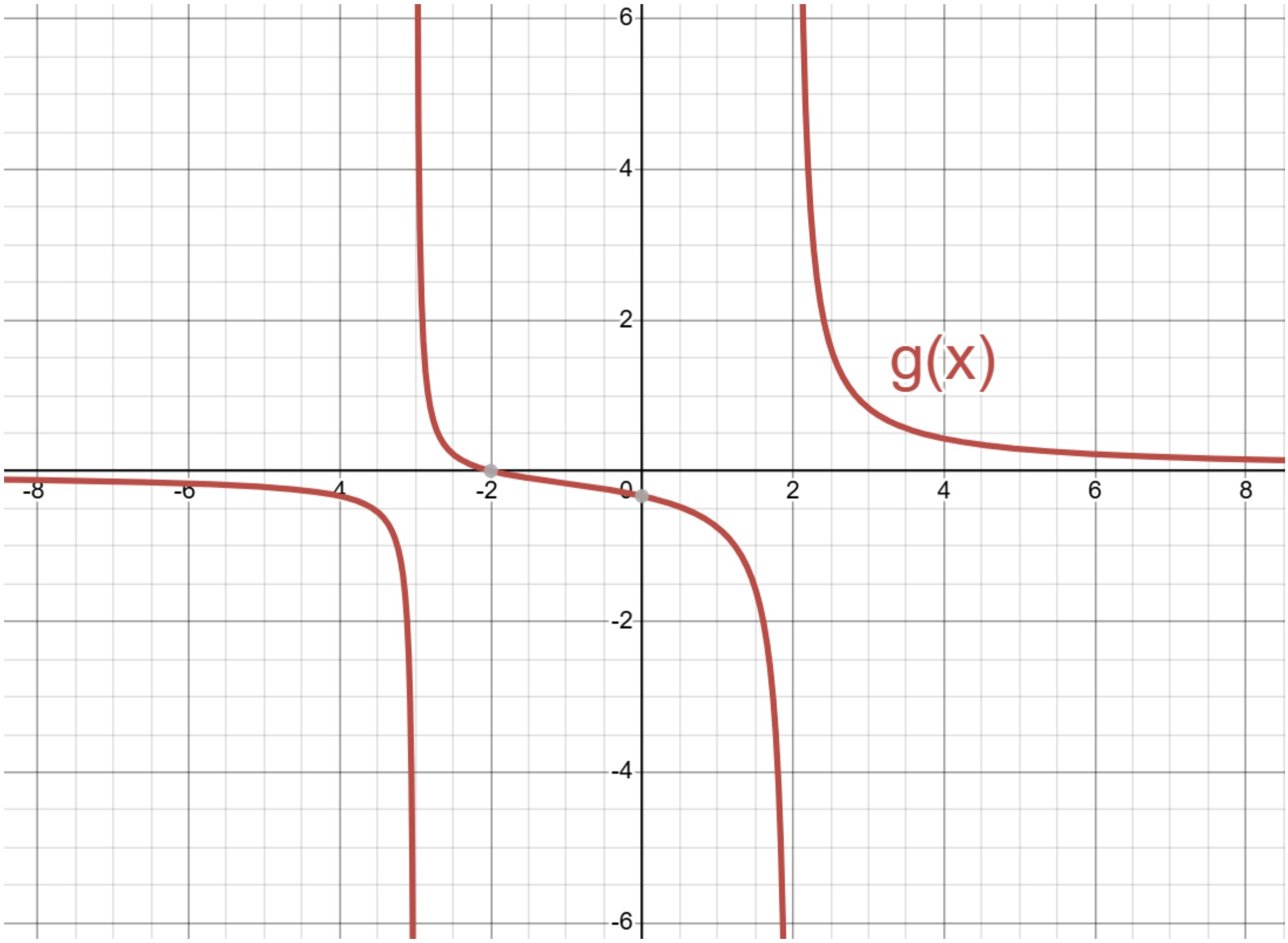
If we were only provided a rational function, then how would we solve for the spots where there is a vertical asymptote? Let’s say we have the function . To solve for the spots where there is a vertical asymptote, we simply look for when the denominator is equal to zero. We can basically ignore the numerator for now.
This means that there is a vertical asymptote at and , and looking at the function of confirms our suspicions.
Exception: Zero Divided By Zero
There are some exceptions to simply looking at the denominator, and we must watch out for these exceptions.
For now, let’s take a look at and be oblivious people. Let’s do our usual step by ignoring the numerator and only finding out when the denominator is equal to zero.
@x=-3, x=3$
This means that there is a vertical asymptote at and , or is there? Let’s plug in the -values into the function and see what we get.
. As usual, this function is undefined.
. This is certainly more interesting, as we got instead of something like . Why is this the case? Well, let’s look at the function.
Earlier, we factored the denominator using the difference of squares. Let’s substitute our factorization of into the denominator of the function and see what happens.
Notice that the function has in both the numerator and denominator. This means that you can simply cancel these factors out and get the following:
From this, we find that the portion of the function goes away, and the function no longer shows that there is a vertical asymptote at , rather there is a vertical asymptote at .
Here’s a graph of the function to show you how it looks.
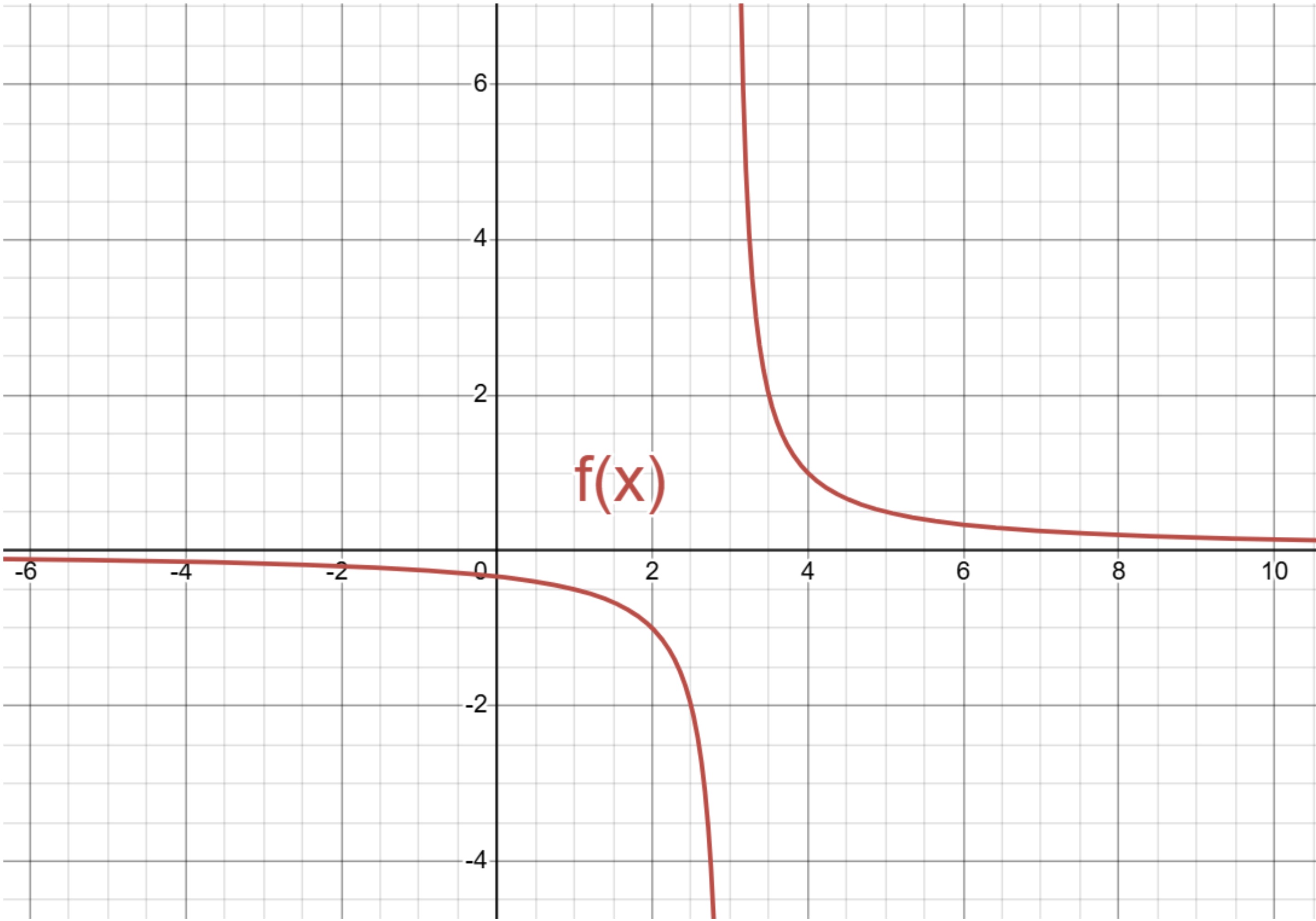
It seems like when you reach a point when the function is , there is no longer a vertical asymptote because everything cancels out. Problem solved, and everything is fine! Just note that the function is not defined at , so it isn’t in the domain of the function. However, there is no vertical asymptote.
Problem solved now, and everything is fine!
Well… not quite. The problem is solved, but everything isn’t fine yet.
Exception to the Exception: Multiplicity
You see, there is an exception TO the exception, a double exception, like a negative cancelling out a negative. Take a look at this:
Find the vertical asymptotes of the function . Let’s ignore the numerator for now, and simply find all the POSSIBLE spots where a vertical asymptote could be present. Let’s find when the denominator is equal to 0.
This means that at and , it is POSSIBLE for a vertical asymptote to be present. Let’s confirm all of this by plugging in and into the function.
. It seems like there is a vertical asymptote at . Now, let’s check .
. It seems like we got , which means that there is no vertical asymptote at . Or is there?Let’s simplify the function by factoring it again. How can we factor the numerator and denominator of ?
Huh. It seems like even though we simplified the function, if we plug in , there seems to still be a vertical asymptote at .
. Welp, there’s nothing else. There really is a vertical asymptote at .
But, why exactly was this the case? Why was there a vertical asymptote at even though we had the exception? And also, how come I never address what “multiciplicity” is?
Multiplicity
Let’s chat. Multiplicity talks about how many times a root appears in a polynomial.
For example, a made-up random polynomial that is already factored can be represented as . If we were to rewrite this polynomial without exponents, you would get: .
Notice that at , and has a root at . How many times in the polynomial does this root appear? Well, twice right? Two times we get . Although both are the exact same, there are still two appearances where is a root. This means that the root has a multiplicity of 2. Simple enough. Let me ask you, what is the multiplicity of in this problem?
The multiplicity is 4, not 3. Notice that we have , and so that’s three. Our fourth one is in , as that can be factored to become , which makes 4 mentions of the root .
Now that we have addressed multiplicity, let’s explain why this exception even exists with an example problem.
Take the function where . Honestly, let’s just start simplifying the function right now, don’t even do the denominator equals zero stuff right now. I see on the top and bottom, perhaps we can cancel some stuff out.
. From this point on, it should be immediately clear that and are where the vertical asymptotes are. We didn’t even need to do any big complex steps! All we had to do was simplify the function and it became really easy from there.
Oh yeah, let’s get back to the multiplicity stuff. We know that there is a vertical asymptote at and , so let’s plug that into the original function and see the results for now.
. At , there is definitely a vertical asymptote.
. It seems like we got . We can confirm that there is a vertical asymptote, but how would we explain this using multiplicity? Well, looking at the original function may offer some insight.
In the numerator, how many instances of are there? Two, so the multiplicity of in the numerator is 2. What about the denominator? It seems like there are three instances, so the multiplicity of in the denominator is 3. It seems like the multiplicity at of the denominator is higher than in the numerator. Because the multiplicity is higher, the term stays in the denominator, and a vertical asymptote is still present! That’s why!
I really want to emphasize this idea here while we are still on it. Multiplicity is something that is related to a root. You can’t say that a polynomial has a multiplicity of 3. You have to say that a ROOT has a multiplicity of 3, like the root has a multiplicity of 3 in the polynomial.
If the denominator has a greater multiplicity at a root than the numerator, then there will be a vertical asymptote at the coordinate of the root.
For example, if the numerator has a multiplicity of 3 for the root , and the denominator has a multiplicity of 5 for the root , then there will be a vertical asymptote at . If this is not the case, then you can be certain that there isn’t a vertical asymptote.
I mean… you could just simplify the function and go from there, but the AP Precalculus exam requires you to know something about multiplicity… so… I’m sorry.
Vertical Asymptote Infinities
Oh yeah, the limit stuff, yeah yeah, the limit stuff.
You may realize that we have been talking about vertical asymptotes, but haven’t talked about the direction that they moved towards, or if they went to positive or negative infinity. If you’re provided a graph and are asked about this topic, it should be pretty obvious to find the answer. For example, provided a graph of this function, tell me which infinity the function goes to.
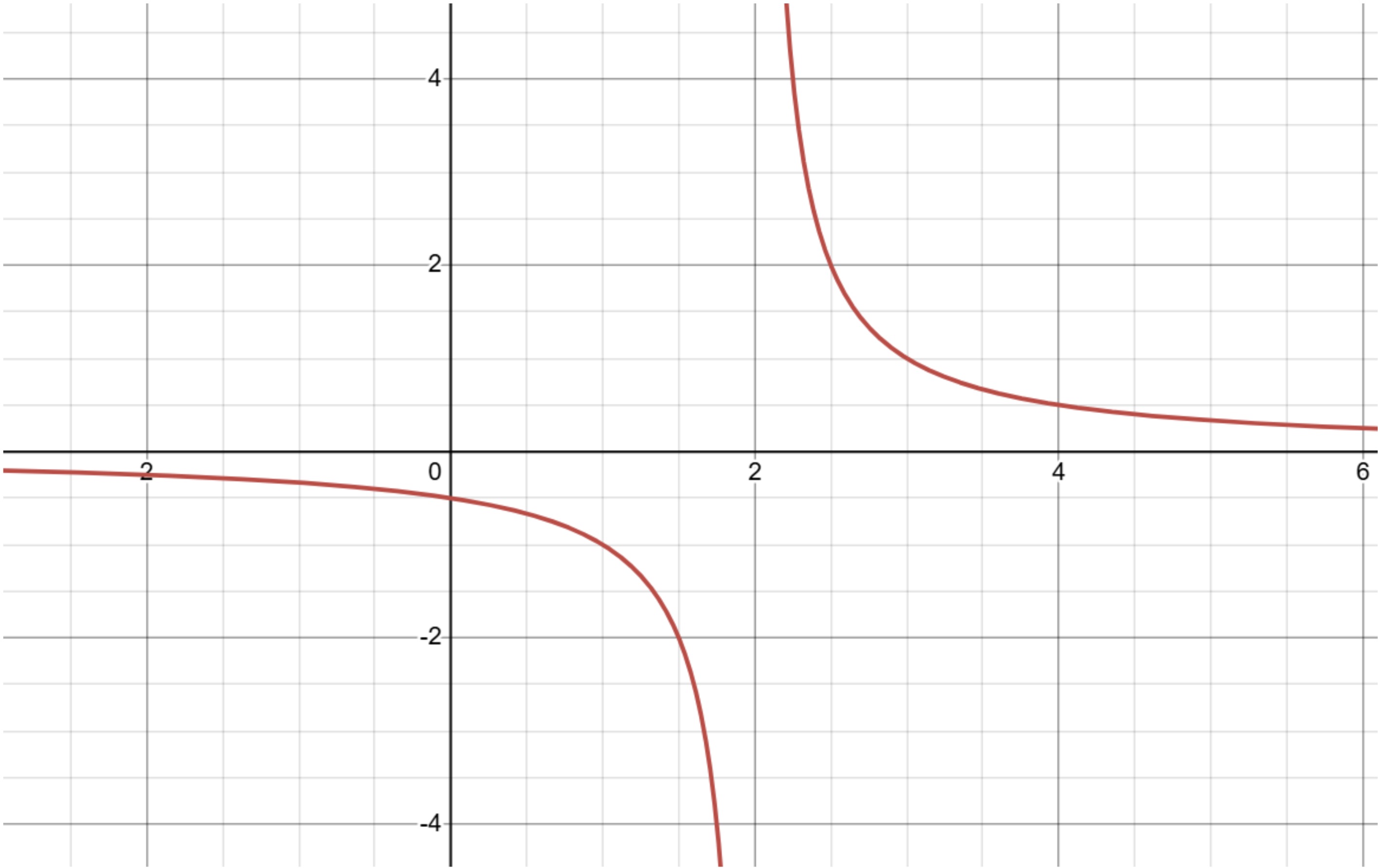
From the left side of the vertical asymptote, the function goes down to negative infinity. From the right side of the vertical asymptote, the function goes up to positive infinity. This left side right side stuff can be put into limits.