
Introduction
Welcome back to AP Precalc! In topic 1.7, we introduced the concept of rational functions. Today we’ll be going over topic 1.8, which discusses rational functions, zeros, and sign charts.
Zeros
A zero of a function is any value such that . For example, for the function , is a zero of because . If we were to graph the function, we would see that the function crosses the -axis at .
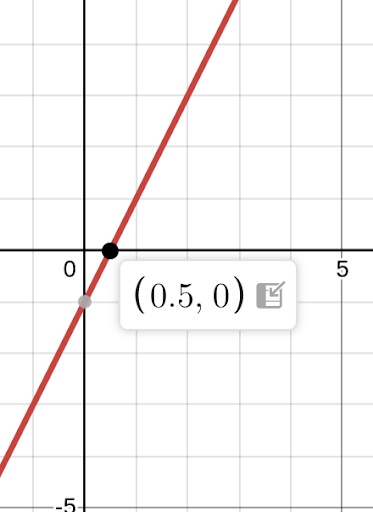
As discussed in topic 1.5, we can find the zeros of a polynomial by finding the zeros of each of its linear factors. For example, the zeros of the polynomial are and , since we can factor into .
When finding the zeros of a rational function, we look at the numerator of the function. When the numerator has a zero at , unless the denominator also has a zero at , the rational function is equal to at .
A common mistake people make when finding the zeros of a function is including zeros that aren’t in the domain of the function. For example, consider the function .
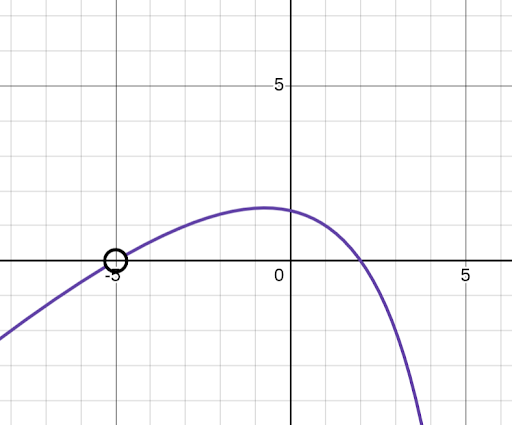
Your first instinct might be that has a zero at because it appears to intersect the -axis at that point. However, if we were to plug in into , we’d get , which is not defined. Therefore, does not have a zero at .
Simply put, if the denominator of a rational function is zero at a point, no matter what the numerator is, the function is not defined at that point and therefore doesn’t have a zero at that point.
Graphing Calculators and Zeros
The graph above clearly shows the hole at . However, if you were to graph the same function on Desmos or your graphing calculator, the hole would not be visible (since the hole in the function is infinitesimally small), and it would look like the function was defined at that point. Therefore, you should always go back and check your answer by plugging it into the function to ensure that you discard any erroneous solutions.
Sign Charts
For a rational function to change from positive to negative or negative to positive at an -value , must either have a zero at or be undefined at .
As previously discussed, a rational function has a zero at an -value if the numerator has a zero at but not the denominator. Additionally, is undefined when is a zero of the denominator. Therefore, we can find the intervals in which is positive or negative by looking at the zeros of the numerator and denominator using a sign chart.
Let’s consider the function . The real zeros of the numerator are at and , and the only real zero of the denominator is . Therefore, the only intervals we need to consider when finding the intervals where is positive are the ones below:
Since the sign of can only change when has a zero or is undefined at some -value, all -values in each interval will have the same sign. From here, all we need to do is sample a point in each interval and find its sign:
Sampling points within each interval is a valid way to generate the sign chart. However, especially if you don’t have a calculator, it can be tedious. However, we can construct a sign chart of a rational function if we know the sign of at least one open interval used in the sign chart by looking at the multiplicity of the zeros in the numerator and denominator. Consider the following partially filled sign chart for the function :
While we could sample points in each interval to create the sign chart, we only need to sample a point in one interval, and we can construct the rest of the sign chart. Sampling a point in the interval , we can see that is positive on the interval. Now let’s consider the adjacent interval . As changes from being greater than to less than , the only term in the rational function that changes sign is the term. Since one term changes signs, the sign of our function also changes when decreasing , meaning is negative on the interval .
We can repeat the process for the interval : since the multiplicity of the term is even in the numerator, when changes from being less than to greater than , no terms change sign, meaning our answer for the interval is the same as our answer for the interval , meaning is positive on the interval .
For the interval , two terms change sign when changes from being less than to greater than , meaning we change the sign of twice. Since changing the sign of a number twice is equivalent to not changing it at all, is positive on the interval . In short, if the multiplicity of the zero in the numerator minus the multiplicity of the zero in the denominator is odd, then the function changes signs when crosses , otherwise it stays the same.