
Introduction
In algebra, you learned how to solve for the value of a variable given a function: for example, if , is equal to . The way you were taught to do this is by isolating the variable on one side, and to do that, you’d perform operations on both sides of the equation to reduce it into a value for the missing variable. For the above equation, we’d solve it as follows:
: Initial equation
: Subtract 5 from both sides
: Divide both sides by 4
Notice that, in order to remove the + 5, we subtracted 5 from both sides, and to remove the coefficient of 4, we divided by 4. This is because addition and subtraction, along with multiplication and division, are inverses, meaning they cancel each other out.
Inverse Functions
An inverse function is a function that reverses the change that another function performed on an input. More formally, if the function is the inverse function of , then . We can also use inverse functions to determine the input when given the output: if , then . Note that this means that the inverse of an inverse function is the original function.
Range and Domain
For a quick recap, the domain of a function represents the set of all possible inputs to the function, while the range of a function represents the set of all possible outputs from the function. Since our input to our inverse function is the output of our original function, the inverse function’s domain is the range of the original function, and the inverse function’s range is the domain of the original function.
Graphically
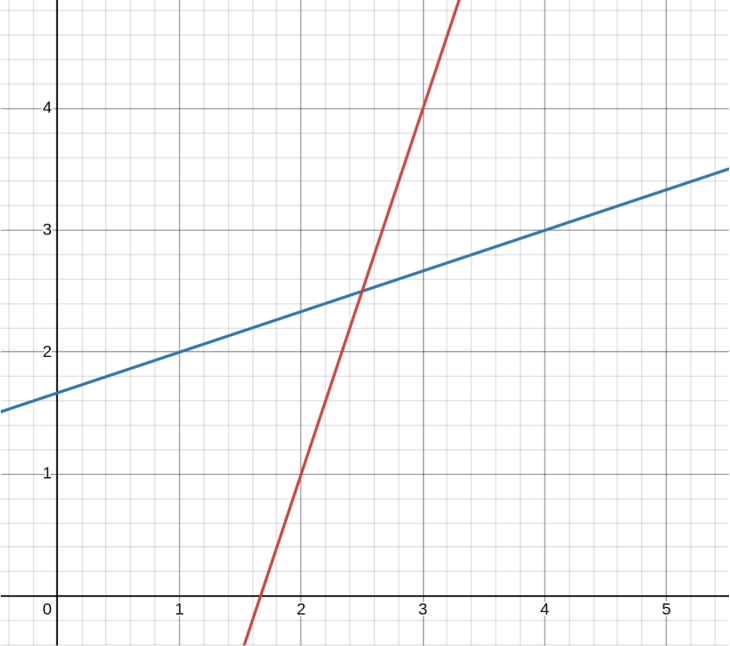
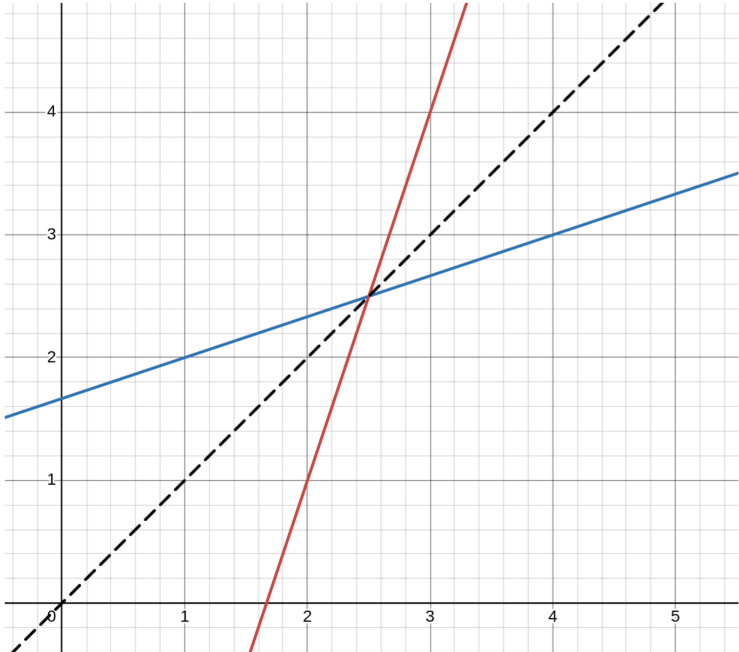
Take a look at the equation , shown in red, and its inverse function , which is shown in blue.
The inverse function of the original function is simply the original function reflected over the line .
Finding Inverses
Algebraically
Let’s take a look at the function . If we wanted to find the inverse of the function, we’d need to find a function such that .
We can solve for this using the rule we showed above
> If , then .
Let’s replace all of the instances of in the function with , and all instances of with . We now get the new equation . Isolating , we get .
Graphically
On the AP exam, you might be given a graph of a function, and asked to find the output of the inverse function at a certain input. Sometimes, you will be able to figure out the original function, and you can solve for the inverse function. However, that’s not always possible. Take a look at the following graph:
Is there an inverse?
Take a look at the graph of below, where .
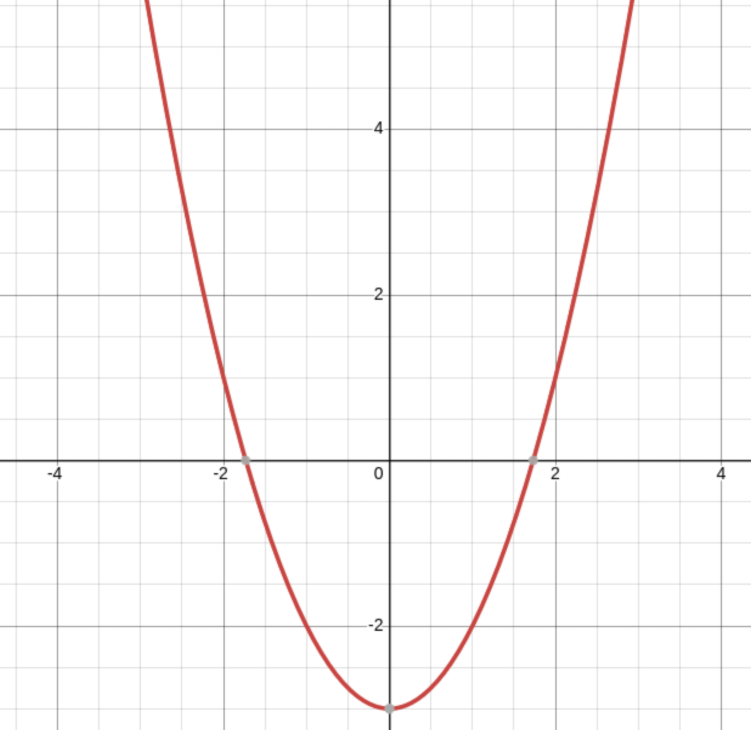
If you were to try to find the value of the inverse function for a given input using the method described above, with the exception of when the input is , you’d get two possible outputs. For example, if is the inverse of , then could equal or , since . However, an inverse function is still a function, and a function can’t have multiple outputs for the same input.
Let’s try solving this using the algebraic method.
Now we have a valid inverse function for our original function. However, this still isn’t a true inverse of the function: if we solve for , we get . When doing this, we completely ignore the other possible input where , and so we violate the rule of an inverse function. Therefore, this function is not invertible, because there are multiple outputs for a single input.
AP Exam Phrasing
The function is invertible because each input has a unique output.
The function is not invertible because multiple inputs have the same output.
They may also say “No two distinct inputs produce the same output” or occasionally refer to one of the line tests.
Domain Restriction
At the moment, the function above isn’t invertible because there are multiple inputs that share the same output. However, we can modify the domain of the function in order to make the function invertible. For example, we can restrict the domain of to only non-negative real numbers, and get the following:
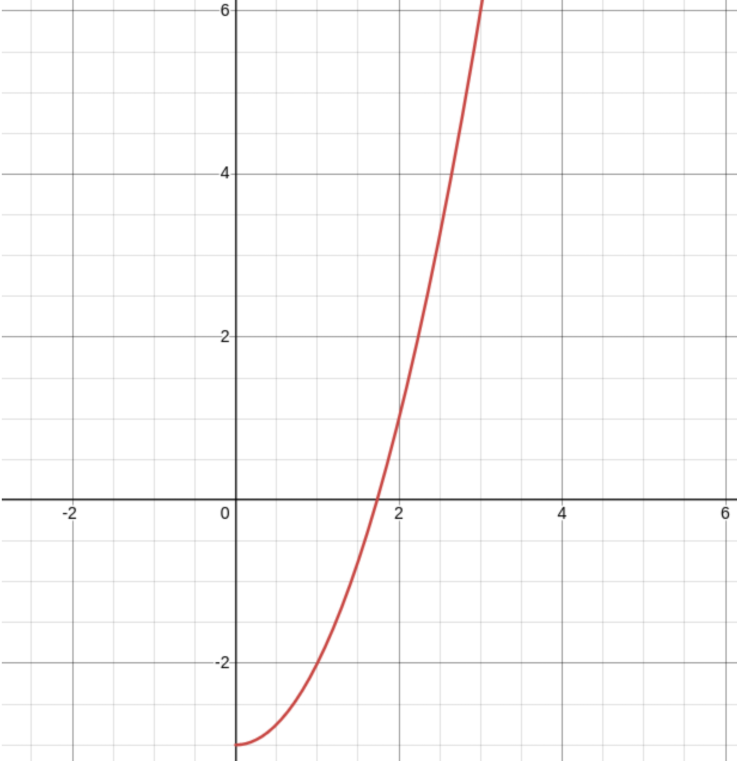
Since no two inputs share the same output, this new function is invertible, and .
These domain restrictions can be very helpful when solving problems, but you still have to be aware that there are other solutions to the problem outside of the restricted domain. For example, if you need to find where , where , you can’t just restrict the domain and call it a day, you have to be aware when you restrict the domain, and make sure to include all possible solutions in your final answer.