
2.9 Logarithmic Functions
Introduction
In sections before, you learned about the exponential functions that had the general form , which is just repeated multiplication. Logarithms undo this property of repeated multiplication. If the exponential function’s answer is “what’s the value?” then the logarithm function’s answer is “what’s the exponent?”.
Logarithmic Functions
The logarithmic function is basically the inverse of the exponential function; if , then the inverse (logarithmic) function is (read as of with base ). The two functions undo each other, just like what an inverse function and an original function do from 2.8.
The common logarithm is a logarithm with base , written as , and the natural logarithm is a logarithm with base , written as .
Domain and Range
For exponential functions, the domain is all real numbers and the range is all positive real numbers. Since the logarithm is an inverse of an exponential function, the domain and range are swapped, resulting in…
- Domain of Logarithm function: All positive real numbers
- Range of Logarithm function: All real numbers
Using a Graph
Looking at the graph below, you can see that the graphs are reflected across , further proof that they are inverses.
Key:
- The red graph is
- The blue graph is
- The black graph is
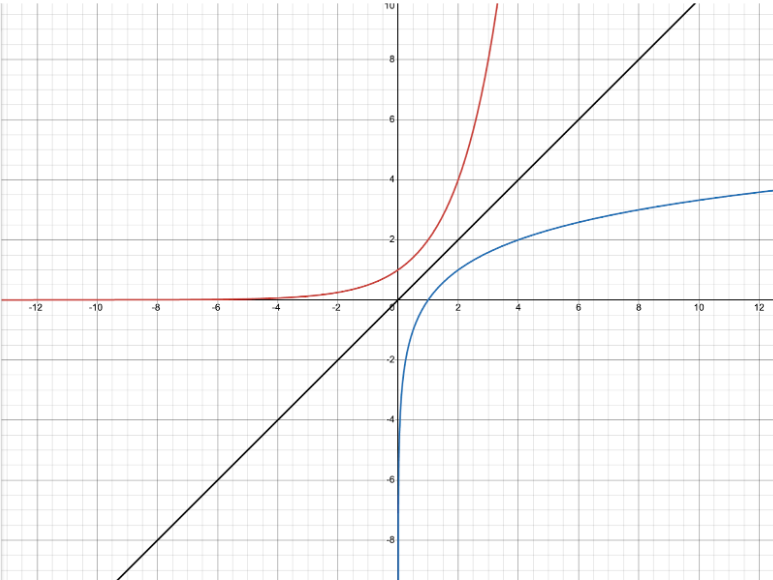
Key Features of the Logarithmic Graph
- The parent function shown has a vertical asymptote at
- Increases slowly to the right and goes without bounds when the base is greater than
- Passes through
- Only exists for
Finding Logarithms Algebraically
You can find the value asked for by simply plugging it in the general equation and solving for the unknown. You can be asked to find the value of given the expression , , or the simplest .
Example 1: Find the value of x given the logarithmic expression .
Since we know that the answer for a logarithmic equation is the exponent and that the bottom number is the base, we have , which means . Thus, .