
Introduction
Welcome! In this lesson, we will be delving into the world of exponential functions and inverse functions and putting these two big topics together into one!
Review
Remember back in Topic 2.8 when we learned about inverse functions? If you don’t remember or didn’t read it, I highly recommend you pay close attention to this review and/or quickly revise that topic. We also discussed logarithmic functions in Topic 2.9, which we will revisit in this topic. Finally, we talked about the center of our title– exponential functions– all the way back in Topic 2.3. Everything is just building up on top of each other.
An essential property of inverse functions is that if , then . If the output of the function is put into the inverse, you get the input of the original function.
Logarithmic functions are written in the form . One important property you need to know here is that if , then .
Inverse of Exponential Functions
If we take a generic exponential function, say , how would we go about solving for its inverse? Well, we can say that so we get . Then, we can simply solve for .
.
How do we solve for in this case? Well, this is where we introduce logs!
Let’s reapply what we said earlier, where can be rewritten in the form . Well, what if we want to solve for ?
If we go to our second statement, , we can have our current expression on both sides be the exponent, and have a base of . If we apply this, we get . Notice that this new equation correlates to the log equation of if we match it back. However, we know that , so .
If you don’t understand what just happened, don’t worry. All you need to know is that . This means that if we have something like , that is just equal to .
We can apply this to solve for .
Let’s continue from this step:
Now, we can simply take the log of both sides with base .
This is the inverse of the function . Let’s now apply some numbers into this and do a quick algebraic example.
Inverse of the Exponential Function
Although we can go on and on about how all of this works, the AP exam requires you to know more concepts.
I think logs popped in quite abruptly to the party, so let’s formally introduce them! Logarithmic functions are the inverse of exponential functions. This means that they both follow the properties of inverse functions. For example, one of the properties of inverse functions is . If and . Let’s plug in the functions and see if it works!
.
Behavior of the Functions
The AP exam also expects you to know the behavior of both functions, but you can figure this out just by the fact that exponential and logarithmic functions are inverses. You can expect that if the exponential function is able to go up very fast, then the inverse goes up very slow. Of course, you need to know a little more.
Take . Let’s plug in the values of and and compare the values.
Notice that as the increases by one, the output is multiplied by the base once. This means that the input and output are proportional. Now, let’s take another function.
Take . Since is the inverse of this function, let’s take the outputs we got from and put it as the input of .
Notice that as the increases proportionally, the output is increased by one. This still means that the input and output are proportional, but it is in a different way compared to the exponential functions.
Graph of the Functions
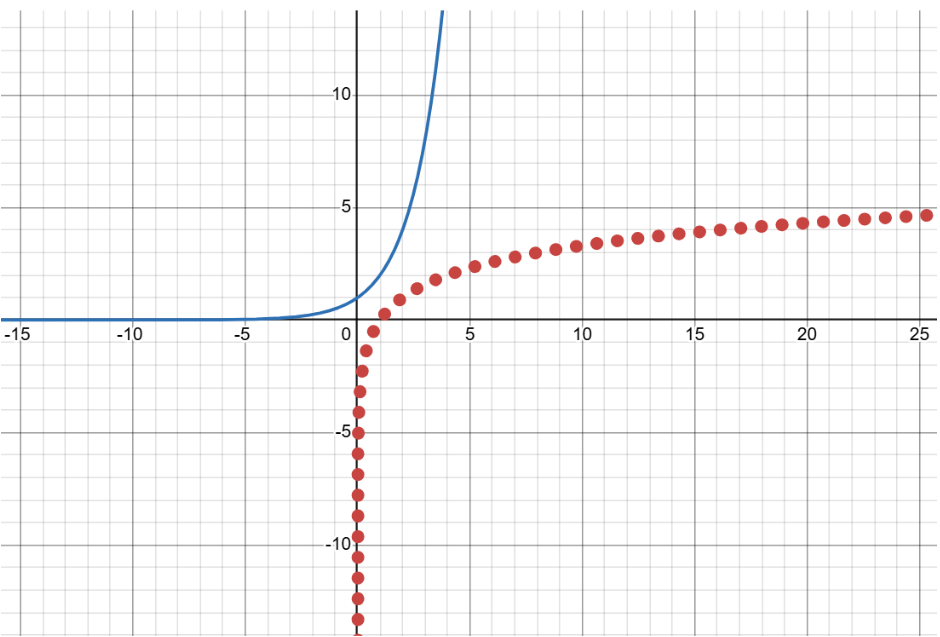
Let’s play a game! Based on your current knowledge of functions, which function is which? One of them is and the other is . I’ll give you some hints… but first, notice how both functions look sort of similar to each other. If you reflect both of the functions along , it becomes easier to see.
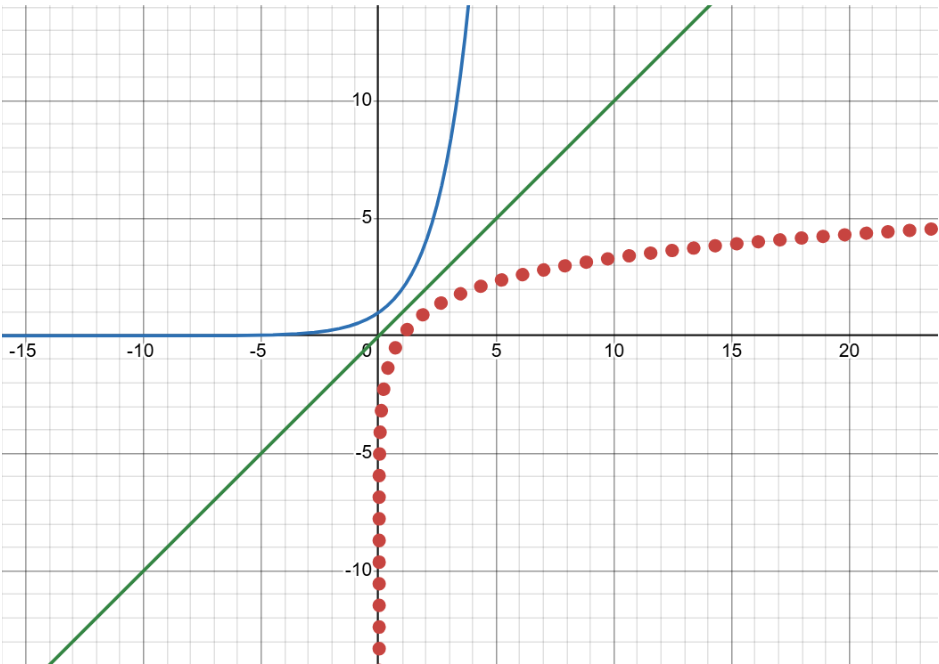
Do you know which function is which? Let me give some more hints. Did you know that all this time, I’ve forgotten something? The log functions and the exponential functions all don’t work if is less than or equal to zero. Try to show that anything works if we have a negative base in our log, it actually doesn’t work. Also, anything with a zero base doesn’t work. That’s a pretty big hint.
Here’s one more good one. The base in a logarithm cannot be either. I encourage you to try to figure out why is simply not valid starting from here. If you think you’ve got it, you’ll get one of the questions correct on the problem set below! Have fun!