
Introduction
Welcome to Topic 2.11! Today you'll learn what logarithmic functions are, why they behave the way they do, and how to work with their graphs and transformations.
Logarithmic Functions
A logarithmic function is defined as the inverse of an exponential function.
For a given base , the equation is equivalent to .
Using this, we can derive some of our basic logarithmic identities.
- where
Additionally, Exponential functions have the domain , and the range , and the logarithmic function is the inverse of the exponential function, the domain of is and the range is .
If , , and when , .
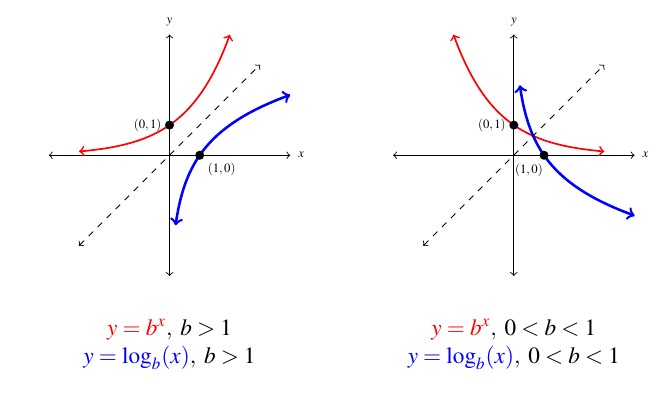
Credits to Texas A&M
Monotonicity and Concavity
Logarithmic functions are monotonic, meaning they are always increasing or always decreasing. Due to this, they also don’t have any extrema, with the exception of when its domain is restricted, in which case, the extrema of the function is its endpoints.
When , the logarithmic function is always increasing on its domain, and when , the logarithmic function is always decreasing on its domain.
Moreover, logarithms have the same concavity and no inflection points. If , the graph is always concave down on its domain; if , the graph is always concave up on its domain.
This means that when , the logarithmic function is increasing at a decreasing rate, and when , the logarithmic function is decreasing at an increasing rate.
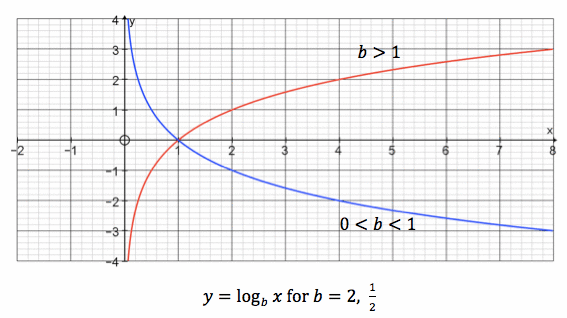
Credit to MathSpace
Additive Transformations
Adding a constant to inside the logarithmic function shifts the graph horizontally, but does not change the shape. Similarly, if you add a constant to the output, it will simply shift the parent log function up or down.
Additive property of logs
A characteristic of logarithms is that equal increments in the output (y) correspond to constant multiplicative changes in the input (x). For instance, with , must double in order for to increase by one.
In general, if the inputs to a function are proportional over equal length output values, then the function must be logarithmic. Equivalently, if the outputs to a function are proportional over equal length input values, it would be exponential. Vertically or horizontally shifting the function does not modify this property.
Vertical and End Behavior
A logarithmic function has a vertical asymptote at . Remember, if , , and when , .
Additionally, the behaviors are reversed when considering as it grows infinitely large. if , , and when , . Because of this, there are no horizontal asymptotes.