
Introduction
Welcome to another AP Precalculus article!
In this article, we will be covering 3.2, also known as Sine, Cosine, and Tangent.
This article covers the basics of the three trig functions, which are fundamental to the study of trigonometry!
The learning objective is as follows:
- 3.2.A: Determine the sine, cosine, and tangent of an angle using the unit circle
Angle Basics
This topic is pretty vocabulary focused, so let’s dive right into it!
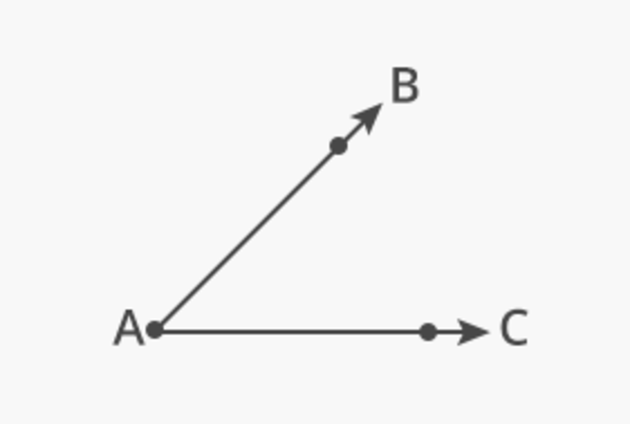
A side note: A ray is a part of a line that has a single, fixed starting point called an endpoint and extends infinitely in one direction. An angle is the rotation of a ray from an initial point to a terminal point. In this picture, C is the initial point & A is the terminal point.
First, an angle in standard position is when the vertex (at ) is based around the origin, and the one ray is on the -axis, specifically on the positive side, known as the INITIAL RAY. The positive side is from . The other ray is known as the terminal ray, which is the end of the angle, based on . is read as theta and is the measurement of an angle.
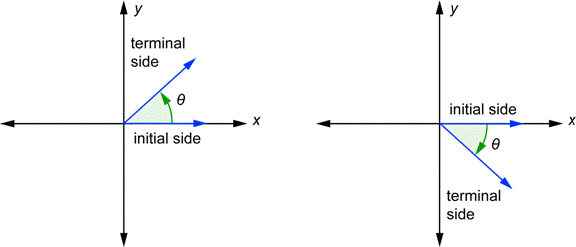
By the way, you will see A LOT for the rest of this unit, so become best friends with . Also, AP Precalculus uses radians, not degrees. Radians are measurements usually in increments of , BUT do not have to be.
Well, what is a radian?
A radian measures how far an angle opens using the arc length of a formula.
Key Idea #1: , where is measured in radians for both formulas.
The unit circle has a radius of . Hence, the radian measure is just the length of the arc.
Finally, how do we convert between radians and degrees?
Well, we convert by this formula.
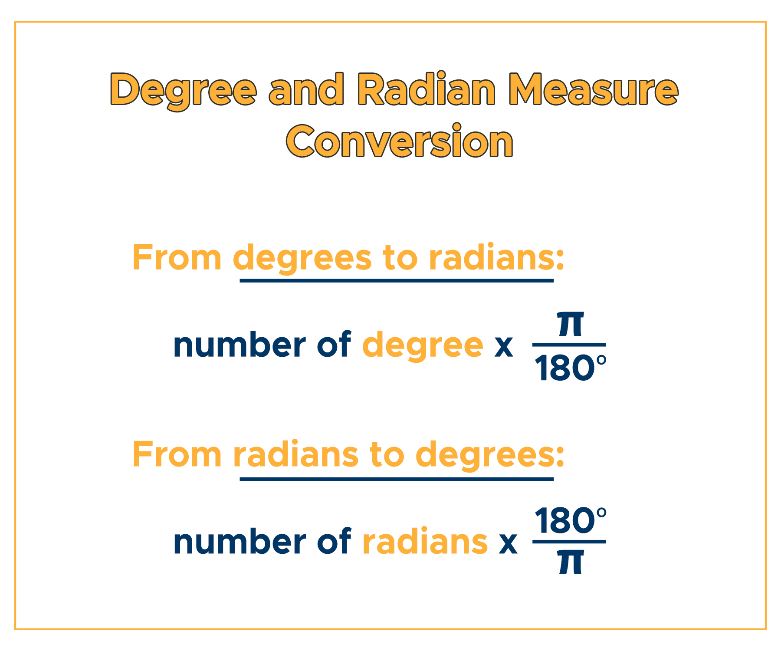
As we see with this formula, if we plug in which is a radian measure to convert into degrees, we get . This shows that is the circumference of a unit circle with a radius of .
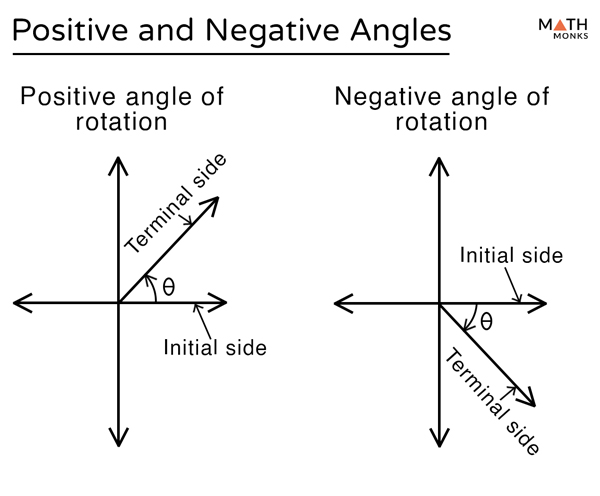
Back to angles, there are two types of angles: positive and negative angles; they both measure rotations from the positive -axis in a counterclockwise or clockwise direction.
Positive angles measure rotations () in the counterclockwise direction.
Negative angles measure rotations () in the clockwise direction.
The last definition for angles is co-terminal angles. These special angles are different angle measurements that share the same initial AND terminal sides. They can pretty much be seen by rotating or , in any multiple of these numbers ( or , or , etc.)
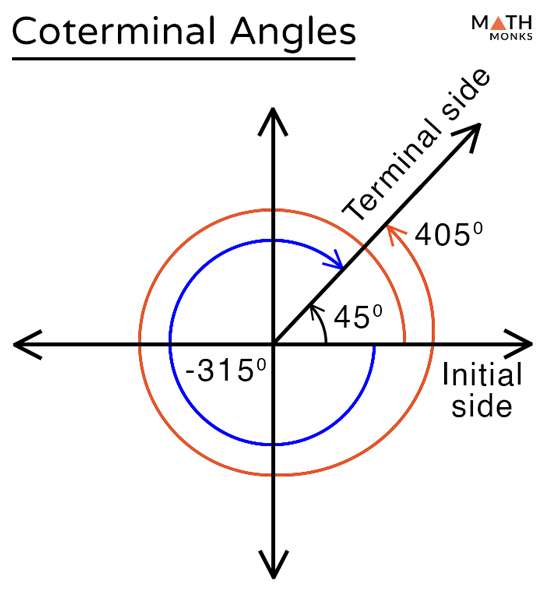
Let’s do some quick practice with these new ideas before moving on to the next topic. Even though some questions use degrees here, AP Precalculus ONLY uses radians.
- Is in the clockwise direction, a positive or negative angle?
- Is in the counterclockwise direction, a positive or negative angle?
- What is one example of a coterminal angle of as a positive angle?
- Convert to degrees
- Convert to radians
Solutions for Angle Basics:
- Negative angle because an angle rotating in the clockwise direction is negative.
- Negative angle because an angle that is negative & rotating counterclockwise would be negative
- , where , examples include , , etc.
Sine, Cosine, and Tangent
Now that we learned all that we need to know about angles, we will move on to the big chunk of this topic, finding sine, cosine, and tangent based on the unit circle.
For the next 3 categories, it goes like this:
“Given an angle in standard position and a circle centered at the origin, there is a point, P, where the terminal ray intersects the circle.” - College Board
This applies to sine, cosine, AND tangent. In simple words, when you draw an angle in standard position, its terminal side will hit the circle at some point, known as P.
- The sine of the angle is or can be represented as
- The cosine of the angle is or can be represented as
- The tangent of the angle is or also known as the ratio of or can also be represented as
Vertical displacement is how far a point is above or below the -axis.
Horizontal displacement is how far a point is left or right from the -axis.
For both of these, direction matters. Going in the positive direction on the -axis or -axis (right and up, respectively) is equivalent to positive displacement, and going in the negative direction on the -axis or -axis (left and down, respectively) is equivalent to negative displacement
Key Idea #2: If the circle is a unit circle, or a circle with a radius of , then the sine of an angle is the - coordinate and the cosine of an angle is the -coordinate.
Key Idea #3: The tangent of the angle is the slope. Because it is the ratio of the - coordinate over the -coordinate.
Try one practice problem with me before you move into the practice section!
If we are on the Unit Circle, what is the horizontal and vertical displacement at ?
What is the sine, cosine, and tangent of this coordinate?
Here are the answers:
- The horizontal displacement is , hence the cosine of this coordinate is also because it’s a unit circle.
- The vertical displacement is , hence the sine of this coordinate is also because it’s a unit circle.
- The tangent of this coordinate is because the is equivalent to which equals a nice and simple .
Practice
Now that you have become pros of this topic, try some practice questions to truly master this topic!