
Introduction
Welcome to another AP Precalculus article!
In this article, we will be covering 3.1, also known as Periodic Phenomenon.
This article is the basis for all of trigonometry that you will be learning for the rest of the unit!
The learning objectives are as follows:
- 3.1.A: Construct graphs of periodic relationships based on verbal representations
- 3.1.B: Describe key characteristics of a periodic function based on a verbal representation
Background
So without further ado, let’s dive straight into:
Well, we can’t dive into this, without knowing what a period is right?
So, a period is just how long it takes for a function to repeat again.
Looking at this graph, what is the period?
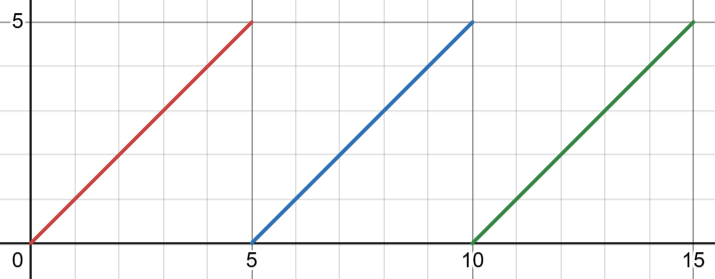
The period is , because from the smallest point at to the next smallest occurrence of the same point at , it takes exactly -values!
Another thing, now that we know what a period is, we need to talk about the AP phrasing:
This is what CollegeBoard wants you to define as a periodic relationship:
“A periodic relationship can be identified between two aspects of a context if, as the input values increase, the output values demonstrate a repeating pattern over successive equal-length intervals.”
And looking at this definition, you already did this!
Our last example of looking at a repeating linear function was identifying a periodic relationship!
Key Idea #1:
If you know the period value and what the graph looks like on the period, you can reconstruct the graph for the entire set of -values.
Let’s test this key idea in action!
Hence, let’s look at this graph:
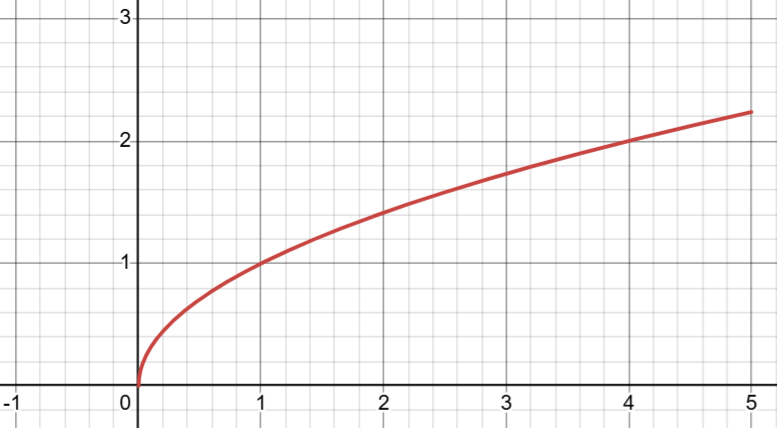
Quick question, what’s the period of this function?
If you said , you are correct!
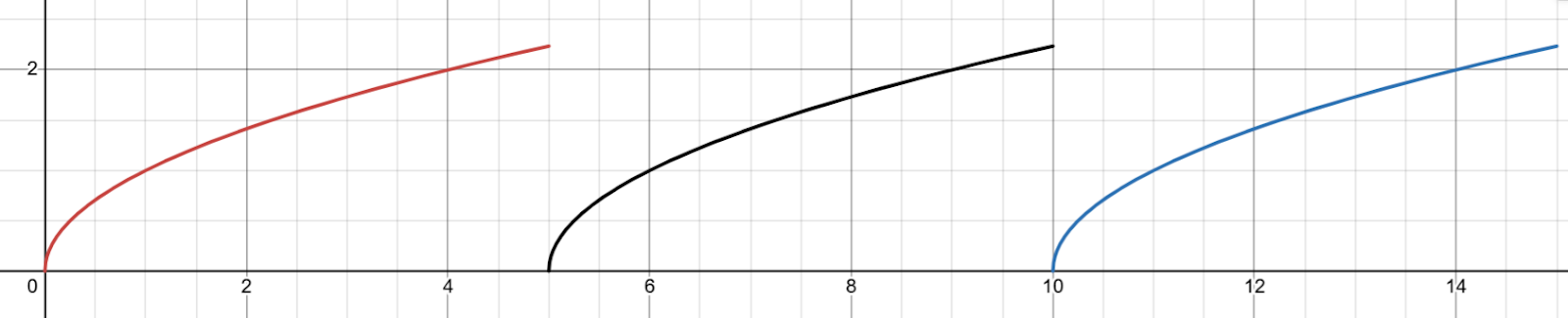
Now, on a piece of paper or on Desmos, try to make the 2nd & 3rd periods, also known simply as making the graph again on a new interval of !
If done correctly, it should look similar to this:
Now we are going to move on to some final notes for this topic!
Key Idea #2:
One period of a function determines the behavior of the function for the whole function!This can be seen with our previous example of this graph:
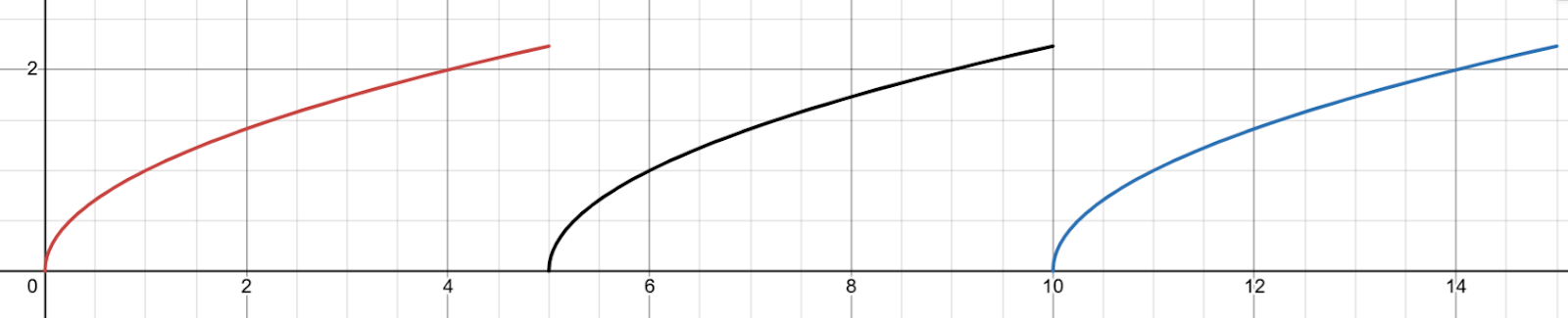
Our minimum will always be , on all real values of . It will also always increase over its period.
This demonstrates that knowing one period can determine, “intervals of increase and decrease, different concavities, and various rates of change”. This is similar to other functions, but in periodic functions, you can find out from just one single period!
All of these ideas combined can allow you to estimate values far off the range of a function because a period is just a pattern that repeats!
This can also be illustrated algebraically as where is your period.
Key Idea #3:
Now that you have learned all of this, for the rest of the unit, you will be applying this to Trigonometric and Polar Functions. This includes our basic trig functions: , , , , , and , all of which are periodic functions.
Practice
Now that you have become pros of this topic, try some practice questions to truly master this topic!