
Introduction
Howdy everyone! Today we’ll be going over topic 3.4 in AP Precalculus, which covers the graphs of the parent sine and cosine functions. We will be taking the values that we found for the sine and cosine functions from topic 3.3 and graph them on the coordinate plane.
AP Course and Exam Description Overview
The AP Course and Exam Description expects you to know how to construct representations of the sine and cosine functions using the unit circle. What does that even mean? Let’s find out.
Sine and Cosine Values on the Coordinate Plane
We will take the values we found for the sine and cosine functions in topic 3.3 and plot them onto the coordinate plane.
Now, we will plot these points for both and .
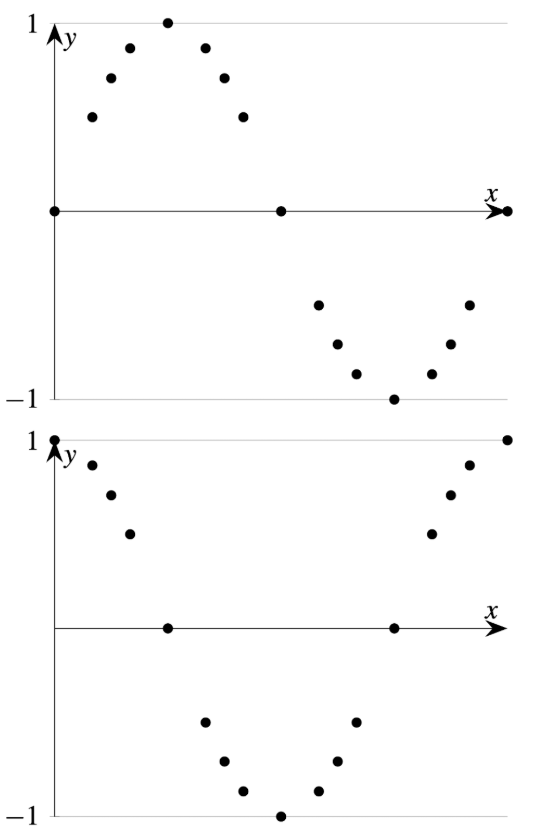
Now let’s connect the dots together :O
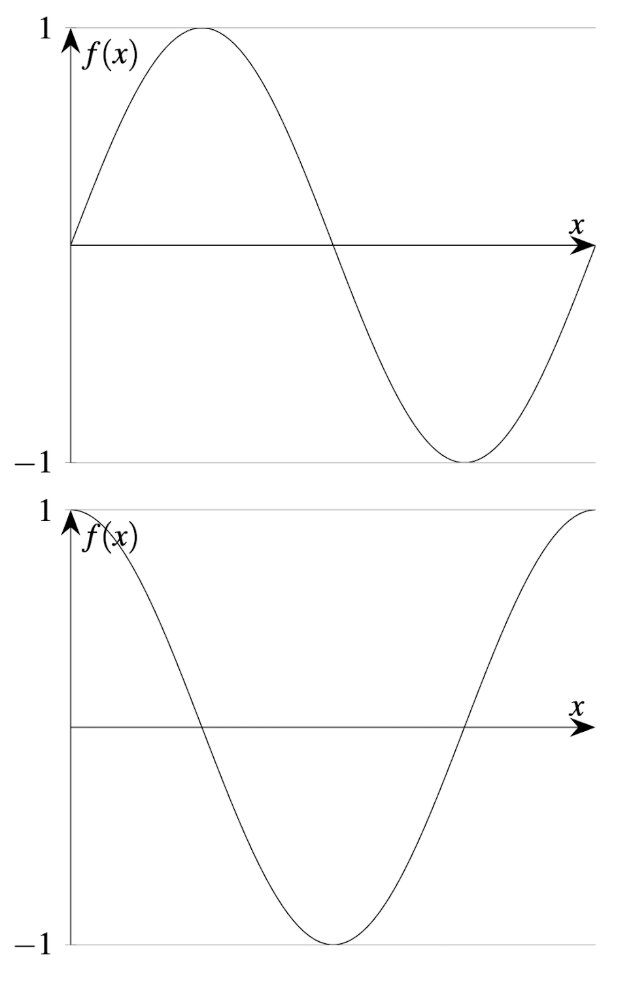
And that right there is a sinusoid function! The first one is the parent sine function, and the second one is the parent cosine function. We call them sinusoidal functions because of the distinct shape they have, as well as some properties we’ll look at in topic 3.5.
So what are some interesting features of these sinusoidal functions?
- They’re periodic functions. The graphs I gave of these functions only covers the domain , but these functions will cycle through these plotted values forever.
- The output values oscillate between and as the input values increase at consecutive equal-length intervals.
- The domain of sinusoidal functions is all real numbers; there are no discontinuities (This will be very important when covering the tangent function, or the reciprocal trigonometric functions).
Let’s get a bit more analytical about these functions. For the parent sine function:
- The intercepts occur at , where is any integer.
- The maxima occur at , where is any integer.
- The minima occur at , where is any integer.
- The function is concave down on the interval @n$ is any integer.
- The function is concave up on the interval , where is any integer.
For the parent cosine function:
- The intercepts occur at , where is any integer.
- The maxima occur at , where is any integer.
- The minima occur at , where is any integer.
- The function is concave down on the interval , where is any integer.
- The function is concave up on the interval , where is any integer.