
Howdy! Today we will go over the formal definition of a sinusoidal function and its key characteristics. This article will combine the knowledge we have gained from topics 3.3 and 3.4 and expand on certain topics.
AP Course and Exam Description Overview
The AP Course and Exam expects you to identify the key characteristics of a sinusoidal function, which includes the following:
- additive and multiplications of a sine or cosine function
- the period and frequency
- the amplitude, and
- the symmetry of a sinusoidal function.
The Definition of a Sinusoidal Function
A sinusoidal function is defined as any function that is a transformation of a sine function or a cosine function . Their shape, which is known as a sinusoid, can be seen in the following graph of the function .
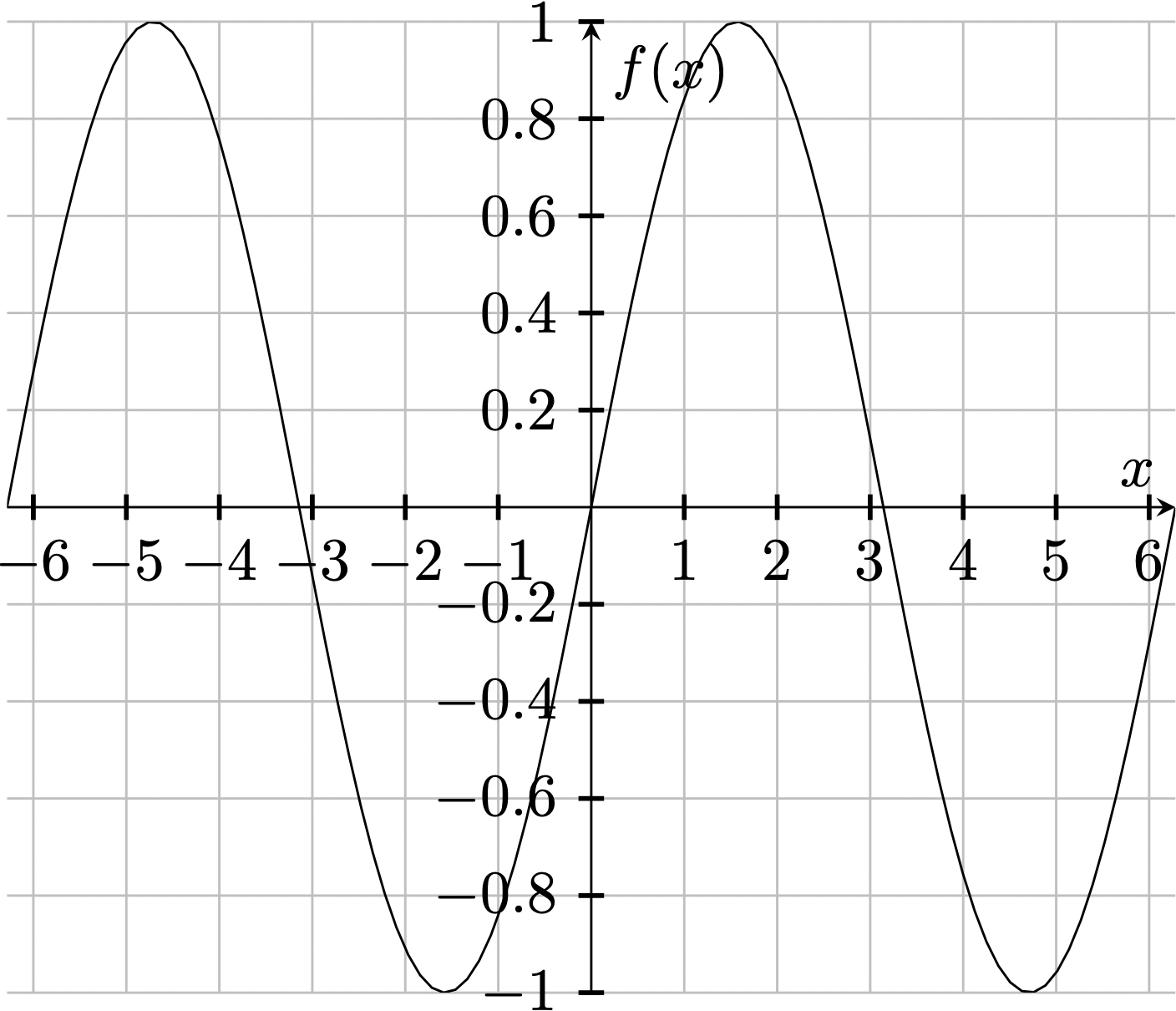
One thing to note about the sine and cosine functions is that each one is a phase, or horizontal, shift of each other by . For example, the cosine function is equal to . We will go more in depth into phase shifts in topic 3.6.
Additionally, each parent sinusoidal function has its own kind of symmetry. The parent sine function has rotational symmetry about the origin, and the parent cosine function has symmetry across the axis. In other words, and .
Amplitude, Midlines, Frequency, and Period
Next, we will discuss the amplitude. The amplitude of a sinusoidal function is the distance from the center of oscillation (or the midline) of the sinusoidal function and its maximum or minimum values. It can also be defined as half the distance between the minimum and maximum values. The parent sine and cosine functions have an amplitude of ; that is to say that the distance between the center of oscillation and its maxima or minima is equal to .
Let's use the following graph as an example.
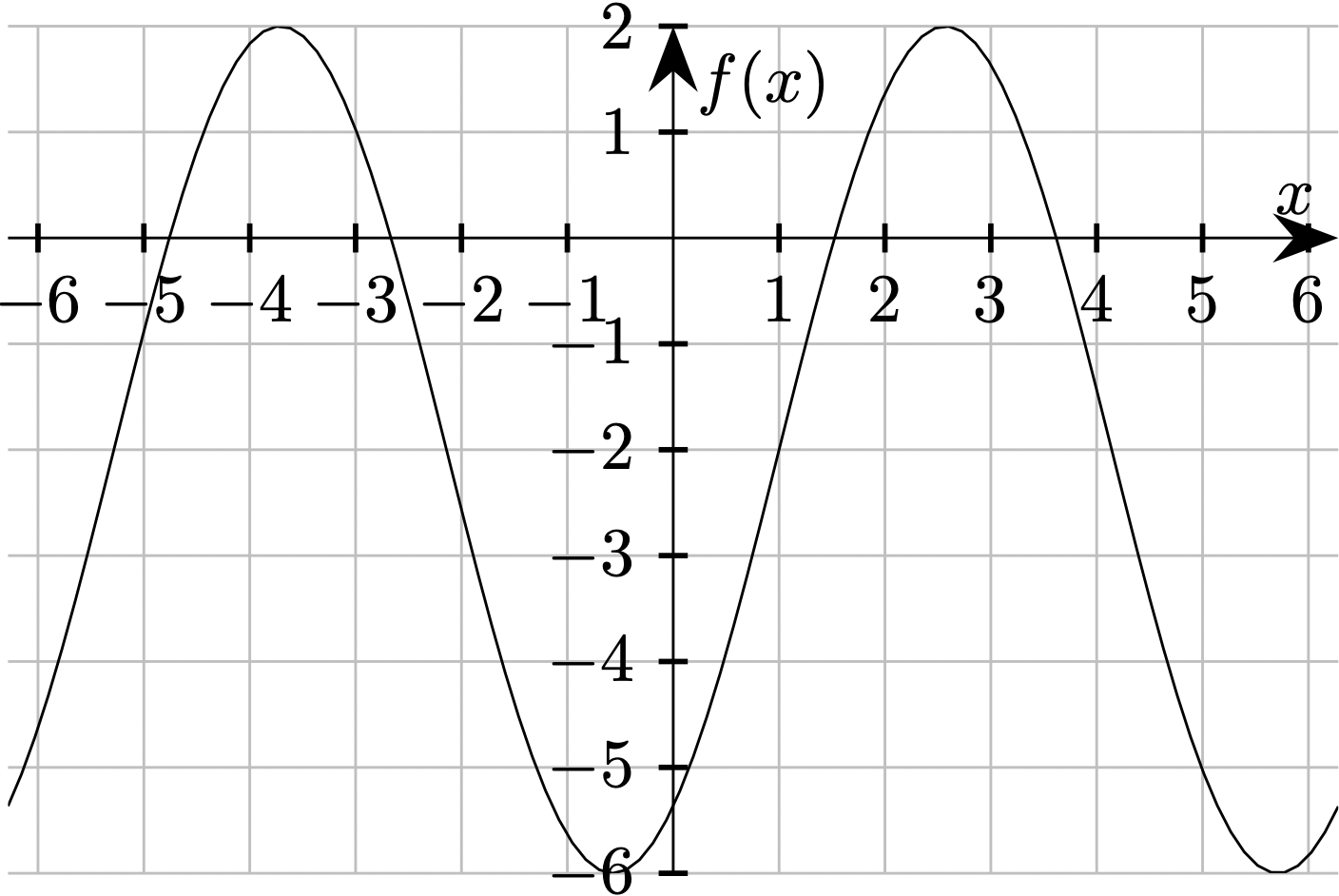
We know that the value of the minima is and that the value of the maxima is . If we divide the distance between these minima and maxima by two, we'll get our amplitude. In this example, the distance is . Dividing this value by two gets us the amplitude of .
We can use the amplitude to help us find the midline, or the center of oscillation, which is a line that the function will oscillate about. The midline is an imaginary line; it doesn't exist in the graph, but it does help us visualize the graph more easily.
To find the midline or center of oscillation, take an extremum (either a minimum or maximum) and either add or subtract the amplitude until you reach the halfway point between a minimum and a maximum. We could also average the maximum and the minimum of the function. If we were to do this with the graph above, our midline would be , which is marked by the red line in the graph below.
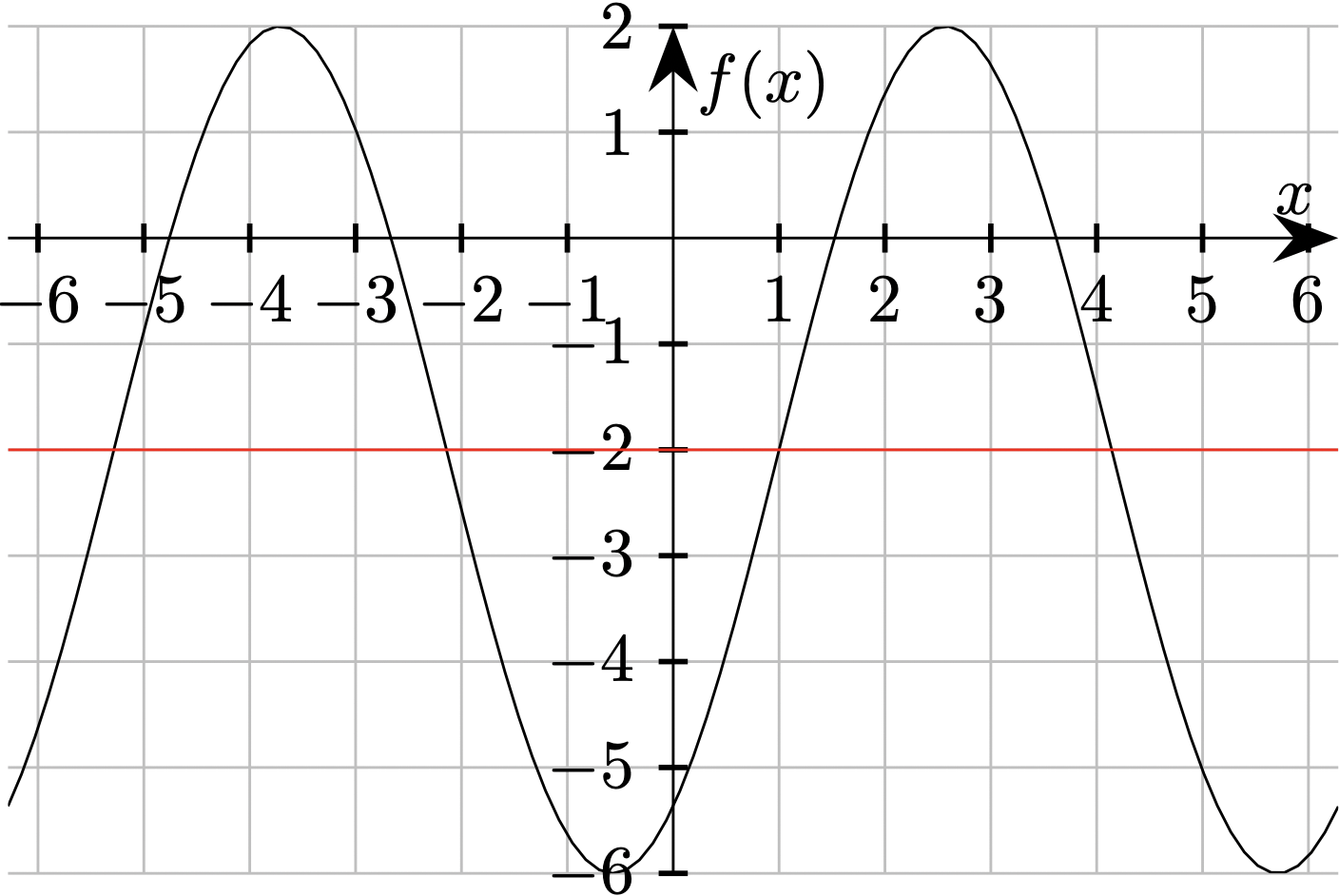
Since sinusoidal functions are periodic, their output values cycle at equally-spaced intervals. Therefore, we can compute their period and frequency. The period is simply the length of a cycle, which for sinusoidal functions, can be found by finding the distance between two extrema with the same value. If we don’t know the extrema, we can also find the amplitude by selecting a point on the graph, and finding the -value of the second occurrence after the selected point, and finding the distance between them. For the example above, the distance between the two points is .
We can also find the frequency of the function, which is simply the reciprocal of the period. The frequency represents the number of cycles per a given interval. It can be expressed as , where is the frequency and is the period of the function. Therefore, the frequency of the graphed function above is .
Concavity
One interesting note is that the points of inflection (where the function changes concavity) fall along the midline of the function, which applies to all sinusoidal functions that you'll see in AP Precalculus.
As a review, concavity represents the behavior of the second rate of change. A concave up function, which will look like a cup or a smiley face, will have a positive second rate of change (or an increasing first rate of change), and a concave down function will have a negative second rate of change (or a decreasing first rate of change).
One interesting note is that the points of inflection (where the function changes concavity) fall along the midline of the function, which applies to all sinusoidal functions that you'll see in AP Precalculus.