
Introduction
Howdy everyone! Today we will cover the topic of holes in rational functions. While we have done work with finding the zeroes and vertical asymptotes of rational functions, there are some times where both occur at the same place. In this case, the graph isn’t defined at that point, but it still exists around it.
Course and Exam Description Overview
The AP Precalculus Course and Exam Description expects you to be able to identify the amplitude, vertical shift, and period of a sinusoidal function. These attributes of a sinusoidal function are important when sketching a graph and analyzing its behavior.
The Form of a Sinusoidal Function
All sinusoidal functions can be written as or , where:
- is the amplitude, or the distance between the midline of the function and an extremum (minimum or maximum),
- is a horizontal dilation (stretch or compression),
- is the phase shift (horizontal translation), and
- is the vertical translation of the midline
Note that in this case is our input. However, you may occasionally see other inputs like or ; it really just depends on the problem.
If a sinusoidal function is written differently or simplified, we will need to transform it into one of the forms above. If the sinusoidal function is written in a different form and you try to evaluate the transformations as is, you may end up making mistakes, especially when it comes to the phase shift and the horizontal dilation.
Finding the Amplitude of a Sinusoidal Function
The amplitude of a sinusoidal function is the distance from the center of oscillation to either the minima or maxima of the function. The amplitude is simply the coefficient that the whole sine or cosine term is multiplied by. The amplitude of the parent sine or cosine function (the function which has no transformations done to it) is . Let’s practice with two examples:
Example 1: Find the amplitude of the function .
Solution: We will just find the coefficient of the sine or cosine term, in which case, is . Therefore, the amplitude is 4.
Example 2: Find the amplitude of the function .
Solution: Again, we will take a look at the coefficient of the sine or cosine term. The coefficient of the cosine term is . Therefore, the amplitude is .
NOTE: The amplitude is NOT the distance between the minimum and maximum! This is a common mistake by many students. The amplitude is the distance between the midline and either the minimum or the maximum, as the following graph of shows:
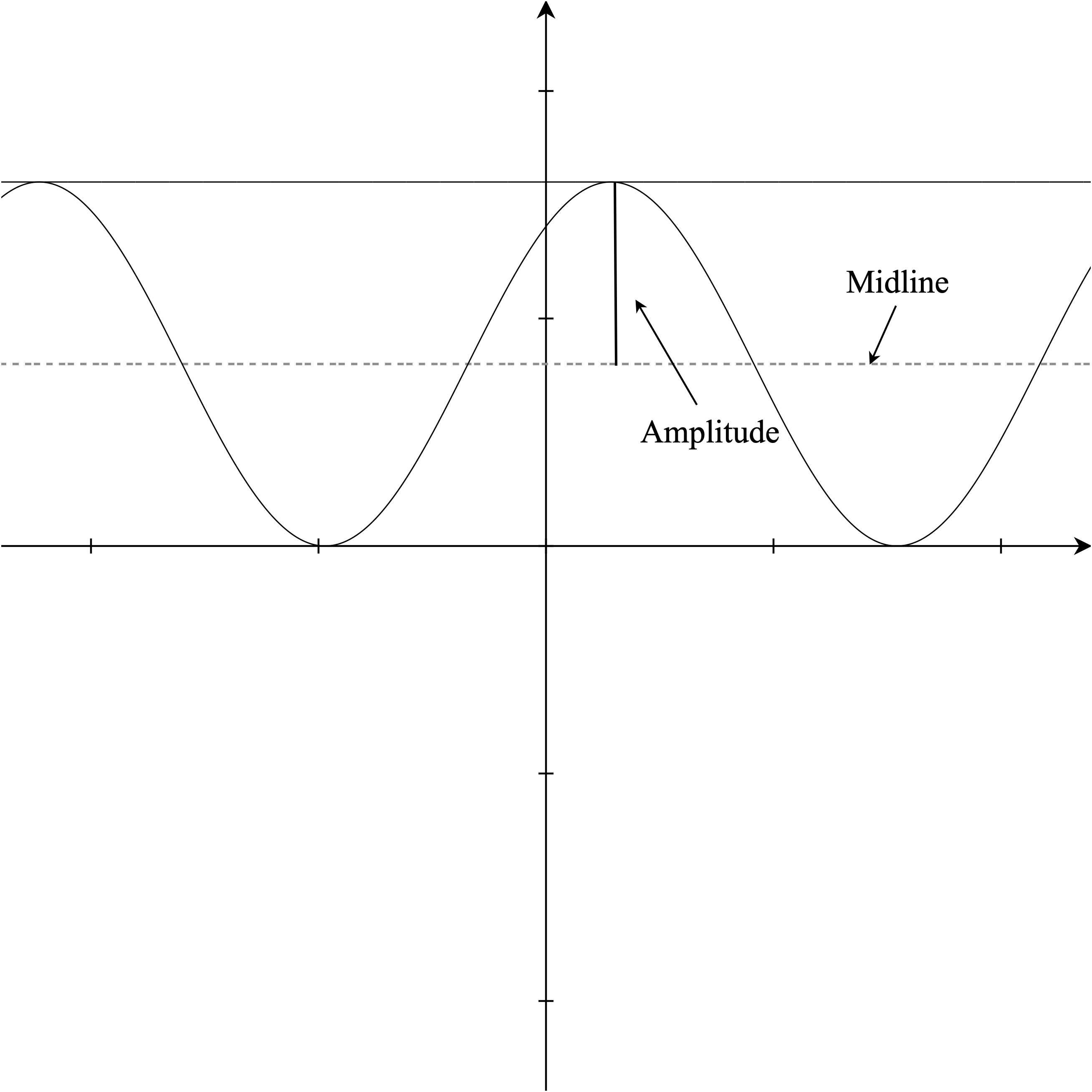
Figure 1: A graph of
The distance between the minimum and the maximum is double the amplitude of the function.
Finding the Horizontal Dilation Factor and Period of a Sinusoidal Function
To find the factor by which the function is dilated by, we will need the term of or . In order to find the term on a sinusoidal function that is not in the form above, you will need to factor the inside of the sine or cosine function. If you don’t do this, your answer will be incorrect. We will need this factor in order to find the period, or the “width” of each cycle of the sinusoidal function.
Example 3: A function is given by . Let be defined by . By what factor is horizontally dilated compared to ?
Solution: We will first need to factor the part of the function that is inside the sin to get into the form .
Now our function is in the form, so we can just go ahead and take our term for . Recall that the term is our horizontal dilation factor compared to the parent function, which is given as in this problem (the factor is always 1). So our final answer is 7.
Finding the Period
To find the period, we will need to divide by our term. Thus, the period is given by . The reason why is absolute in this question is because we only care about the magnitude of as the period is always positive.
Example 4: A function is given by . What is the period of the graph of ?
Solution: We will first need to find our term. We already did this in the example above; our term is 7. We will need to divide by our term to find the period. Thus, the period is .
Finding the Phase Shift of a Sinusoidal Function
The phase shift of a sinusoidal function is just a fancy term for the horizontal translation (this only applies to periodic functions; please don’t go around saying the phase shift of a parabola :D). To find the phase shift, we will need the term of the function or .
Example 5: A function is given by . Find the phase shift of .
Solution: We will first need to factor the part of the function that is inside the sin to get into the form .
Now that we have our function in the form , we can look for our term. Our term appears to be , but be careful! You need to pay close attention to the signs in this case. Recall that a positive horizontal transformation indicates that it is shifted to the left, while a negative horizontal transformation indicates that it is shifted to the left. Because our term is being added, the function is being phase shifted to the left. Therefore, the phase shift of is units to the left.
There is an interesting thing to note here: To “transform” a sine function into a cosine function or vice versa, you can simply phase shift the function by units to the left.
Example 6: A function is given by . Rewrite this function in terms of cosine.
Solution: Just like when we are finding a phase shift, we will need to factor the stuff inside the parentheses to get the function into the form . If we just add to the stuff inside the parentheses, we will get a different phase shift which will be incorrect for our purposes. Thus, will be rewritten as the following:
Now we will add to the term and change the sine to cosine.
We can then simplify this to get our newly rewritten function in terms of cosine.
Finding the Vertical Shift of a Sinusoidal Function
Lastly, we will cover finding the vertical shift of a sinusoidal function; that is, by how much the function is “lifted” or “lowered.” Finding the vertical shift is more straightforward; it’s usually the term added to the whole sine or cosine bit, aka the term. It’s the same way you find the vertical shift for any other function.
Example 7: A function is given by . Find the vertical shift of .
Solution: We will take a look at the term of this function, which in this case is . Because the value of is negative, this function has been shifted downward.
We will add or subtract this value to the midline of either one of the sinusoidal functions to get the new midline. Because the midline is a line, you’ve got to include . So in this case the midline is .
Finding the Above Graphically
On the AP exam, you may be expected to do everything above from both a given function as well as a graph. The process is mostly the same for the vertical shift and amplitude, but gets a bit quirky with finding the phase shift and the period; most notably, the phase shift.
Example 8: The graph of a sinusoidal function is shown below. It is known that the function below can be written as . Find values for the constants , , , and . (Note: Each vertical tick represents 1 unit, and each horizontal tick represents units.)
Solution: We will first start off with the amplitude of the sinusoidal function. It is known that the amplitude is the distance from the midline of the function to its extrema, or half the distance from its minima to the maxima. In this graph, we can see that the distance between the extreme is . We will divide this by two to get our amplitude, which is . This is our value, so .
Next, we will find the vertical shift of the midline, which is our value. Recall that the midline or center of oscillation of the parent sinusoidal functions and are . To find the midline of a graphed sinusoid, we will locate an extrema (doesn’t matter if it is a minimum or maximum) and add or subtract the amplitude to the extremum’s value to find the midline of our function.
A maximum point we have located here is at . We also know that our amplitude is units; we will subtract this from the coordinate of our maximum. Therefore, our midline is at , which is a shift of 1 unit down from the midline of the parent sine and cosine functions. Thus, our value for is .
Now, we will find a value for . For this, we will need to find the period of the function. The period of this function is . But this is not the horizontal dilation factor; this is the period. Now recall that the period is equal to and we will need to solve for . Solving for gets us a value of .
Lastly, we will need to find a value for , which is the phase shift. In this case, it is very important to take a look at how the problem wants you to express it. In this case, the problem wants us to express our problems in terms of sine. Recall that the parent sine function will “hit" the midline at as it goes ; what we want to do is to find at what value of the function graphed does the same and find the distance between this new value of and where the parent function “hits” the midline. In this case, the distance shifted is units to the left. Thus, our value is .
So to wrap this all up, our values are , , , and .
So, that concludes Topic 3.6, folks! You now know how to graph basically any sinusoidal function in existence. Stay tuned for Topic 3.7, which is where we actually apply this knowledge to real-world events.