
Introduction
Welcome! In this article, you will learn how to examine rates of change in polar functions and graphs. This is the last article you need for the AP Exam, as Unit 4 is not tested.
Rectangular Graphs
A graph on the rectangular -coordinate plane increases or decreases when the graph goes up or down. Consider the graph . It should be very easy to recognize where the function increases or decreases.
Relationship Between Graphs
Now, graph a similar function, . If you have anything straight (such as a pencil or ruler), place it on the pole (the origin/center but for a polar graph). By definition, the distance between the center and the point at which your pencil touches the graph is the equivalent counterpart of the y-value of the rectangular graph. Notice that this is the signed distance, which is negative when the graph crosses the pole.
Solving ROC in Polar Graph Problems
Consider , where . Instead of graphing it normally, let's graph it as if it were a rectangular function ( as and as or ). This means we graph . Isn't it so much easier to tell if the graph is increasing or decreasing?
No Equation? No Problem!
Sometimes, you may see an AP problem that asks about an interval on a polar equation, but only shows you the graph. You're doomed. Or are you? To solve this type of problem, start by sketching the polar graph on your scratch paper as if it were a rectangular graph.
Then, you can determine if any intervals are increasing or decreasing by looking at the rectangular graph you just graphed.
Distance, Not (Signed) Radius
Questions may ask you for the distance of a point from the pole. This may sound like the radius of the polar coordinate pair. Remember, the polar coordinate uses the signed radius. The distance from the pole is always positive (and you should be too). Imagine a waterproof drone that flies up and down into an ocean. If it is in the air, its elevation would be positive, and if it is in the water, its elevation would be negative. Now, if the drone rises in the water (negative elevation), it would be closer to the surface. Its elevation is increasing whereas its distance from the surface is decreasing. The same principle applies to the distance from the pole. If the radius is negative and increasing (the water), the distance from the pole (distance from surface) is decreasing (getting closer).
Clones?
Recall from Unit 3.13 that a point on a polar graph can be represented by an infinite number of coordinates. For example, can also be represented as and . This is important because the way the polar function is graphed should affect how you graph your rectangular graph. For instance, consider the following graph:
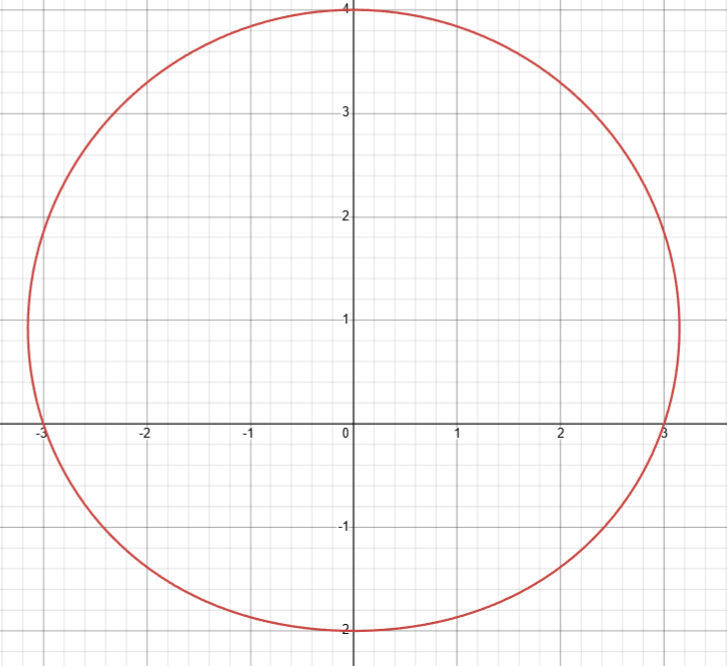
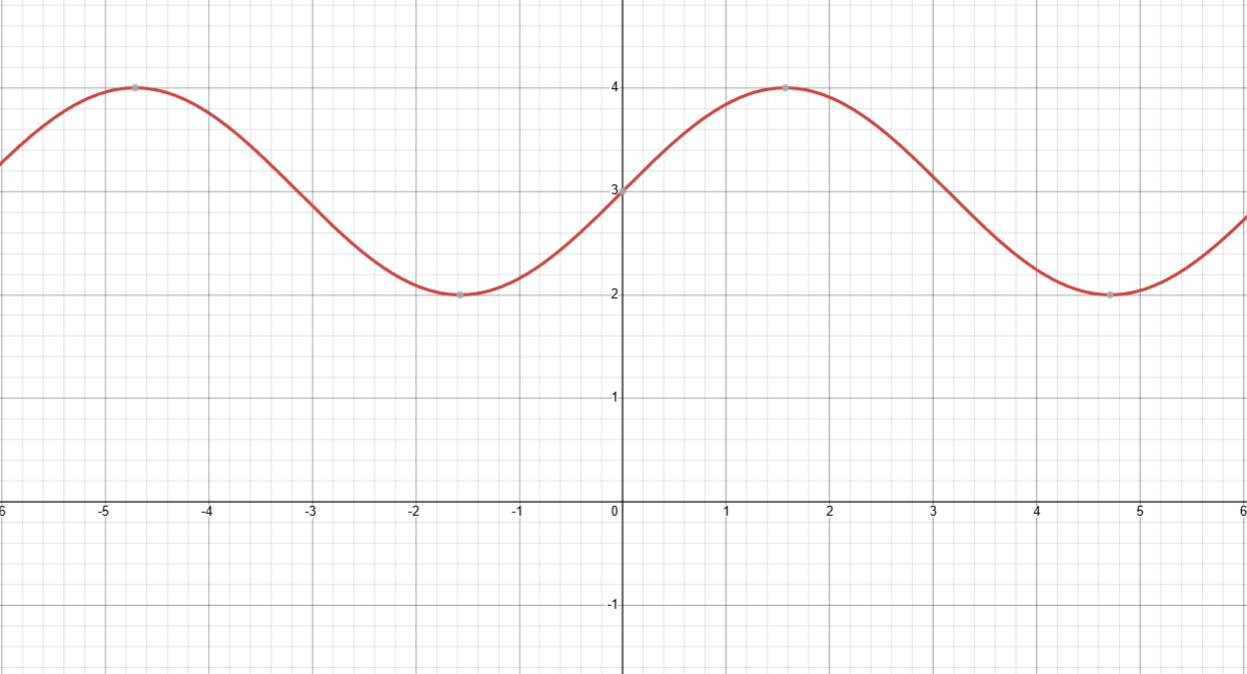
Your rectangular graph may need to be a shifted version of what it is supposed to be. Usually, a question that requires you to differentiate the graphs would have points on the polar graphs and use wording such as “The graph passes through points , , , and , in that order."